


































































Why We Must Finally Stand Alone
Our loyalty belongs strictly to Bangladesh, to our rivers, to our workers, to our ecology, to our farmers, to our reforestation, and to our children. It is time to discard every foreign proxy and forge a new political vocabulary

For decades, the political landscape of Bangladesh has been haunted by a recurring tragedy: Our inability to look inward. Instead of treating politics as a sovereign contract between the state and its citizens, our major political factions have too often acted as proxies for external powers.
Caught in this perpetual tug-of-war, the ordinary Bangladeshi -- the citizen who simply wants a stable, democratic, and self-reliant nation -- is left standing in an impossible vacuum, abandoned by the very concept of home-grown leadership.
The Core Truth of 71 and Historical Inceptions
To see our history clearly, we must first recognize the foundational reality that neighboring states frequently attempt to obscure. The 1971 Liberation War was not a routine proxy conflict between two nations; it was a grueling, nine-month grassroots struggle waged entirely by ordinary Bengali citizens.
While Sheikh Mujibur Rahman was imprisoned in West Pakistan and entirely absent from the country, the people of Bangladesh risked everything to lead the resistance.
Yet the tragedy of history is that both Pakistan and India seek to redefine this nine-month citizen-led war to suit their own narratives. India often prefers to frame the conflict strictly as the final month's war between India and Pakistan -- where India emerged victorious and liberated Bangladesh.
Underneath this geo-political framing lies a persistent desire to maintain permanent tutelage and undermine our sovereign right to self-determination.
True to this pattern, as soon as Sheikh Mujibur Rahman returned to power, New Delhi assumed the new state would remain securely under its sphere of influence, setting a precedent of centralized, one-party dominance that later authoritarian regimes would mimic.
Compromise, Bloodshed, and the Chronological Descent (1972–2026)
Examining our chronological sequence of governance reveals how each era fractured the nation through compromises, systemic corruption, and external dependencies:
The Mujib Era and BAKSAL (1972–1975)
The Good: Leading the nation through immediate post-war reconstruction and establishing a foundational constitutional framework.
The Bad: Post-independence governance soon buckled under severe economic distress and internal corruption. To tighten absolute control, BAKSAL was instituted in 1975, creating a one-party state. Critically, under the 1972 general amnesty and early policies, the Mujib administration permitted elements associated with Jamaat-e-Islami -- implicated in wartime atrocities -- to be released from custody and re-enter civil life. On August 15, 1975, Sheikh Mujib was assassinated in a military coup, leading to Khondaker Mostaq Ahmad’s brief, reactionary tenure.
The Ziaur Rahman Era (1975–1981)
The Good: Major-General Ziaur Rahman stepped into intense instability, restored military discipline, lifted one-party rule, founded the Bangladesh Nationalist Party (BNP), and initiated outward-looking economic stabilization policies.
The Bad: In an effort to forge a political counterweight to the Awami League, his administration rehabilitated political factions that had been sidelined post-1971, planting deep ideological divisions.
Notably, during the domestic political restructuring within Bangladesh following those turbulent years, both the Awami League and Jamaat-e-Islami navigated or pragmatically accommodated shifting power dynamics when it suited their domestic political calculations.
Ziaur Rahman was assassinated in May 1981 during a failed military mutiny.
The Ershad Dictatorship (1982–1990)
The Good: Local upazila administration decentralization and rural infrastructural development projects.
The Bad: Army Chief Lieutenant General Hussain Muhammad Ershad overthrew the elected government in March 1982. Desperate for political survival and unconstitutional legitimacy, he institutionalized corruption and pushed through the Eighth Amendment in 1988, declaring Islam as the state religion. This shattered the secular foundation of the 1971 constitution and opened the floodgates for religious-nationalist and extremist networks to mainstream themselves unchecked. He was ousted in December 1990 by a mass uprising led jointly by Khaleda Zia and Sheikh Hasina.
The Return of Multi-party Democracy and the BNP Era (1991-1996)
The Good: Following the fall of Ershad, parliamentary democracy was restored under a framework of neutral caretaker governments, with Khaleda Zia and the BNP winning power in 1991. This era restored open political competition and foundational civil liberties.
The Bad: Despite democratic restoration, partisan rivalry intensified, systemic corruption persisted, and political confrontations regularly paralyzed governance, paving the way for further instability and subsequent shifts in power through alternating caretaker-managed elections.
Political Rotation and the Caretaker Cycles (1996–2006)
The Good: The establishment of the Caretaker Government system ensured that power rotated constitutionally between the Awami League (under Sheikh Hasina, winning in 1996) and the BNP (returning to power in 2001 alongside coalition partners, including Jamaat-e-Islami).
The Bad: This era was plagued by intense institutional politicization, violent street agitations, and the direct integration of religious extremists into state power during the 2001–2006 coalition tenure, cementing a cycle of toxic electoral combat.
The 15-Year Awami League Era and the Distortion of History (2009–2024)
The Good: Extended periods of macro-economic growth metrics and large-scale infrastructure projects.
The Bad: The subsequent 15-year rule under the Awami League morphed into an entrenched, one-party authoritarian structure characterized by heavily compromised elections, extreme institutional corruption, and fierce crackdowns on all forms of dissent. Crucially, this regime leaned heavily on New Delhi's backing and completely manipulated the historical narrative of 1971.
By relentlessly placing Sheikh Mujibur Rahman at the center of everything -- placing his face on banknotes, covering cities in murals and posters, and turning state ideology into a personality cult --they sought to legitimize their grip on power.
Those of us whose families lived through that era and remained politically alert always knew the full truth about BAKSAL, his authoritarian streak, and New Delhi's heavy intervention. The tragic result of this relentless, over-saturated propaganda was that the Awami League completely bastardized the sacred idea of 1971.
They engineered a backlash, raising a whole new generation that grew so exhausted by the forced mythology that they turned entirely against the very meaning of 1971 -- a disillusionment that did not happen in a vacuum, but was forged directly by the regime's distortions.
The Unchecked Spread of Waj Mahafils and Ideological Subversion
Independently of shifting partisan administrations, another dangerous structural shift occurred across society: the unchecked proliferation of unmonitored Waj mahafils and localized religious networks.
Successive governments -- driven by short-term political expediency -- allowed these platforms to operate without intellectual or regulatory audits.
This gave safe harbor to rigid, intolerant ideologies heavily influenced by external Salafi-Wahhabi frameworks -- a hierarchical, hyper-capitalist interpretation of faith completely foreign to our indigenous Sufi traditions and inclusive Bengali culture.
The July Uprising, Transitional Turmoil, and Geo-political Anxieties
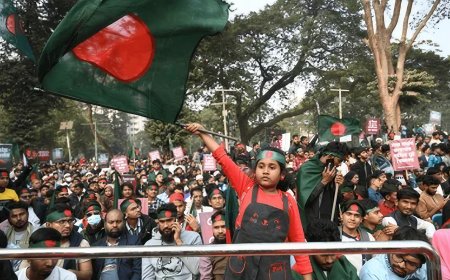
When the historic July uprising finally shattered the long-standing regime, ordinary citizens initially assumed a genuine democratic renewal had arrived. However, the subsequent transition -- marked by the emergence of an administration associated with Dr. Yunus—quickly stoked deep suspicions regarding external engineering.
Critics note the alarming release of convicted militants and killers of secular bloggers during these transitional shifts. These developments fuel widespread anxieties that external Western powers and global superpowers engineered or leveraged the transition to destabilize the country.
By utilizing extreme forces and allowing radical elements (such as those tied to extra-national extremist networks) to re-emerge, global players create the exact "crisis" conditions they need to intervene, establish strategic footholds, and control critical regional assets like Saint Martin Island for their geo-political containment games against China.
Caught in this cynical game, ordinary Bangladeshis are left with an impossible choice: holding their noses to vote for the BNP simply because they know that at least it is not Jamaat-e-Islami -- a party whose ideological core remains aligned with Pakistan rather than sovereign Bangladesh.
Reclaiming the Soul of Our Homeland
As an ordinary mother and artist who simply wants her children to be safe and free, I write this not from the playbook of a politician, but from a deep yearning for clarity.
Whenever we stamp ourselves with divisive labels -- calling ourselves Awami League, BNP, Jamaat, Hindu, Muslim, or any faction—we stop questioning the whole and surrender the essence of who we are.
We are not merely defined by a single political tag or a rigid dogmatic code. Bangladesh is a rich mosaic, an amalgamation of cultures, languages, and identities.
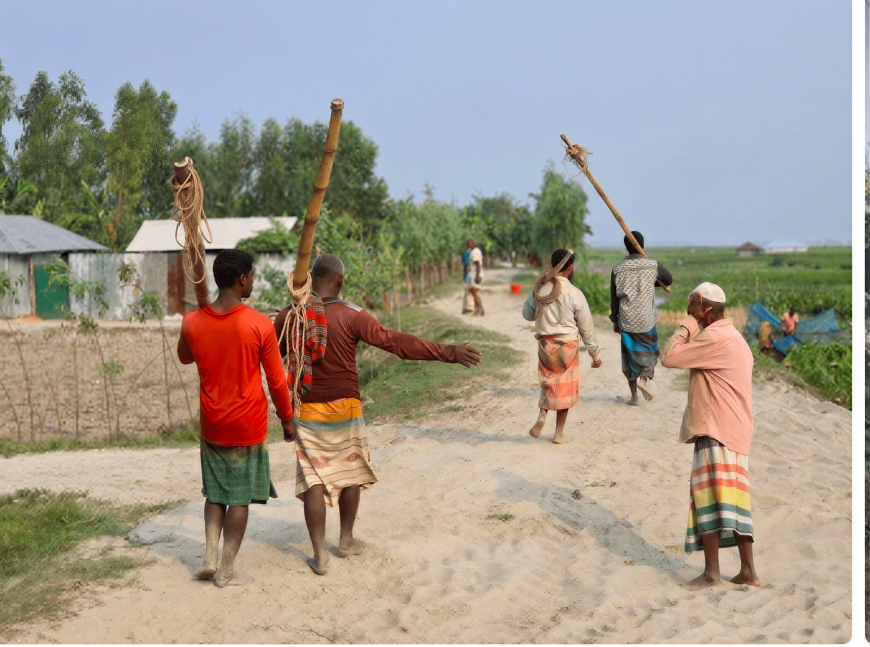
We are people of the rivers, of the green earth, of the soil, of farming, and of rich indigenous traditions shared by the Chakmas, Marmas, Garos, and every community that calls this delta home.
When we lose our forests, our biodiversity, our rivers, and our folk songs, we lose everything that makes us human.
If we refuse to view our reality through partisan, multi-colored lenses, our ultimate loyalty is crystal clear:
We do not want India's heavy-handed tutelage or proxy interference. We do not want Pakistan's religious-nationalist dogma. We do not want American or Western interventionism manipulating our sovereignty or targeting strategic assets like Saint Martin's Island.
And we refuse to accept the corrupt hypocrisy of domestic political machines that bargain away our autonomy for temporary power.
Our loyalty belongs strictly to Bangladesh, to our rivers, to our workers, to our ecology, to our farmers, to our reforestation, and to our children. It is time to discard every foreign proxy and forge a new political vocabulary rooted entirely in our sovereign land.
Anusheh Anadil is a Bangladeshi musician, artist, cultural activist, and social entrepreneur.