







































































We're Missing the Key Point About the Pink Buses
Giving a woman a corner of the bus and giving her control of the direction of the entire bus are not the same politics. Today her passengers may be women. Tomorrow everyone may be on board.

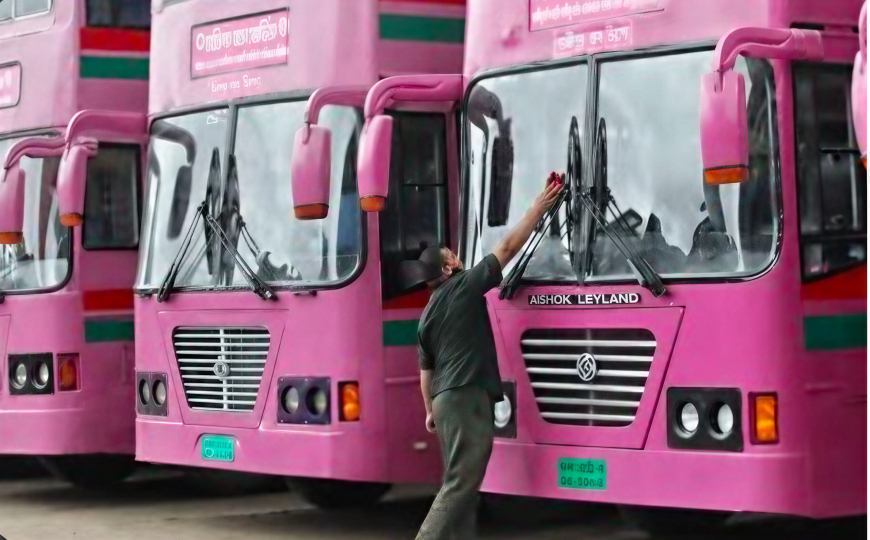
A debate has emerged around Bangladesh's new Pink Bus service: Is transport reserved for women genuinely empowering, or is it simply another form of gender segregation?
The question matters. But reducing the politics of the initiative to the label "women only" risks flattening two very different forms of gendered space.
Moving women behind a screen in an otherwise open public space is not analytically equivalent to creating an institutional pathway for women to enter a transport industry in which they have historically been almost absent as drivers, conductors, and workers.
In the first case, women may be moved away from the visible centre of public space. In the second, women are being placed behind the steering wheel of an occupational space that has long been overwhelmingly male.
A woman confined to a separate corner of a bus and a woman professionally trained to drive that bus do not occupy the same political position.
In one scenario, she is merely the recipient of a service. In the other, she is a skilled worker, wage earner, service provider, and professional responsible for public mobility.
The important question, therefore, is not simply whether the bus is pink or reserved for women. It is whether the intervention expands or contracts women's choices, mobility, employment, and agency in public space.
For me, the central feminist question is straightforward: is women's space becoming smaller or larger? If the state were to say that women could no longer use ordinary buses and must travel only on Pink Buses, that would clearly be segregation.
If female drivers were told that they could drive only buses carrying women and would never be permitted to drive the regular BRTC fleet, that too would become occupational segregation.
But that is different from retaining women's right to use ordinary public transport while adding another safer option, and simultaneously creating opportunities for women to enter a profession in which they have barely been represented.
Removing choice and expanding choice are not the same thing.
This is where the distinction between equality and equity becomes essential. We often assume that equality exists once the same rule formally applies to everyone.
Yet a door can be legally open to women and men while the social road leading to that door remains profoundly unequal.
From childhood, boys are more likely to be encouraged to engage with cars, bicycles, machines, roads and the outside world. They are often granted greater freedom to explore public space and stay outside later.
Girls, meanwhile, are more likely to be taught to monitor their bodies, return home before dark, avoid crowded male spaces and choose occupations considered suitable for women.
Add harassment, unsafe transport, family restrictions and a male dominated workplace, and 20 years later it makes little sociological sense to look at labour market statistics and conclude that women simply do not want to become drivers. We should first ask whether a meaningful social doorway into the profession ever existed for them.
Targeted intervention, therefore, is not automatically discrimination. Scholarships for women, political quotas, specialised training, entrepreneurship programmes and targeted recruitment into male dominated professions are not necessarily attempts to build a separate female world. Their purpose can be to correct historically unequal starting points.
The Pink Bus can be understood in this sense as a transitional intervention. It should not be the destination. It can be a bridge. The problem begins only if the bridge is turned into women's permanent address.
We should also remember that a public space does not become gender neutral simply because it is formally mixed. A bus may legally be available to both women and men, but can both use it with the same degree of freedom?
If a man can finish work at eight in the evening and return home by bus without giving the journey much thought, while a woman declines the same job because she cannot travel home safely, then the transport system may be formally inclusive while remaining substantively unequal.
If a woman must calculate before every commute whether she will be touched in a crowded bus, subjected to sexual comments, able to find transport after dark, or permitted by her family to work so far from home, mobility is no longer merely a transport question. It becomes a question of education, employment, income and economic independence.
Transportation is, in this sense, an infrastructure of power. When a woman cannot move safely, her world does not merely become geographically smaller. Her labour market shrinks with it.
A distant university becomes less accessible. A better paid job farther from home becomes harder to accept. Night shifts become difficult or impossible. Opportunities for career progression narrow. Restrictions on physical mobility therefore become restrictions on social and economic mobility.
This is why safe transport may be much more than a comfortable journey. For some women it can be a precondition for accepting employment, continuing education or participating independently in urban life.
The evidence on women only transport should not be dismissed either. Research reviewed by the World Bank has found that women using reserved train carriages in Rio de Janeiro reported substantially lower levels of physical harassment than women using mixed carriages.
At the same time, the World Bank has also recognised the risks of such measures, including the possibility that they may reinforce segregation or encourage victim blaming if they are treated as a permanent substitute for making the entire transport system safe.
Evidence from Pakistan is also instructive. A randomised study found that offering women access to women only commuting transport substantially increased their willingness to apply for jobs, with a considerably weaker effect from mixed gender transport.
The significance for feminist policy is clear. Safe mobility can do more than reduce exposure to harassment. It can alter whether women are able or willing to enter the labour market at all.
This is why the binary of segregation versus inclusion is inadequate. For the same reason, I find the framing of Pink Bus versus structural reform to be a false choice.
Bangladesh absolutely needs a public transport system in which every woman can safely board any bus. That requires serious enforcement against sexual harassment, effective complaint mechanisms, safe bus stops, adequate lighting, appropriate surveillance and gender sensitive training for transport workers.
If a woman is harassed on an ordinary bus and someone responds by asking why she did not take the Pink Bus, the initiative will have become a vehicle for victim blaming.
The existence of a Pink Bus can never absolve men of responsibility for their behaviour or the state of its responsibility to make mainstream public transport safe.
But neither can women living now be told to tolerate harassment while society waits for structural reform to arrive. Feminist policy must be capable of doing two things at once: reducing immediate harm and pursuing long term transformation.
Women need safer transport today. Harassment requires accountability today. Women need training and employment as professional drivers today.
At the same time, the long term objective must remain full mainstream integration. Safety now and equality ultimately are not contradictory goals.
In fact, the most transformative aspect of this initiative is not, for me, that it is women only. It is that it is women driven.
On Bangladeshi roads, women have long been visible as bus passengers, as claimants to reserved seats and, too often, as victims of harassment.
Now they are appearing in another role: As authorities over the vehicle itself. A public vehicle weighing several tonnes is under a woman's control. She knows the route. She operates the machine. She carries responsibility for passenger safety. She is paid for that skill.
Representation that produces skills, employment, income and occupational access cannot automatically be dismissed as tokenism. It becomes tokenism if a handful of women are dressed for a photograph and the initiative ends there.
if today's female drivers become the beginning of a regular training pipeline, if more women obtain professional licences and permanent employment, if they subsequently drive the regular BRTC fleet with passengers of all genders, and if they become trainers, supervisors, depot managers, engineers and transport planners, then today's Pink Bus may become the first stage of structural change.
14 buses can be a token if the programme ends at 14. They can also be a pathway if they eventually lead hundreds of women into the transport workforce. The difference lies not in the colour pink, but in policy design and outcomes.
Visibility matters as well. Social conditioning is not created by law alone and cannot be dismantled by law alone. If a girl grows up without ever seeing a woman driving a bus or train, repairing a vehicle or operating heavy machinery, those occupations can remain outside her imagined future. When a young girl sees a woman behind the steering wheel of a double decker bus, she sees more than a driver.
She sees a possibility for herself. Law can open a door, but visibility can open the imagination. Social norms often change in precisely this way: First a sight appears unusual, then familiar, and eventually ordinary.
There is, however, a clear feminist red line. The Pink Bus must not become a Pink Ceiling. It may serve today as a protected entry point into the transport sector. But if tomorrow female drivers are told that their proper place is only on women only buses, empowerment will have hardened into segregation.
That is why, several years from now, I would not measure the success of this initiative simply by counting pink buses. I would ask how many women have become professional drivers, how many are driving the regular fleet, how many are carrying passengers of all genders, and how many have progressed into training, management, engineering and transport planning.
I would ask whether they receive equal pay and promotion, and whether their workplaces provide safe toilets, rest facilities, maternity protection, childcare support and effective mechanisms for reporting harassment.
Those are the metrics of empowerment, not the colour of the bus.
My feminism does not seek to create a small, separate and supposedly safe world for women. Nor does it dismiss women's immediate needs while waiting for a theoretically perfect mixed society to emerge. I want women to have more options.
The Pink Bus is theirs, but so is the regular bus. The Metro is theirs. The road is theirs. The driving seat is theirs. And, if qualified, the highest chair in the transport authority should be theirs too.
The decision about which option a woman chooses belongs to her. The state's responsibility is not to make that choice on her behalf, but to make every legitimate choice genuinely accessible, safe and equally dignified.
The feminist value of the Pink Bus will therefore depend on where it ultimately takes women. If it becomes the outer boundary of their mobility, it will have failed.
If it becomes a doorway through which women gain safer mobility, skills, income, professional experience and entry into a male dominated transport sector, I see little liberation in closing that doorway simply because its first stage is reserved for women.
The ultimate destination of equality is, of course, a public sphere in which people of all genders are equally safe and equally free.
There is no rule that every bridge from an unequal society to an equal one must look perfectly gender neutral from the first day. Sometimes a door that has been unequally closed for generations requires a targeted intervention to provide the first push.
That is why the most powerful image of the Pink Bus, for me, is not its colour. It is a woman with the city ahead of her and a huge steering wheel in her hands.
Giving a woman a corner of the bus and giving her control of the direction of the entire bus are not the same politics. Today her passengers may be women. Tomorrow everyone may be on board.
Empowerment often begins this way: First a door opens, and then the whole road does.
Dr. Lubna Ferdowsi is an academic and researcher based in England.