

































































We Need to Whip Inflation Now. Here's How.
As economic conditions evolve, is the central bank prepared to allow the taka to depreciate, or indeed appreciate should it come to that, over time? The MPS should ideally spell these out in an analytical manner.

The 1970s was a great decade for movies involving a certain kind of character -- usually a young man, all too often angry, filled with a righteous if nihilistic rage, in Billy Joel’s words, one who refuses to bend, refuses to crawl. Men like Clint Eastwood in Dirty Harry, Charles Bronson in Death Wish, and Robert De Nero in Taxi Driver, Razzak in Rangbaaz.
Amitabh Bachchan is, of course, practically synonymous with the words "angry young man." His fictionalized portrayal of Haji Mastan (aka Sultan Mirza) in Deewaar, a real-life don of Bombay's underworld, being perhaps the most iconic of such roles.
Anti-heroes and angry young men -- the 1970s were a more sexist time, and angry young women were very few -- resonated with audiences all over the world, because the 1970s was a time when, across the world, there was socio-economic instability and malaise.
It was a time of high inflation and economic stagnation.
Whereas GDP statistics are not well understood, and unemployment or stock prices affect only some sections of the society, one economic indicator that is readily understood, and disliked, by everyone, everywhere in the world is high and rising inflation.
Inflation means a rising cost of living. When inflation outpaces wages, there is a cut in real income. When inflation is high, savers' wealth is devalued. Rising or volatile inflation makes it difficult to plan, affecting investment, employment, and incomes. The effects on people's living standards are palpable.
Inflation also feeds into social malaise and discontent in less tangible ways. Historically, high and rising inflation had been the times when rulers debased their metallic coins, often to pay for ruinous wars. In a modern economy, volatile inflation is always the result of macroeconomic mismanagement.
There is probably something akin to folk memories of inflation being associated with a society that is coming apart at the seams, where those in charge have abdicated their responsibility, where an honest person cannot afford Roti, Kapda aur Makaan (a 1974 blockbuster about, you guessed it, young men who cannot lead a decent life through education and hard work).
Inflation and stagnation, the stagflation, of the 1970s created the zeitgeist that gave us the onscreen anti-heroes and angry young men.
Stagflationary times
Bangladesh’s economy is mired in a staglfationary quagmire. Economic growth has hovered around 4 percent or less for three years now, far lower than the 7% or so averaged before the pandemic, and the 8% aspiration of the current government.
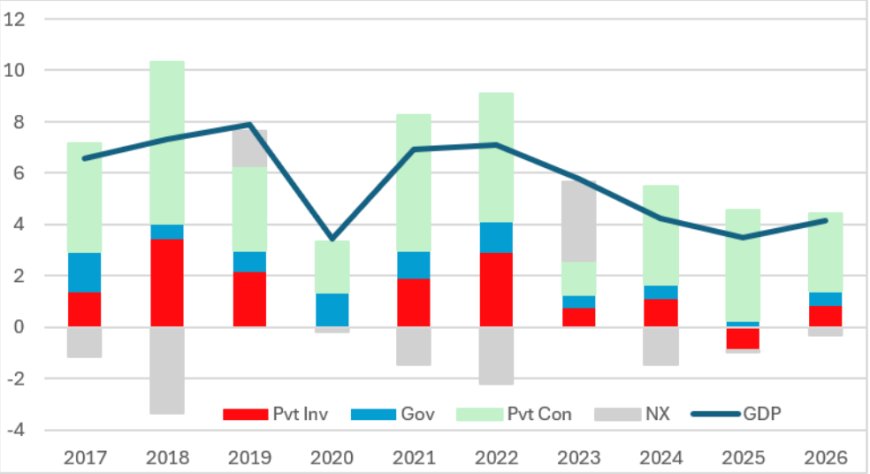
Chart 1 shows the contribution to GDP growth from different sources of demand. Private investment’s contribution has weakened significantly in recent years. Private investment grew by 3.5% in 2025-26 fiscal year, after declining by 3.6% in 2024-25. This compares with annual average private investment growth of 9.6 % before the pandemic. That is, the economy is undoubtedly struggling, a private investment is at the heart of the malaise.
Chart 1: Real GDP growth (contribution by expenditure), percentage points
Source: Bangladesh Bureau of Statistics.
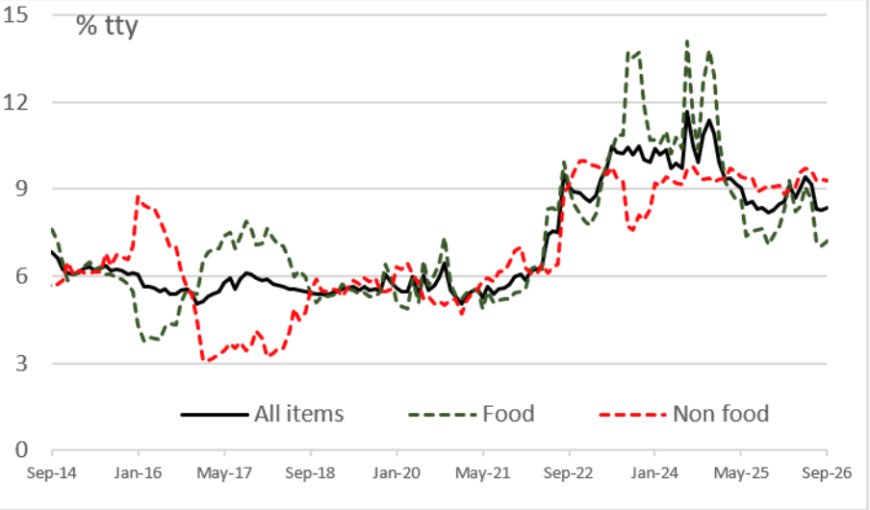
Yet, the Bangladesh Bank faces a difficult monetary policy challenge because inflation has been elevated in recent years (Chart 2). After running at around 6 percent for years, inflation shot up sharply in the summer of 2022 in the wake of the Ukraine War, reaching double digits in 2023 driven by food prices.
Food price inflation has moderated since the July Uprising, and overall inflation had eased as well, effects of the Iran War notwithstanding.
Chart 2: CPI Inflation, (percent through the year)
Source: Bangladesh Bureau of Statistics.
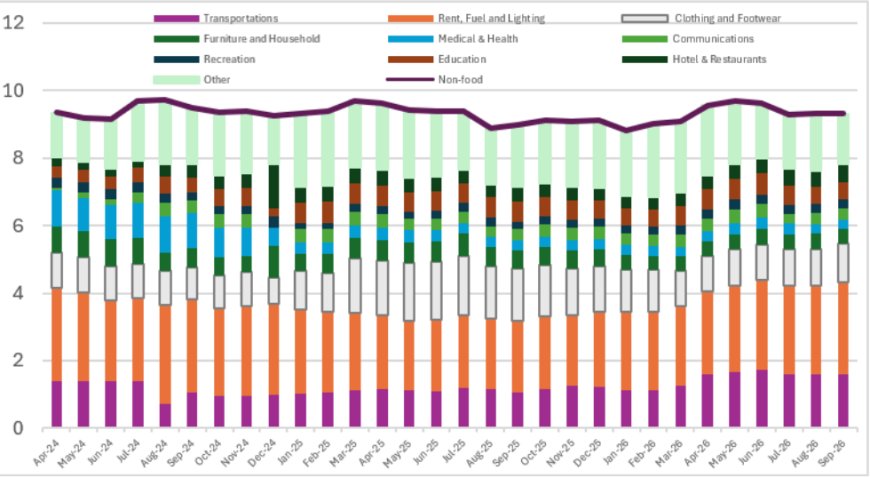
However, non-food inflation has remained stubbornly elevated since 2022, complicating the central bank’s tasks. Non-food items make up 55% of the CPI basket, and they are conceptually more amenable to monetary policy.
Therefore, it is important to understand exactly what prices have been mechanically contributing to the elevated non-food inflation in the past couple of years. Chart 3 shows that Transportations and Rent, Fuel and Lighting have mechanically contributed the most to non-food inflation since the July Uprising.
Chart 3: Non-food inflation, (percentage point contribution)
Source: Bangladesh Bureau of Statistics.
Understanding the inflationary dynamics
At this point, it might be useful to pause and understand that inflation is different from price level -- a subtle point that is often lost in policy discourse in Bangladesh, even among economists. Price of individual goods and services typically reflects microeconomic factors in the market of that specific good or service.
Developments in one market, of course, can and often does affect other markets. A one-off change in diesel price, for example, surely would percolate through the economy, and thus raise prices across the board.
Inflation is the rate of change of general price level in an economy. A one-off diesel price rise, or flood affecting vegetable prices, or depreciation of the taka, or blockades of roads, can raise prices across the board and thus would affect the inflation figure once.
All else equal, there is no reason to think that these specific events or shocks would lead to persistently higher inflation. Inflation used to be 6%, then a set of things happened, and now it is higher and refuses to decline. That’s what we see from Chart 2 above. Strip away the food inflation, and the picture is even clearer, non-food inflation is stubbornly stuck at around 9%.
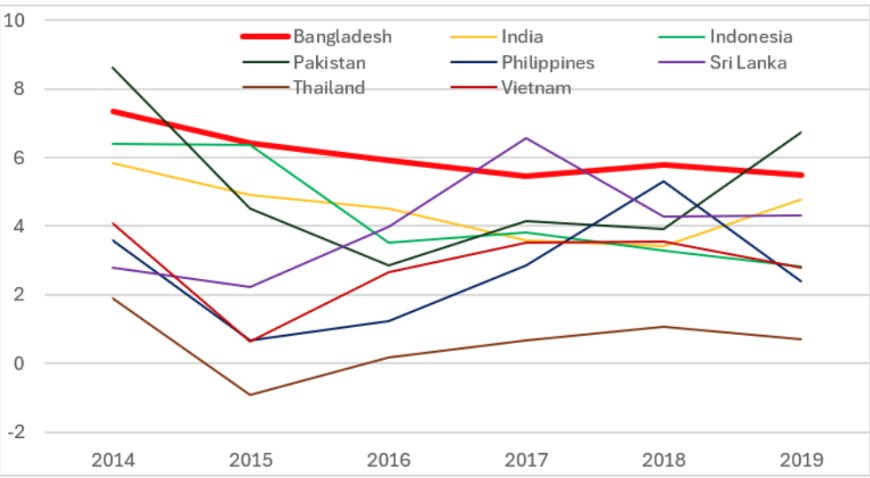
Interestingly, it is seldom appreciated but Bangladesh was a relatively high inflation country even before the pandemic. Back in the late 2010s, the world was experiencing significant disinflation, so much so that The Economist published a Special Report in its October 12 issue titled “The end of inflation?”.
Yet, in the five years prior to the pandemic, Bangladesh experienced higher inflation than others in the region (Chart 4).
Chart 4: Inflation in the Monsoon Asia, (percent)
Source: International Monetary Fund.
Did the Bangladesh Bank have a formal inflation target of 6 percent before the pandemic? Hardly. Indeed, the central bank very likely did not have a modern monetary policy framework -- international financial institutions repeatedly recommended that the central bank adopt such a framework, and it was among the conditions for the now defunct IMF program.
Rather, what in fact happened was that the then central bank operated monetary policy in a way that accommodated the then regime’s fiscal policy and the preference to keep the taka stable against the US dollar, which resulted in 6 % inflation, and expectations formed that inflation would remain at around 6%.
This underscores one point that is well understood in the economic literature, but seldom appreciated in Bangladeshi policy discourse -- inflation is a macroeconomic phenomenon.
Milton Friedman famous maxim is that inflation is always and everywhere a monetary phenomenon. In the IMF, there is a folk wisdom corollary to that, which is it’s mostly fiscal.
Then came the series of shocks after the pandemic. First, there was the disruption to global supply chains because of the lockdowns and the aftermath. Then came the monetary and fiscal stimuli in major economies, flooding the world economy with a massive demand shock. These created a global inflationary impulse.
Even as this inflationary shock was washing through came the Ukraine War, which raised food and energy prices around in global markets, and led to sharp appreciation in the US dollar in the summer of 2022.
The fallen Hasina regime responded to these shocks through a series of calamitous and confused blunder. Interest rates were capped even inflation soared above it, making taka cheaper than free to those who had access to credit.
In the context of the fallen regime’s plunder-and-launder banking sector governance structure, and against the backdrop of possible Western sanctions by against the then regime for human rights violations, many of the regime cronies likely took advantage of the capped rates to empty out the banks’ coffers and siphon of the funds.
These put downward pressure on the taka, which depreciated by over 40%, even as the central bank lost half of its foreign exchange reserves trying to defend the exchange rate. The government tried import control, which created more problems in the supply chain.
The net result of all of this was the rise in inflation in the summer of 2022.
Once inflation had risen to double digits, how could it be brought back? And what rate should it be brought back to? After the July Uprising, the central bank tightened monetary policy and the newly appointed governor vowed to reduce inflation. Indeed, headline inflation did moderate, but this has been driven entirely by food inflation. As is clear from Charts 2 and 3 above, non-food inflation has persisted.
Why has that been the case?
While the Bangladeshi policy discourse may look for proximate factors such as this or that shocks to this or that market —political uncertainty, extortion, law and order, natural disaster -- the real answer maybe that inflation (particularly non-food inflation) persists because the central bank lacks a credible monetary policy framework.
How to win friends and convince people
What does a credible Monetary Policy Framework look like?
To begin with, a credible monetary policy framework does not inherently need to be inflation-targeting. In principle, monetary policy could focus on exchange rate stability, price level target, or indeed formally adopt economic growth and development as its objective -- though the case for the last one is very weak in the literature. In practice, most successful central banks in modern era aspire to be inflation targetters.
If the objective is to reduce inflation, the Bangladesh Bank should announce a Framework that clearly defines what its inflation target is, and over what time frame it expects to get there all else being equal. For example, the Framework could spell out that the Bank’s target is inflation of 5-7 percent by 2028 absent any adverse shocks to the energy or food prices.
However, simply announcing a Framework isn’t sufficient. It needs to be backed with detailed analysis that address the current and evolving economic conjuncture, outlook and risks. And these analyses need to be regularly communicated through detailed Monetary Policy Statements. In this regard, the recent decision to publish quarterly MPS is a very welcome move. However, future iterations of the MPS should spell out how the monetary policy is acting to reduce inflation under current circumstances.
For example, the MPS should clearly explain the monetary policy transmission mechanism. Does the central bank expect higher or lower policy rates to affect money supply and thus prices? If so, over what time horizon? Or is the transmission mechanism more indirect, and runs through the exchange rate?
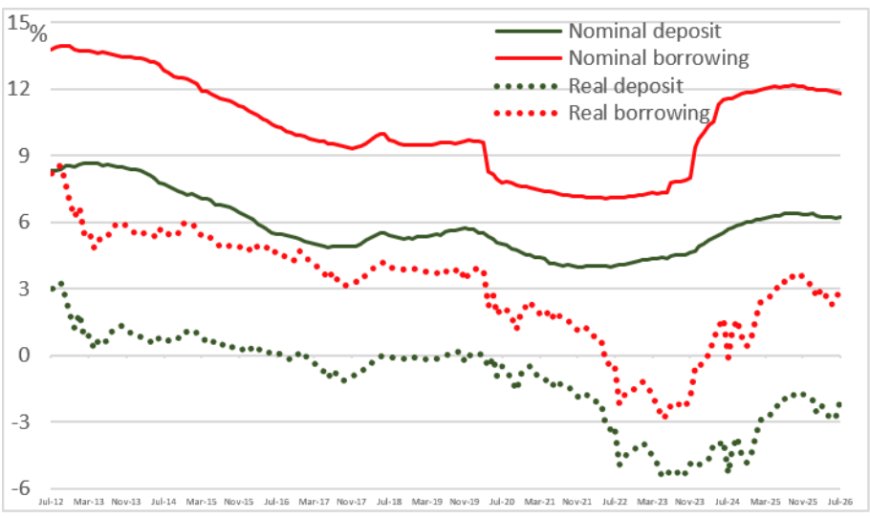
Further, the MPS should spell out that given the presumed focus on inflation, what would be the implication for the real economy? For example, there is much hullaballoo about supposedly high interest rate hurting private investment. Well, Chart 1 above shows that private investment slumped in 2022-23 fiscal year, when interest rates were capped and the real borrowing rates were negative! Indeed Chart 5 shows that real borrowing rates are similar to what were prevailing before pandemic.
Chart 5: Interest rates, (percent)
Source: International Monetary Fund.
Chart 5 implies that the reasons for current investment malaise is probably not the cost of credit, but other factors such as legacy issues in the banking sector and corporate balance sheet, and non-economic factors such as the law and order.
Without addressing these broader issues, simply announcing stimulus packages or cutting policy rates may not restore private investment, but would likely damage central bank’s inflation targeting credibility. This is an important point that Bangladesh Bank needs to internalise as well as externally communicate.
The recently published MPS raises the risk of fiscal dominance but does not offer any mitigation strategy or guardrails. Chart 6 shows that credit to government has been growing faster, causing money supply growth to inch up (Chart 7) —that is, fiscal dominance is more than a mere academic risk. Credibility demands a more robust stance by the central bank.

Similarly, the MPS needs to explain how it sees evolving risks to exchange rate, remittances, energy imports and the balance of payments more generally. As economic conditions evolve, is the central bank prepared to allow the taka to depreciate, or indeed appreciate should it come to that, over time? The MPS should ideally spell these out in an analytical manner.
The MPS should be published in conjunction with regular meetings of the Monetary Policy Committee, which should be given a far greater prominence in our public policy discourse than it has thus far received.
A proper Monetary Policy Framework, operated by a high calibre Monetary Policy Committee, communicated through regular Monetary Policy Statements -- that is the bedrock of a credible inflation fighting central bank.
The IMF will likely be asking for something like this as a condition in any program negotiation. The Bangladesh Bank should act without anyone asking.
Jyoti Rahman is the Executive Editor of the weekly Counterpoint.