

































































You Cannot Renovate a Haunted House
If Bangladesh is to emerge from this transition with institutions genuinely stronger than those it inherited, power must become harder to capture, harder to personalize and easier to restrain.

A house can be repainted. Its walls can be scrubbed, its portraits removed and its furniture replaced. The people who once occupied its rooms can leave, and before long, it may look as though an entirely different family has moved in.
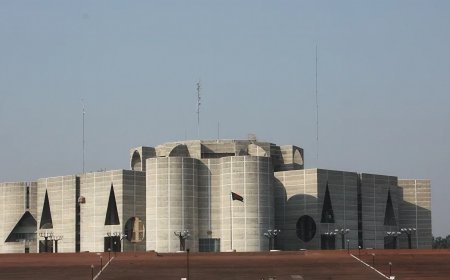
But appearances are deceptive. Some things do not live on the surface. They remain in the foundations, in the subterranean vaults no one thought to open and, sometimes, in the monolithic architecture itself.
Bangladesh has spent the last two years trying to renovate.
The fall of Sheikh Hasina's government in August 2024 represented more than the removal of one leader or one party. The uprising was directed against an authoritarian political order marked by weakened institutions, impunity and an extraordinary concentration of power.
Its aftermath therefore carried an equally extraordinary promise: not simply a new government, but a new beginning.
That promise has not gone entirely unanswered. Bangladesh returned to elected government in February 2026 after the interim period, while the reform process initiated after the uprising placed constitutional and institutional change at the centre of the country's political future.
The July Charter emerged from negotiations among political actors and consolidated more than 80 reform proposals concerning institutions ranging from the judiciary and electoral system to the police and public administration.
The current government deserves credit for inheriting a transition that was never going to be simple. Governing after an uprising means confronting public expectations shaped by promises of transformation while managing institutions whose weaknesses were accumulated over decades.
The return of competitive electoral politics itself represents a significant departure from the political stagnation that preceded 2024.
Yet the urgency of the present moment lies precisely in what happens next.
Recent debates over constitutional reform have revealed that consensus on the need for change does not necessarily produce consensus on how that change should be achieved.
The July Charter created an ambitious framework, but disagreements over its implementation have raised questions about how much of it will ultimately survive the transition from proposal to practice.
This is the distinction Bangladesh must confront: passing through a political transition is not the same as completing a political transformation.
Changing a country's laws is one thing; changing the instincts of its institutions is another. A state does not become authoritarian in a single day, and it cannot become genuinely democratic merely because the government changes.
Power leaves spectral traces. The ghost of authoritarianism is highly adaptable; it survives in procedures designed for the convenience of those in office, institutions accustomed to obedience and the public willingness to excuse abuses when they are directed at people we already dislike.
Bangladesh has become particularly adept at recognising authoritarianism once it has fully taken root. We know what it looks like in retrospect, when dissent has already been silenced and institutions sufficiently weakened for the consequences to become impossible to ignore.
Recognizing its earliest forms is considerably harder, especially when they emerge under the language of justice, stability or necessity.
This is not an accusation that Bangladesh has returned to where it stood before 2024. Such a conclusion would ignore the profound changes of the last two years and genuine efforts to reform the state.
The question is whether the safeguards being built today will remain in place when another government eventually takes its turn in the same rooms.
That is where the present reform agenda should be judged.
Its success cannot be measured solely by commissions established, ordinances drafted or promises announced. The more meaningful test is whether the institutions emerging from this period become capable of limiting power regardless of who possesses it.
A judiciary should not require a particular political party to be in power before it can be independent. The police cannot become genuinely professional merely because their loyalties have shifted. Due process cannot be treated as sacred for allies and dispensable for enemies.
These are not criticisms of one administration alone. They are problems that outlive administrations, which is precisely what makes them so difficult to solve.
The current government has an opportunity that few governments inherit: to prove that reform is not merely another phase of political competition. That will require protecting institutional independence even when it becomes inconvenient, allowing accountability mechanisms to function without partisan selectivity and resisting the temptation to treat temporary electoral mandates as permanent permission.
There is something deeply comforting about the idea of a clean break. It allows us to divide history neatly into a before and an after, to believe that the shadows belong entirely to one tyrannical epoch while the dawn of a new administration casts a permanent light. Countries, however, do not remake themselves so easily.
They carry their institutions, habits and unresolved failures into the future.
The purpose of reform, then, cannot simply be to replace those who wield power. It must involve examining why institutions became vulnerable to political capture and building mechanisms capable of preventing it from happening again.
Perhaps this is the central unfinished task of July.
Bangladesh has already demonstrated that its people can remove those who abuse power. It has shown, too, that political transitions can create opportunities for reforms that once seemed impossible.
What remains is ensuring that the reforms of one extraordinary moment become ordinary protections for the future.
Fresh paint may conceal a stain, and replacing the furniture may make a room feel unfamiliar. Neither, however, changes what supports the house beneath it.
The current government should therefore treat the reform agenda not simply as a record of what it has introduced, but as a test of what it is willing to leave beyond its own control.
If Bangladesh is to emerge from this transition with institutions genuinely stronger than those it inherited, power must become harder to capture, harder to personalize and easier to restrain.
That is the difference between renovation and reconstruction. One changes what the house looks like. The other ensures that whoever enters it next cannot so easily rebuild the same rooms.
After everything Bangladesh has endured, appearance is no longer enough.
Suhaira Maysan is a student at Chittagong Grammar School.