


































































Bangladesh Bank Needs to Establish Policy Credibility. This is not How.
The Monetary Policy Statement was announced in the last week of June, and was almost immediately hemmed in by the circular announcing the spread cap -- a sequencing that signals incoherence. And that incoherence matters more than the actual policy. Macroeconomic policy cannot be effective in supporting growth or curbing inflation unless it is credible.


There is a ritual about our budget discourse whereby during the weeks preceding the budget speech, the same few civil society personalities submit the same few standard talking points about what is needed, followed by equally standard responses in the weeks after the speech. By the time the new financial year comes around, the whole thing is forgotten.
One wishes this time was different. After many years, we have an accountable Finance Minister placing the budget before an elected parliament. And the macroeconomic context is fundamentally challenging, with economic growth languishing below 4% (Chart 1) and inflation stubbornly around 9% (Chart 2).
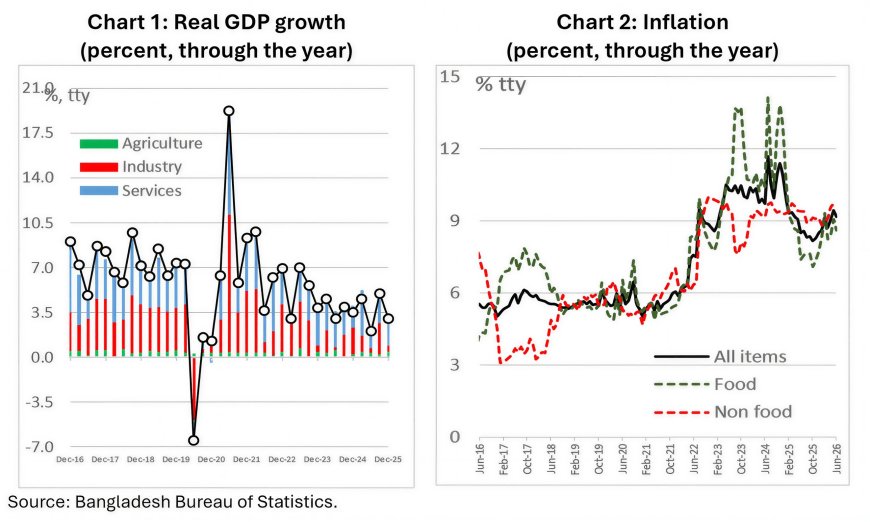
Macroeconomic management is difficult under these circumstances. There aren’t any good policy options. There are, however, many bad policy choices a government can make. And a better policy discourse can help avoid worse mistakes. When it comes to our policy discourse, there is still a lot of room for improvement.
An Ambitious Budget, in Context
Every new budget invites the same question: Is it credible, or is it wishful thinking dressed up in tables? This one was no different. One could have randomly chosen commentaries about any budget from the past quarter century, and they would probably apply to this one as well. Plus, there were a few interesting ones.
My favourites were along the lines of Amir Khasru Mahmud Chowdhury’s first budget being big on emotions and feelings -- from the heart -- but perhaps not very well grounded on cold hard numbers. You see, the Finance Minister is reputed to be a man of culture, and perhaps the cut and thrust of public finances are not for him, or something like that.
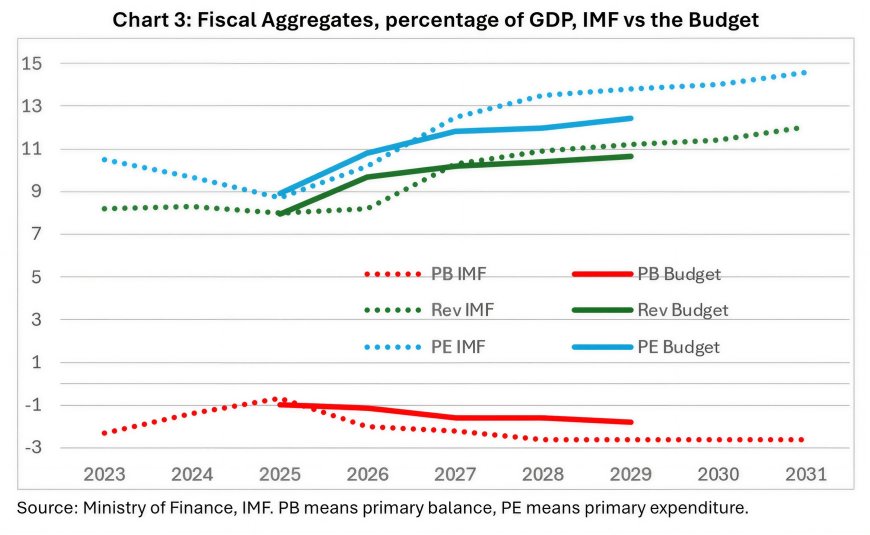
Well, no one would accuse the IMF of being a bunch of bleeding heart softies. Let us compare the FY26 budget targets against those of the now defunct IMF program. In Chart 3, the solid lines represent the budget whereas the dotted lines represent the IMF program. Compared with the budget, the recently terminated IMF program asked for more revenue and more expenditure.
Under the IMF program, primary deficit would have widened by 1.9% of GDP between 2025-26 to 2027-28, compared with 0.8% of GDP projected by the budget. And it’s important to note that the IMF figures are from January, before the Iran War.
Somehow, one doesn’t hear much commentary about the "unrealistically ambitious IMF program."
Fiscal Expansion
One way to think about the government’s fiscal policy (as opposed to budget allocation on this or that sector) is to compare a set of fiscal aggregates over the three latest budgets, and try to understand possible macroeconomic impacts.
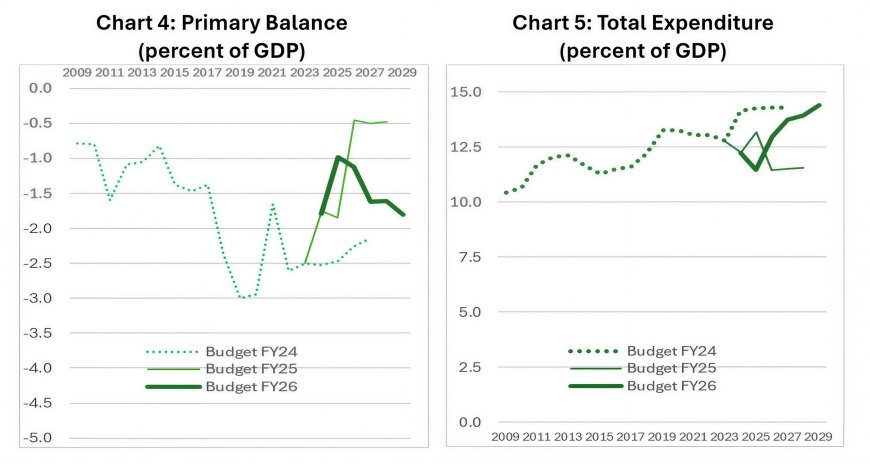
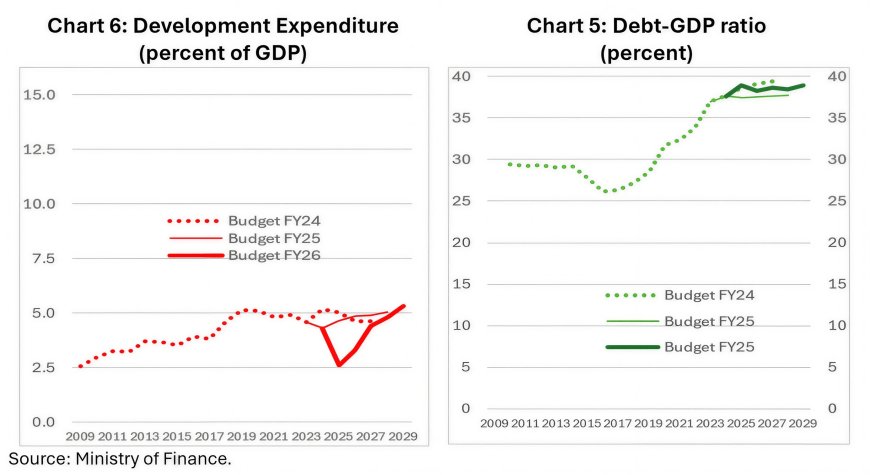
In Charts 4 to 7, the thick lines represent the budget that was just announced, the thin line represents the budget announced by the Interim Government in June 2025, and the dotted line represents the last budget of the fallen regime.
The current government has embarked on a modest fiscal expansion, reflected by the widening of the primary deficit over the coming years (Chart 4). As is well reported, the government has an ambitious revenue target.
The fiscal expansion therefore reflects the expenditure side of the ledger, particularly the non-development expenditure, with development expenditure projected to return to what previous budgets targeted (Charts 5 and 6). Chart 7 shows that the government plans to achieve all this while keeping a lid on debt.
Is the fiscal expansion appropriate?
From a macroeconomic policy perspective, in a stagflationary environment such as the current economic conjuncture, it is possible to argue that targeted fiscal measures to cash starved households or firms may help, provided they are affordable and that monetary policy remains geared towards broader macroeconomic stabilization.
Let us consider each caveat.
Fiscal Risks
Of course, there is a reason for our "traditional pattern." Bangladesh's budget history is one of revenue shortfalls met, in-year, with expenditure cuts rather than financing adjustments -- a pattern that, if repeated, would mean the ambitious figures in these charts are more aspirational ceiling than realistic floor.
Then there is the composition of spending: while the clichéd commentaries are about the wastage in public servants’ pays and procurement, it is really the transfer payments and subsidies that really need scrutiny on targeting, since untargeted transfers are exactly the kind of spending that is politically hard to cut when revenue disappoints.
Third, and most consequential, is financing. Even if the "old pattern" of shortfall-then-cut reasserts itself as it has before: this is not the 2010s anymore. Global liquidity conditions, the after-effects of the Iran war shock, and a domestic financing landscape that looks nothing like the pre-pandemic decade all mean that the safety valve Bangladesh has relied on before may not open as easily this time.
Monetary Policy isn’t Helping
Fiscal policy is easier when it is supported by well monetary policy that is anchored in a transparent and credible framework. When that is not the case, however, even well-intentioned monetary policy actions tend to backfire and complicate things in unforeseen and unintended manner.
Let us consider Bangladesh Bank’s policy stance -- the stated and the actual.
In its latest Monetary Policy Statement, published in the last week of June 2026, the central bank stated that:
Under these conditions, BB will sustain its contractionary monetary policy stance through the first half of FY27 (H1FY27) to rein in headline inflation and anchor long-term inflation expectations. Accordingly, the policy rate will remain unchanged at 10.0 percent. The Standing Lending Facility (SLF) rate will remain at 11.5 percent and the Standing Deposit Facility (SDF) rate will be 7.5 percent, respectively.
Almost immediately, the central bank circumvented its own stance by a circular that capped the spread banks may charge between their lending and deposit rates.
The point here is not to argue whether the contractionary policy stance is a good idea or not -- at least it’s something sensible, but one can debate whether it is desirable. Nor is it to argue whether the spread cap is a good idea -- it is not, market interventions like that are rarely good ideas.
Rather, the point is much more fundamental, and far more serious. The point is that the monetary policy lacks credibility.
Credibility is the Constraint
The Monetary Policy Statement was announced in the last week of June, and was almost immediately hemmed in by the circular announcing the spread cap -- a sequencing that signals incoherence between the central bank's stated stance and the tools to enforce it.
And that incoherence matters more than whether monetary policy should be expansionary or contractionary. Macroeconomic policy cannot be effective in supporting growth or curbing inflation unless it is credible.
The central bank could have made an intellectually defensible argument that tight monetary policy was bringing inflation down, the recent reversal was because of extra-monetary factors, and monetary policy is going to switch to support growth going forward, presaging a modest cut in policy rate. But the central bank chose a different route.
Bangladesh Bank needs to establish policy credibility. It needs to return to textbook macroeconomics and avoid gimmicky policy interventions that, however well-intentioned they may be, will only take us down a road to economic perdition.
Without credible monetary policy, macroeconomic stability is put at risk. And without macroeconomic stability, the government's broader economic visions have no realistic path to being realized.
Jyoti Rahman is the Executive Editor of the weekly Counterpoint.