





































































Why Bangladesh Cannot Afford to Fail the 2027 Money Laundering Test
Bangladesh does not need more boxes ticked. It needs evidence that financial crime is investigated regardless of who committed it, that stolen assets can be recovered, and that institutions can withstand political pressure.
Ten years after Bangladesh was last examined by the Asia/Pacific Group on Money Laundering (APG), the country remains under “enhanced follow-up” -- a status reserved for jurisdictions whose anti-money-laundering systems require continued scrutiny.
The next full evaluation, scheduled for 2027-28, may be far more consequential. An APG planning delegation visiting Dhaka recently warned that the looting of banks and the capital market under the previous government, along with the movement of money abroad, could damage Bangladesh’s evaluation. The delegation welcomed current reforms but stressed that they must be sustained.
The message is clear: Bangladesh has made progress, but it has not yet proved that its financial system can effectively police itself.
Why the FATF System Matters
The APG is a 42-member regional organization that evaluates countries against standards established by the Financial Action Task Force (FATF), the global standard-setter against money laundering and terrorist financing.
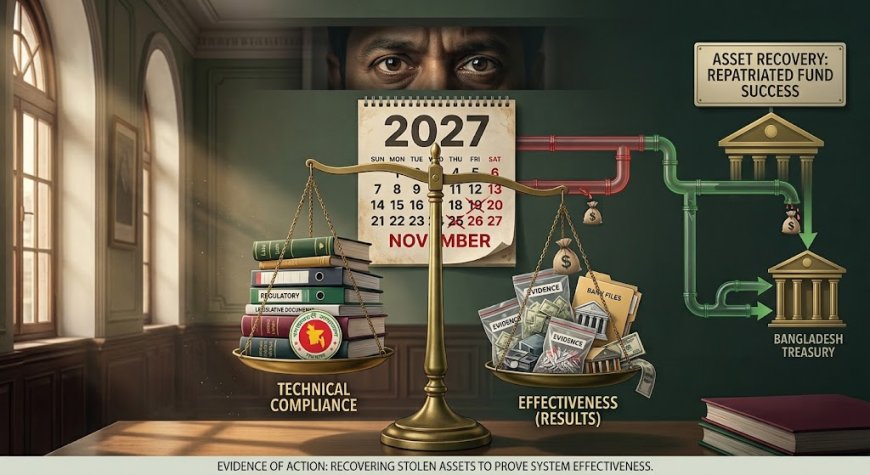
FATF evaluations examine two things. The first is technical compliance: Whether a country has appropriate laws, regulations and institutions. The second -- and increasingly more important -- is effectiveness: Whether those systems actually produce investigations, prosecutions, sanctions and confiscation of criminal assets.
Bangladesh has remained in enhanced follow-up since its 2016 evaluation. That should not be confused with FATF’s “grey list,” formally known as “Jurisdictions under Increased Monitoring.” Grey-listing is more serious. It publicly identifies countries with strategic deficiencies and can lead international banks and investors to apply greater scrutiny to transactions.
The consequences are economic even without formal sanctions. Higher compliance costs can make trade finance more expensive, slow cross-border transactions and discourage correspondent banking relationships and foreign investment.
Bangladesh knows this from experience.
We Have Been Here Before
A 2009 evaluation found that Bangladesh had laws against financial crime but weak enforcement. In 2012, FATF placed Bangladesh on its grey list.
Bangladesh responded with legislative and institutional reforms, including amendments to its anti-money-laundering framework, stronger financial intelligence capabilities and expanded reporting requirements. The country was removed from the grey list in 2014.
The 2016 evaluation acknowledged those improvements. Subsequent follow-up reports upgraded Bangladesh on several FATF recommendations, and by 2020 the country was rated compliant or largely compliant with 35 of the 40 recommendations.
Yet Bangladesh remained under enhanced follow-up.
Why? Because having laws is not the same as enforcing them.
That distinction may define the 2027-28 evaluation.
The Problem the Evaluators Cannot Ignore
In the years following the 2016 evaluation, Bangladesh’s banking sector suffered extensive irregularities. Bank boards were captured, connected borrowers received enormous loans, capital markets faced manipulation scandals, and significant sums allegedly moved abroad.
The institutions designed to prevent such abuses -- the central bank, Financial Intelligence Unit, Anti-Corruption Commission and courts -- were often unable or unwilling to intervene effectively.
For anti-money-laundering evaluators, that history matters more than another newly written regulation.
They will ask whether suspicious transaction reports produced investigations. Did investigations produce prosecutions? Were criminal assets frozen and confiscated? Were politically connected individuals subjected to the same scrutiny as ordinary citizens?
The fifth round of FATF evaluations places greater emphasis on asset recovery. For Bangladesh, therefore, money allegedly taken abroad is not simply a political issue. It is an international financial-compliance issue.
Bangladesh’s graduation from least-developed-country status, scheduled for November 2026, also means the country will approach the evaluation as an increasingly significant participant in the global financial system.
The Economic Stakes
A poor evaluation does not automatically mean grey-listing. But serious deficiencies could place Bangladesh into FATF’s International Co-operation Review Group process and potentially return the country to increased monitoring.
The economic environment makes that risk particularly dangerous.
Bangladesh depends heavily on international trade finance, garment exports and remittances. Additional compliance burdens could increase transaction costs for exporters, banks and overseas Bangladeshis. Making formal remittance channels more expensive or difficult could also encourage informal channels such as hundi -- ironically worsening the problem regulators are trying to solve.
Foreign investors, development institutions, credit-rating agencies and correspondent banks also pay attention to FATF assessments.
There is therefore a cost even before grey-listing occurs. International banks conduct their own country-risk assessments. A jurisdiction that has remained under enhanced follow-up for more than a decade while facing major financial scandals will inevitably attract greater scrutiny.
What Bangladesh Must Do Now
The government should concentrate on four measurable priorities before evaluators arrive.
First, recover assets. Announcing investigations and forming task forces will not be enough. Bangladesh must demonstrate actual freezing, confiscation and, where possible, repatriation of proceeds linked to financial crimes.
Second, strengthen institutional independence. The Bangladesh Financial Intelligence Unit and central bank supervisors must be able to investigate and sanction politically connected actors. Published enforcement statistics and credible actions against major offenders would demonstrate that independence.
Third, establish meaningful beneficial-ownership transparency. Financial crimes are frequently hidden behind nominee shareholders and layers of companies. Investigators need reliable information identifying who ultimately owns and controls corporate entities.
Fourth, treat politically exposed persons as high-risk individuals regardless of political affiliation. Prosecuting yesterday’s powerful figures while protecting today’s would merely replace one system of impunity with another. The credibility of reform depends on consistent enforcement.
Bangladesh’s earlier experience offers two lessons.
The period from 2012 to 2014 demonstrated that the country can reform rapidly when international financial consequences become unavoidable. But the decade since 2016 demonstrated something equally important: technical compliance cannot protect a financial system when institutions themselves can be captured.
The 2027-28 evaluation will therefore measure much more than Bangladesh’s compliance with forty international recommendations. It will test whether the reforms following the upheavals of 2024 represent genuine institutional change or simply a change in the people occupying the institutions.
Bangladesh does not need more boxes ticked.
It needs evidence that financial crime is investigated regardless of who committed it, that stolen assets can be recovered, and that institutions can withstand political pressure.
The APG has already delivered its warning. Bangladesh should treat the remaining time not as another reporting cycle, but as a deadline.
Shafquat Rabbee is a geo-political columnist.