











































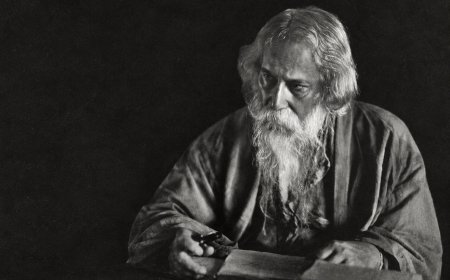



























Who Does Rabindranath Belong To?
The development of Bengali nationalism around Rabindranath cannot be understood merely as a Hindu-Muslim cultural conflict. It was intertwined with language, power, and the right to determine one’s own identity.

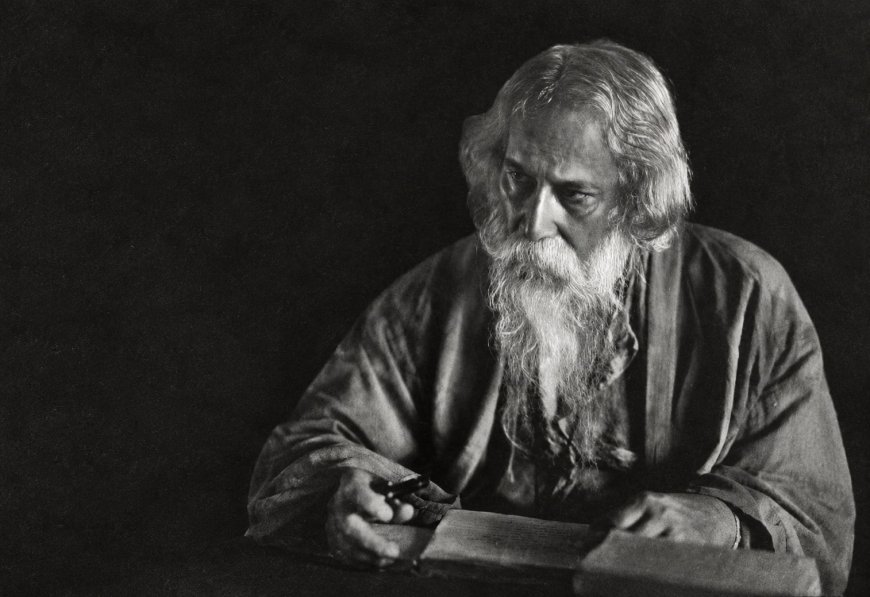
Why does a section of Bengali Muslims feel ambivalent about Rabindranath? Does the root of this ambivalence lie in Rabindranath’s literature and philosophy, or in the history of how Bengali Muslims have constructed their own social, political, and cultural identity?
To understand this, one must look at the evolution of Bengali Muslims from the latter half of the 19th century to the early 20th century.
Under colonial rule, the spread of modern education, the rise of a middle class, and the dominance of Hindu bhadralok society in the world of Bengali language and literature, Bengali Muslims were trying to forge a distinct modern identity.
On one side stood their historical ties to the Bengali language and regional culture; on the other, their religious identity and the desire to establish the distinctiveness of Muslim society -- creating a tension between the two. It was in this context that ambivalence around Rabindranath emerged.
He was one of the foremost representatives of Bengali language and literature, yet many associated his cultural world with the influential culture of Hindu bhadralok society.
Accepting him was therefore not merely a question of literary taste; it was also bound up with how Bengali Muslims would define the inheritance of Bengali culture as their own.
This ambivalence, however, was not universal.
One section of Bengali Muslims embraced Rabindranath, while another questioned his cultural position. Behind this debate lay the complex history of Bengali Muslims becoming modern, changing their social position, and determining their place between religious and linguistic identities.
After the establishment of Pakistan in 1947, this older tension acquired a new political dimension. The national identity of the Pakistani state was based on Muslim identity, and an influential section of the ruling groups in West Pakistan sought Hindu and Indian influence within the Bengali language and culture.
To them, Rabindranath was not merely a poet; he represented a cultural tradition that could not easily be reconciled with Pakistan’s religion-based nationalism. Obstacles to the celebration of Rabindranath’s birth centenary in 1961 and the attempt to stop the broadcast of Rabindra Sangeet in 1967 made this conflict even clearer.
Yet the very effort by the Pakistani ruling groups to distance Rabindranath from the cultural life of Bengalis ultimately strengthened cultural resistance around him.
This is where the most important aspect of the matter emerges. Pakistani rulers’ opposition to Rabindranath did not newly create love for him among Bengali Muslims; rather, it changed the political significance of accepting him.
Earlier the question had been how far a Muslim could regard Rabindranath as his own. In the Pakistan period the question became whether the state had the right to sever a Bengali Muslim from the inheritance of his own language, literature, and music.
Consequently, for many, accepting Rabindranath ceased to be merely a matter of literary practice or love of music and became a way of standing up for one’s cultural rights.
When the state viewed Rabindranath with suspicion, many Bengali Muslims challenged the identity imposed by that state precisely by making him their own.
For this reason, the development of Bengali nationalism around Rabindranath cannot be understood merely as a Hindu-Muslim cultural conflict. It was intertwined with language, power, and the right to determine one’s own identity.
After the Language Movement of 1952, the political force of Bengali identity grew, and in the 1960s it expanded further. Rabindra Sangeet then became one of the expressions of this identity. The song Amar Sonar Bangla itself contained such an expression of the Bengali land, language, and cultural emotion that it could transcend the limits of religious identity.
In other words, against the Pakistani state’s implicit assumption that a Bengali Muslim would have to abandon his Muslim identity in order to accept Rabindranath, Bengali Muslims claimed Rabindranath as their own while retaining their Muslim identity.
Thus, in my view, the controversy that arose around Rabindranath during the Pakistan period made the pre-existing trend among Bengali Muslims of accepting him more conscious and political.
Drawing him closer meant, on the one hand, recovering the inheritance of the Bengali language and literature, and on the other, establishing the distinctiveness of Bengali cultural identity against the monochromatic Muslim nationalism of the Pakistani state.
The significance of this history lies precisely here: Bengali Muslims did not have to give up their Muslim identity in order to prove their Bengali-ness; rather, alongside their religious identity they established the Bengali language, literature, and culture as their own.
Rabindranath became an important symbol of that self-identity formation.
Even today, the renewed rise of opposition to Rabindranath is driven by political and religious narrowness, fundamentalism, and communalism. Without understanding Rabindranath in the context of his time, society, literature, and philosophy, various kinds of false propaganda, fragmented information, and motivated interpretations are being spread about him.
Sadly, some pseudo-intellectuals have at times provided fodder for this propaganda; by simplifying historical complexities or ignoring relevance, they have put Rabindranath in the dock of a particular political or religious narrative.
Yet there is no need to establish Rabindranath as an unquestionable great man. Reasoned discussion and criticism of his literary works, philosophy, political thought, social ideas, and even his limitations are certainly necessary. But such criticism must be based on facts, history, and intellectual honesty -- not on the desire to belittle him, present him in a distorted manner, or spread communal hatred.
The right to criticize a writer and the tendency to conduct false propaganda about him are not the same thing.
The question is: Will we move forward by understanding our own history and cultural roots, or will we remain trapped within the narrow confines of political and religious identity and deny our own heritage?
The history of Bengali Muslim self-identity is not a monochromatic one; it contains religious faith as well as the long flow of the Bengali language, literature, folk culture, and multi-layered cultural inheritance. Rabindranath is an important part of that inheritance.
Accepting him does not mean sacrificing one’s religious identity, and criticizing him does not mean rejecting him. Rather, in order to understand him properly, we must return to history, to reason, and to our own cultural roots.
For no nation can build its future by becoming severed from its roots; and handing over one’s identity to narratives created by others without knowing and understanding one’s own heritage only deepens the crisis of self-identity.
Dr. Selim Raihan is a Professor at the Department of Economics, University of Dhaka, Bangladesh and the Executive Director of the South Asian Network on Economic Modeling (SANEM).