
























![A Ledger of the Soul: Navigating the Allah-Bhagavant Nexus in a 19th-Century Puruṣākāra Jñāna Caupara [Gyan Chauper]](https://counterpointbd.com/uploads/images/202608/image_430x256_6a93baa3b09a7.jpg)



















The Miracle and the Squeeze
This first article in a three-part series argues that Bangladesh’s celebrated growth story was always more fragile than it looked. Now that growth is slowing and investment is yielding less, the hidden costs of that model are becoming harder to ignore.

For years, I took the Bangladesh miracle more or less at face value. Growth above 6%, year after year. The garment sector conquering global markets. Bridges, flyovers, power plants -- the physical proof that the country had put the old language of famine and aid dependence behind it. It was a persuasive story.
I am not sure when I started to doubt it, but I think it was sometime around 2018 or 2019, when the numbers were at their best and yet the people I spoke to -- relatives in Dhaka, friends working in development, a friend who ran a small textile operation in Gazipur -- kept saying things that did not match the headlines.
The ground-level picture was always more jagged than the aggregate suggested. Nobody I know in Bangladesh lives inside a GDP growth rate. They live inside rent increases, the price of rice and onions, transport fares, medicine costs, and wages that never quite seem to catch up. The miracle looked one way from government speeches and investor presentations, and quite another from the factory floor, the bazaar, and the household budget of anyone earning less than, say, thirty thousand taka a month.
That gap matters because Bangladesh’s present crisis did not fall from the sky. It is not just the result of bad luck, global turbulence, or a temporary policy mistake. Those things matter. But they landed on top of a deeper economic structure: One built on cheap labour, weak bargaining power, rising concentration of wealth, and a development model that celebrated growth while quietly pushing the costs downward.
The recent numbers make the strain harder to hide.
In fiscal year 2024-25, GDP growth slowed sharply to 3.97%. Inflation remained punishing. The taka lost a large share of its value against the US dollar over the last few years. Private investment softened. What had once been sold as a stable upward march now looks much more uncertain. The question is not whether the old model delivered growth. It did. The real question is: Growth for whom, at what cost, and how durable was it?
I should say upfront that I am not an economist by training, and this series does not pretend to be a formal academic paper. But I have spent enough time reading the data, talking to people who work in and around Bangladesh's economy, and thinking through the political implications to feel that something important is being missed in most of the mainstream commentary -- and that a Marxist lens, used carefully, can help recover it.
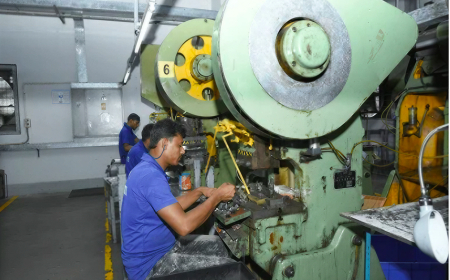
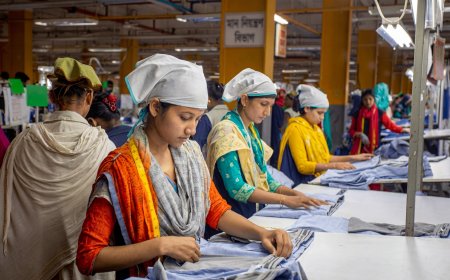
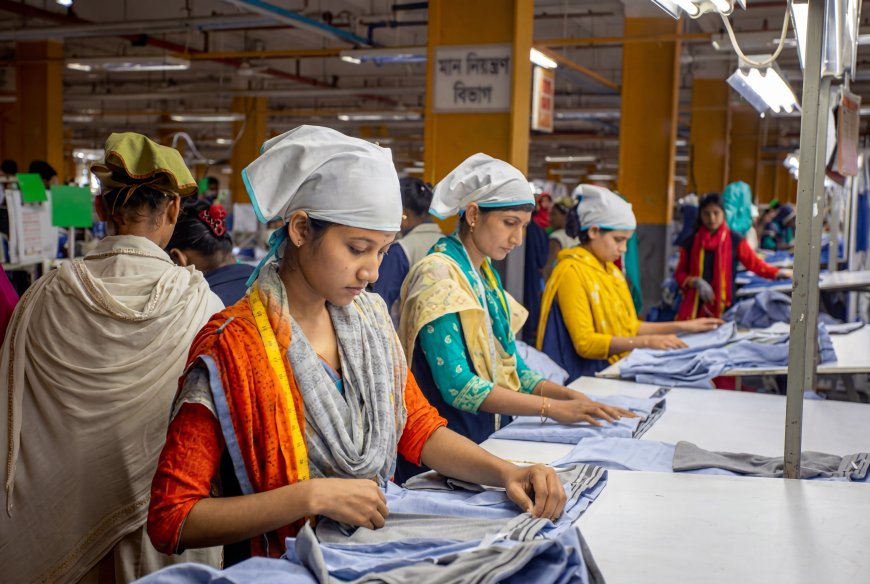
The clearest place to start -- and I keep coming back to this -- is the garment industry, because it is where the success story and the injustice of that success are impossible to separate. Ready-made garments account for roughly 84% of Bangladesh’s export earnings and employ more than 4 million workers, most of them women. That sector has been the backbone of foreign exchange earnings and one of the main reasons Bangladesh came to be celebrated internationally as an export success.
But the same sector also exposes the basic social relation underneath the model. Workers whose labour sustains the country’s export machine are paid extremely little. The minimum monthly wage of 12,500 taka, roughly 113 dollars, is far below what many labour rights groups and wage studies consider a living wage.
Some recent research has argued that the legal minimum itself is not consistently paid across the sector. In plain language, the workers who hold up the country’s most celebrated industry often cannot secure a decent standard of life from the very work that sustains it.
What strikes me most, looking at the sector data over the past decade, is how steadily the gap between what workers produce and what they take home has widened. Productivity has gone up -- the factories are faster, the throughput is higher, the supply chains more efficient.
But real wages have barely kept pace with inflation, let alone with the extra value those workers are now generating. That difference does not just disappear. It accumulates somewhere -- in profit margins, in brand markdowns, in the surplus that leaves the factory floor and never finds its way back to the people who created it.
I want to let a few workers speak here, because their words carry more weight than any data table. One garment worker in Ashulia told Swedwatch researchers during their fieldwork in 2024 (Swedwatch, "Paying the Price for Fashion," November 2024): "As garment workers, we do not have any future. We never have any value, respect, or dignity in the society."
That is not rhetoric from an activist. It is a description of daily experience from someone who stitches clothes for European high streets and earns less than what many of those brands spend on a single advertising photograph.
Another worker, interviewed by Climate Rights International (Climate Rights International, "My Body Is Burning," 2025.) in Dhaka in late 2024, put the physical reality more bluntly: "My body is burning. But still there is no break at all. I have to complete my work. I am suffering, but I have to do my job."
A third, asked why he had not joined the factory workers' union, said simply: "The factory management has already fired several workers for participating in protests. I am a poor man, and I cannot afford to lose my job."
I realize that invoking Marx in a newspaper article risks sounding like a university seminar, so let me try to keep this grounded. His idea of surplus value is not complicated, and you do not need the theoretical apparatus to see the point. A worker produces more value than she receives back in wages.
That gap is the source of profit. In Bangladesh’s garment sector, the gap is not hidden. It is visible in the distance between the value embodied in the clothes, the foreign exchange they earn, and the poverty-level wage of the person who stitched them.
There is another feature of the model that matters just as much as low pay: Labour must remain weak. When workers try to organize, management resistance is common, and in many parts of the export economy the institutional space for genuine independent union power remains severely restricted. In some special economic zones, the formal structures available to workers are much weaker than full trade union rights. That is not a side issue. It is part of how a low-wage export regime is kept in place.
Here is another thing that took me a while to see clearly. Bangladesh's official unemployment rate sits at around 5% -- which sounds reassuringly low until you ask what lies beneath it. Roughly 85% of all employment in the country is informal: insecure, unregulated, without contracts or protections. That vast pool of underemployed and precariously employed people is not a footnote to the labour market.
It is what keeps the formal sector disciplined. When millions of people are available to work for almost any wage, organized workers know they can be replaced. Marx called this the reserve army of labour. In Bangladesh, it is not a metaphor. It is a structural fact that suppresses wages across the entire economy.
When this kind of model hits turbulence, workers absorb the shock first. Since the political upheaval of July and August 2024, more than 155 garment, knitwear, and textile factories are reported to have closed over the following year. For many workers, especially those with long years of service, the result was not dignified protection but insecurity, delayed dues, or token compensation. The same people who built the so-called miracle were among the first to be discarded when the system came under pressure.
Defenders of the old growth story usually make one argument at this point. They say low wages and labour discipline may be harsh, but they were necessary to get industrialization going. There is a real issue buried in that claim. Late industrialisers do face intense global competition. But even if one accepts that argument for a moment, it still does not answer a crucial question: Why is so much sacrifice producing weaker returns?
That is where the broader macroeconomic picture becomes important, and I want to be upfront about the limitations of what follows.
The problem is not only that labour was squeezed. It is also that the overall growth model appears to be yielding less and less from a sustained high level of investment. I have tried, using standard macroeconomic proxies -- investment-to-GDP ratios, GDP growth rates, and the labour share of national income -- to construct estimates of what Marxist economists call the rate of profit and the organic composition of capital.
Figure 1 shows what I found: The estimated rate of profit falls sharply over the decade, even though investment remains relatively high. The figure should be read with caution, because these are proxy calculations, not direct Marxist accounting. Still, the direction of travel is hard to miss.

Figure 1: Tendency of the rate of profit to fall -- Bangladesh (FY2015–FY2025)
In 2019, with growth at 8.2% and investment at 31.6% of GDP, the estimated rate of profit stood at about 25.9%. By 2025, with investment still around 30.7% of GDP but growth down to 3.97%, the estimate drops to roughly 12.9%. Capital is still being poured in, but the growth payoff is much weaker than before. Whether one uses Marxist language or not, that is a serious warning sign.
Figure 2 makes the same point in a simpler way.
The incremental capital-output ratio, or ICOR, tells us how much investment is needed to generate an extra unit of output. If the number rises, the economy is becoming less efficient at turning investment into growth. Bangladesh’s ICOR rises from around 3.85 in FY2019 to 7.73 in FY2025. That is a large deterioration in a short period.

Figure 2: Rising ICOR vs. falling GDP growth -- diminishing returns to capital
I find this genuinely troubling. It means, in plain terms, that Bangladesh now needs roughly twice as much investment to get the same growth impulse it was getting five or six years ago. That is not a small deterioration. And it matters politically, not just economically.
When growth becomes harder to sustain, the pressure on labour often intensifies rather than eases. Wages are held down. Union demands are resisted. Work is pushed harder. What appears at first to be a macroeconomic issue turns out to be deeply social and political.
This is why the garment worker and the growth graph belong in the same story. They are not separate topics. A development model built on keeping labour cheap can look successful for a long time, especially when exports are rising and foreign buyers are placing orders.
But if that same model starts delivering weaker returns on investment, the temptation is always to restore profitability by squeezing workers further. The burden of adjustment does not fall equally. It falls downward.
I want to be clear that none of this means Bangladesh achieved nothing. It achieved a great deal. Export growth was real. Industrial expansion was real. Women's entry into wage labour on a vast scale changed the country in ways that my own family has witnessed firsthand.
My mother's generation could not have imagined the economic independence that millions of Bangladeshi women now exercise, however imperfectly and however constrained. But those gains were fragile, unevenly distributed, and too often built on suppressing the people whose labour made them possible. That is the contradiction now coming into sharper view.
If Bangladesh wants a more durable and more just future -- and I believe it can have one -- it cannot simply return to the old script: more exports, more discipline, more megaprojects, and another round of self-congratulation around aggregate growth numbers. It has to confront the structure beneath the numbers. That means wages people can actually live on.
Real freedom of association -- not the paper version. And a development strategy that stops treating the people who make things as a cost to be compressed, and starts treating them as what they are: The foundation of the whole economy.
In the next part of this series, I turn to the banking system: Bad loans, political patronage, cosmetic accounting, and the way public institutions were bent to serve private power.
Jamil Iqbal is a UK-based researcher and writer from Bangladesh whose work spans qualitative research, public policy, and social analysis.
Sources:
Figure 1: Gross capital formation as percentage of GDP and GDP growth rate from World Bank World Development Indicators and Bangladesh Bureau of Statistics. Labour share of national income (42%) from Danish Trade Union Development Agency, Bangladesh Labour Market Profile 2024/2025. Rate of profit estimated as GDP growth divided by investment-to-GDP ratio. Organic composition proxy calculated as capital share divided by labour share.
Figure 2: ICOR calculated as investment-to-GDP ratio divided by GDP growth rate. Underlying data from World Bank, Bangladesh Bureau of Statistics, and ADB Asian Development Outlook, April 2025. ICOR of 3.87 in FY2019 and 6.06 in FY2020 corroborated by The Business Standard, "How Could Productivity of Capital Drop 56% in a Year?" August 2020
Jamil Iqbal is a UK-based researcher and writer from Bangladesh whose work spans qualitative research, public policy, and social analysis.