









































































Do We Recognize Patriarchy Only When it Carries a Whip?
Sometimes there is a locked gate. Sometimes there is family honour, the marriage market, or the comforting language of protection. And sometimes it may appear at an immigration counter as an apparently ordinary question: Are you married?

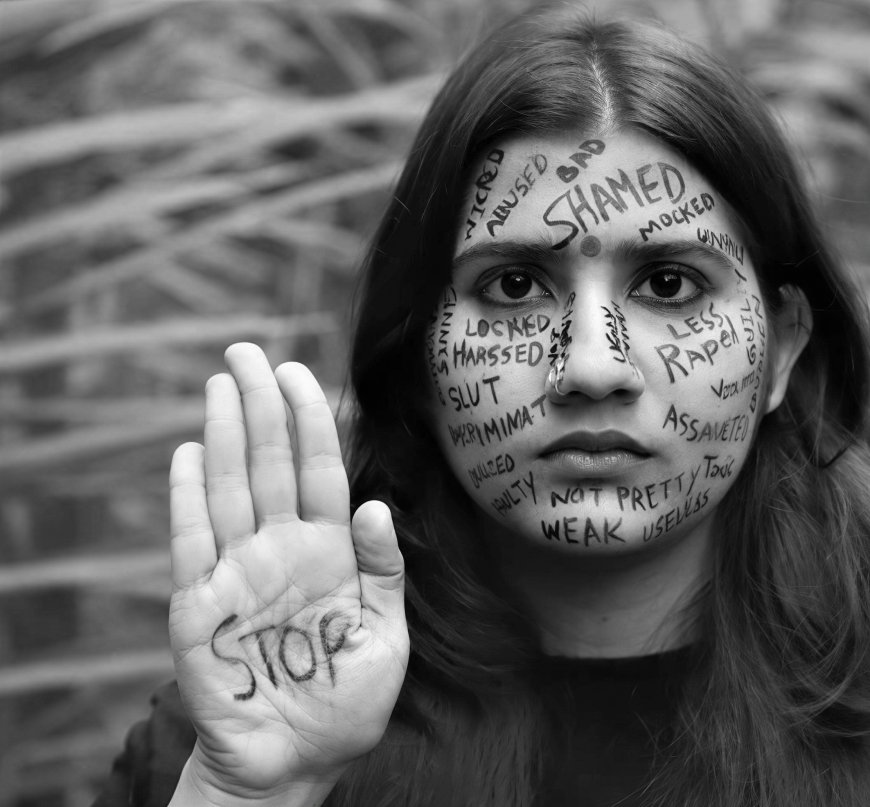
Several years ago, while I was in Poland on an Erasmus program, my Iranian roommate Mina Navidi came running into our room and hugged me. She was crying.
By then we were more like sisters than roommates. A friend of hers in Iran, she told me, had been punished with 74 lashes for not covering her head and was still in police custody.
Mina said something I have remembered ever since: “Bangladesh is far better than Iran’s radically masculine society.”
I remember listening to her and thinking: Is it?
I wrote about that conversation around four years ago. I was angrier then, and my argument was more absolute. I wrote that a radically masculine society might control women visibly, through law and punishment, while a supposedly moderate masculine society could exercise control more quietly through religion, family honour, marriage, respectability and the constant social supervision of women’s choices.
I would not make the comparison so easily today.
A woman being physically punished by the state for violating a compulsory dress code and a woman encountering paternalism in Bangladesh are not equivalent experiences. The nature of the law matters. The severity of coercion matters. State violence matters.
Flattening very different forms of oppression into a single category does not strengthen a feminist argument; it makes the analysis less precise.
But Mina’s words left me with a different question, and that question has stayed with me: Do we recognize patriarchy only when it carries a whip?
I found myself returning to that conversation after reading about three Bangladeshi women who had planned to travel together to Nepal.
On August 8, Rifa Tamanna, Sohani Islam Somapty, and Najnin arrived at Hazrat Shahjalal International Airport intending to travel to Nepal. According to their lawyer, the three adult friends had valid passports, the necessary entry documents and air tickets, and there were no criminal cases or court orders preventing their foreign travel. Their allegation is that immigration officials nevertheless stopped them, asking, among other things, why they were unmarried and whether their families had consented to the trip.
The women challenged the incident before the High Court. On September 29, the court issued a rule asking why preventing them from travelling should not be declared without lawful authority. It also directed the relevant police authority to dispose of their earlier complaint within seven days and told immigration authorities not to obstruct their future foreign travel unless there was a lawful basis. These are interim directions and questions before the court, not a final judicial finding that the allegations have been proved.
That distinction matters.
But the case raises a question that is larger than the disputed facts of one afternoon at an airport.
When does a Bangladeshi woman become her own guardian?
Imagine three adult Bangladeshi men arriving at an airport for a trip with friends.
“Are you married?”
“No.”
“Do your parents know you are travelling?”
“Why are you travelling abroad without a guardian?”
The exchange sounds faintly absurd.
Change the travellers from men to women and, somehow, the questions become more familiar. Some people may even find them reassuring.
That difference interests me.
Because the deeper contradiction here is not simply between patriarchy and freedom. It is between legal adulthood and socially recognized adulthood. A woman can be old enough to vote, work, pay taxes, sign contracts, own property and hold a passport, while still encountering institutions and social expectations that approach her as somebody’s daughter, somebody’s wife, or somebody whose decisions require another layer of validation.
The law may recognize an autonomous citizen while culture quietly places an asterisk beside the word adult:
Adult* Conditions apply.
Where are you going? Who are you going with? When will you return? Do your parents know? Are you married? What does your husband think?
A man becomes an adult.
A woman can become an adult who is still expected to demonstrate that somebody else knows what she is doing.
And this is where the issue becomes more complicated than a simple story about sexist officials.
Immigration officers do have legitimate responsibilities. Human trafficking is real. Fraud is real. Border security is real. Officials sometimes have very little time to determine whether a traveller is being deceived, coerced or trafficked. Safeguarding can require uncomfortable and even intrusive questions.
The relevant question, therefore, cannot simply be: Was a woman questioned?
It has to be: What justified the question?
Was it connected to an identifiable risk? Would a male traveller displaying comparable risk indicators receive similar scrutiny?
Was the intrusion proportionate to the concern? And, most importantly, if someone’s fundamental freedom of movement is ultimately restricted, what is the lawful basis for doing so?
Bangladesh’s Constitution recognizes the right of every citizen, subject to reasonable restrictions imposed by law in the public interest, to leave and re-enter the country. Freedom of movement is not absolute, but restrictions must have a legal basis and cannot rest merely on arbitrary executive preference.
This is important because equality does not always require identical treatment. If evidence shows that a particular traveller faces a genuine trafficking risk, safeguarding may justify additional scrutiny. But differential treatment requires reasons. Gender cannot become a shortcut for evidence, and marital status cannot quietly become a proxy for risk.
That brings us to a less visible problem: Discretion.
Discrimination is relatively easy to identify when somebody writes it into a rule: Unmarried women may not travel alone. The more difficult form appears when no such rule exists at all.
No legal or administrative system can prescribe exactly what an official should do in every human encounter. Officials inevitably exercise judgement. But judgement is never culturally weightless. We all carry assumptions about who appears trustworthy, vulnerable, suspicious, respectable or out of place.
An official therefore does not need a written policy saying that unmarried women travelling independently deserve additional scrutiny. Cultural assumptions about what a “normal” woman does can potentially enter an administrative decision through discretion.
This is one of the places where social prejudice can become institutional practice without ever announcing itself as policy.
And it is why “protection” deserves more careful examination than we usually give it.
Across South Asia, restrictions on women have frequently arrived wrapped in the language of concern. The street is unsafe, so the daughter should not go out. The night is unsafe, so she should return earlier. Public transport is unsafe, so perhaps she should not travel alone.
There is an old bargain hidden inside this language: The protector often acquires authority over the protected.
The father protects the daughter and therefore claims a say in where she goes. The husband protects the wife and therefore acquires a voice over her movements. When institutions inherit the same logic, protection can quietly become a claim to jurisdiction over an adult woman’s choices.
Look closely at what happens next.
The dangerous street remains dangerous. The inadequate transport remains inadequate. The potential harasser retains his mobility.
The woman disappears.
We may call that protection. But sometimes what we are actually doing is managing the potential victim rather than confronting the source of danger.
I was thinking about a similar cultural logic recently while writing about restrictions affecting female students returning late to residential halls at Dhaka University. The two situations are legally and institutionally different and should not be collapsed into one. Yet the questions surrounding them reveal a familiar cultural grammar.
Why does a woman need to be outside so late?
Why does an unmarried woman need to travel abroad?
Why does she need to go alone?
The word need does an extraordinary amount of work.
A man does not always need to establish a socially acceptable reason for moving through the world. He can travel because he wants to see another country. He can stay out because he enjoys his friends’ company. He can walk through an unfamiliar city because curiosity itself is reason enough.
A woman’s movement is more readily converted into a question requiring justification.
This is where sexual politics becomes a politics of space.
Gender inequality is not produced only inside households, marriages or intimate relationships. It is also produced through unequal access to space: Who can occupy the street at midnight, remain in a library after dark, travel alone, sit in a café without explanation, cross a border with friends, or simply be somewhere without having to justify why she is there.
Freedom is partly spatial.
Citizenship is experienced not only through elections, employment or formal legal status, but through these mundane freedoms: To move, linger, study, work, socialize, travel and return. Two people may possess the same constitutional rights on paper while experiencing very different degrees of freedom in everyday life if one of them must continually explain her presence in the world.
That is the difference between formal equality and lived citizenship.
The Constitution can recognize a woman as an equal citizen. The harder task is making that equality ordinary enough that exercising it does not itself become suspicious.
And even here, there is no single experience called “women’s mobility.”
A professional woman with an extensive travel history, fluent English and recognisable institutional credentials may be read differently from a young woman travelling abroad for the first time. Class, age, occupation, dress, language, destination and perceived social status can influence who is seen as an independent traveller and who is seen as vulnerable, suspicious or in need of supervision.
Gender rarely travels alone.
This is precisely why discretion must be tied as closely as possible to evidence rather than stereotype.
Marriage adds another layer.
In much of South Asian social life, marriage does more than organize intimacy and kinship. Culturally, it can also reorganize perceived authority over a woman’s movement.
Before marriage: What will her parents say?
After marriage: What will her husband say?
The guardian changes.
The assumption that a guardian is required survives.
Female adulthood becomes strangely relational: A woman’s decisions are treated as more intelligible when they can be connected to another person who authorizes, accompanies or knows about them.
This is also where the politics of family honour enters the picture.
Honour in our societies is an oddly distributed possession. The entire family owns it, but women are disproportionately asked to carry it.
Where she goes, what she wears, whom she meets, when she returns, whether she has relationships and what other people might say about her can become measurements not simply of her individual choices but of her family’s moral standing.
The double standard is so familiar that we sometimes stop noticing it. A man’s mobility can signify independence; a woman’s can provoke questions about morality. A man’s sexual history may produce gossip; a woman’s can become a family crisis.
Sex workers carry enormous social stigma while the men who purchase their services can remain almost socially invisible.
And three unmarried men travelling together rarely generate anxiety about whether men should be allowed abroad without guardians.
None of this means women do not need protection.
They do.
Human trafficking, harassment and sexual violence are not feminist inventions. They are precisely the kinds of realities feminism has spent decades demanding that institutions take seriously.
But safety and autonomy are not natural enemies.
If transport is unsafe for women, make transport safer. If public spaces facilitate harassment, address harassment. If trafficking networks exploit travellers, identify trafficking indicators and pursue traffickers.
The answer cannot routinely be to reduce the potential victim’s freedom until the danger disappears from view.
Otherwise we arrive at a peculiar social bargain: Men retain the world, while women receive protection from it.
This is why I am wary of one of the most affectionate sentences in our cultural vocabulary:
We see women as our mothers and sisters.
There can be genuine care in that language. There can also be paternalism.
Why must a woman become somebody’s mother, sister, daughter, or wife before her dignity becomes intelligible?
A woman does not possess rights because she is somebody’s sister.
She possesses them because she is a citizen.
That is why the decision of these three women to seek legal redress matters beyond their individual journey, whatever the court ultimately concludes about the disputed facts.
Their case brings an elementary democratic question to the surface: Under what law did you stop me?
Not: Do you care about me?
Not: Were your intentions good?
Not even: Did you believe you were protecting me?
Under what law? On what evidence? According to what objective criterion? Was the restriction proportionate to an identifiable risk?
Those are not radical feminist questions.
They are rule-of-law questions.
And they take me back to Mina.
If we were sitting together in that small room in Poland today and she again told me that Bangladesh was “far better,” I would answer differently from the way I did four years ago.
A woman being physically punished by the state and a woman encountering paternalistic scrutiny are not equivalent experiences of oppression. Treating them as equivalent would erase crucial differences in violence, law, and coercive power.
What connects them is not equivalence but a question: Who gets to decide how an adult woman may inhabit the world?
Patriarchy has proved remarkably adaptable in answering it.
Sometimes it speaks through religion. Sometimes through honour. Sometimes through family and marriage. Sometimes through administrative discretion. And sometimes, most persuasively of all, it speaks through concern: We are only thinking about your safety.
Four years ago, I thought the easiest way to recognize patriarchy was to look for the whip.
I no longer do.
Sometimes there is a whip. Sometimes there is a locked gate. Sometimes there is family honour, the marriage market or the comforting language of protection.
And sometimes, if the allegations now before the High Court are established, it may appear at an immigration counter as an apparently ordinary question: Are you married?
A woman’s passport carries her own name.
The state has every right to ask questions necessary to protect its borders and its citizens. But adulthood should not require a woman to identify the man who has authorized her to exercise it.
Dr. Lubna Ferdowsi is an academic and researcher based in England.