



































































Why Does Bangladesh’s Knowledge Not Reach Its Businesses?
Bangladesh’s weakest areas are human capital and research (127th), business sophistication (125th) and institutions (113th). The second deserves the most attention, because it shows exactly where the system breaks.


The Global Innovation Index (GII) 2026, published by the World Intellectual Property Organization (WIPO) on September 29, ranks Bangladesh 105th among 139 economies. Most of the discussion will focus on this headline rank.
However, the more useful message is inside the report. According to the GII, Bangladesh’s weakest areas are human capital and research (127th), business sophistication (125th), and institutions (113th). The second deserves the most attention, because it shows exactly where the system breaks.
Business sophistication measures how well firms employ knowledge workers, work with universities and research institutes, and absorb knowledge from abroad. Bangladesh scores 18.4 out of 100 on this pillar, below the average of lower middle-income economies (23.3) and of Central and Southern Asia (21.9), while the ten best performers average 60.0.
Inside the pillar, one indicator stands out. On university-industry collaboration in research and development, Bangladesh ranks 128th, close to the bottom of the world. Indonesia ranks 10th, the Philippines 17th, and Viet Nam 24th. Even Sri Lanka at 89th and Pakistan at 111th do better.
This weakness is not because Bangladesh produces no knowledge. The same report lists the citation impact of Bangladeshi research (57th) and the ranking of its top three universities (58th) among the country’s strengths, and scientific publications grew by 16.5% a year between 2015 and 2025.
In other words, knowledge is being produced, but it is not reaching the businesses that could turn it into products, jobs, and exports.
That is the single point of this article, Bangladesh’s innovation problem is a missing link between knowledge and business.
The figure below shows this pattern along the innovation chain.
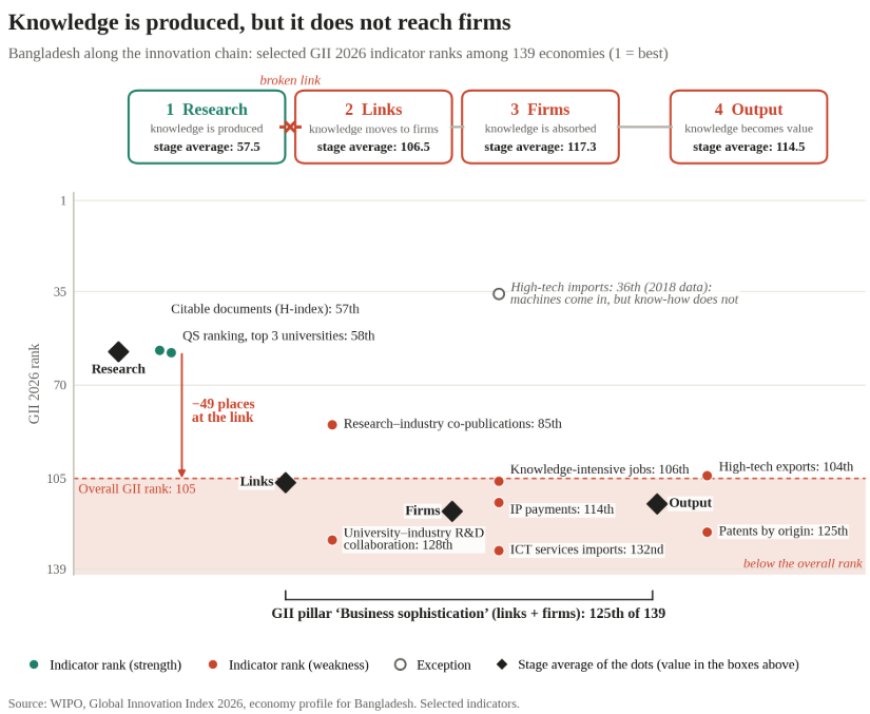
From the figure above, we see that Bangladesh does reasonably well at the research end of the chain, but its position falls by about 49 places, from an average of about 58th to about 107th, once knowledge has to move into firms, and it never recovers. Bangladesh ranks 125th on patents by origin and 104th on high-tech exports.
There is one interesting exception. Bangladesh ranks 36th on high-tech imports (on 2018 data), which suggests firms buy advanced equipment. But it ranks 114th on payments for intellectual property and 132nd on imports of ICT services. Machines come in, but the know-how to adapt and improve them does not.
A recent research paper on Bangladesh’s innovation system explains why this happens. It describes the situation as a failure of translation: Universities, publications and digital access have expanded, but the institutions that turn knowledge into economic value are scarce.
The paper points to three missing pieces in the middle of the system. Technology transfer offices at the major universities exist on paper but are understaffed and lack licensing skills. Accredited testing facilities are scarce, so exporters often pay for testing abroad.
And engineering and design services are few, concentrated in Dhaka and used mainly by large firms.
As a result, innovation is confined to a thin layer of large exporters with links to foreign buyers, while small and medium firms rarely innovate at all.
Other data support this reading. The first national R&D survey by the Bangladesh Bureau of Statistics counted 12,797 full-time-equivalent researchers in FY2020–21, about 76 per million people, compared with 836 per million in Viet Nam according to the GII, or about one-eleventh of Viet Nam’s level.
In the World Bank’s 2022 Enterprise Survey, only 11% of the Bangladeshi firms surveyed reported an internationally recognised quality certification, against about 25% in Pakistan’s and 27% in India’s 2022 surveys. Knowledge-intensive jobs also account for only 8.39% of employment, and this share fell by 0.85 percentage points in 2024.
The paper also makes an important point about demand. Garments earned about 84% of Bangladesh’s export income in FY2022–23, yet the sector is almost absent from formal R&D statistics.
Because firms compete mainly on low cost, and because tariff protection keeps the domestic market profitable without much effort, most firms have little reason to look for new knowledge.
Universities, on the other hand, have weak commercial links with industry, as the paper notes. Public procurement does not help either, as it mostly rewards the lowest bid and established suppliers, leaving local innovators without an early market. So, both sides of the bridge are waiting for the other to move.
This matters even more now. Bangladesh is due to leave the least developed country (LDC) category on 24 November 2026, and its request for a three-year extension awaits a decision by the UN General Assembly. Either way, trade preferences will not protect its low-cost exports forever, and firms will need to compete on quality and technology.
Much of this bridge can be built on what is already there. The technology transfer offices that major universities have on paper could become real meeting points if run by people who know industry and judged by the licences and joint projects they help create. Public research money can do similar work.
If part of it went to projects where a firm shares the cost, researchers would have reason to knock on factory doors, and firms reason to open them. Accredited laboratories at home would let a firm prove a new product's quality without sending it abroad. Firms also need a first customer.
The government is a large buyer, and procurement that leaves room for new local solutions could give innovators an early market, while large exporters, pushed by demanding foreign buyers, can draw in local suppliers.
In time, success would be judged less by papers and graduates than by licensing deals, joint projects and certified new products.
Overall, it can be said that Bangladesh does not mainly lack knowledge; it lacks the bridge that carries knowledge into business. The GII has pointed to the weak spot, and the research evidence explains it.
Building that bridge will take years, but it will do more for the country’s innovation performance than adding more inputs to a system that cannot yet use them.
Arifuzzaman Khan is a researcher in the field of science, technology, innovation, and entrepreneurship. He can be reached at [email protected].