























































How Much Puja Can the Economy Afford?
If Puja holidays damage the economy, calculate the economic cost of holidays demanded for one's own religious occasions as well. If religious processions blocking roads are unacceptable, demand the same rule for every religious and political gathering.

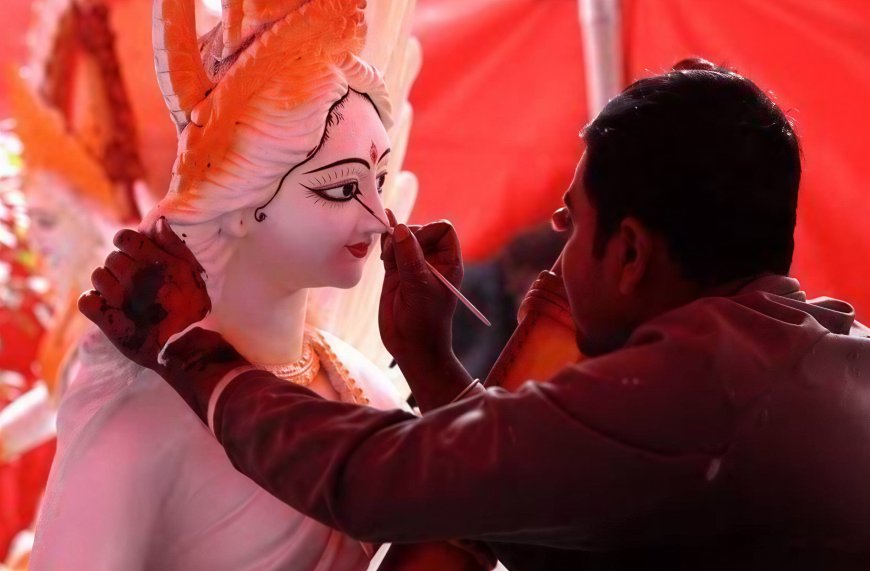
At this rate, Bangladesh may soon need a ministry to determine exactly how much Durga Puja the economy can survive.
It appears that the source of several national anxieties has finally been identified: The economy, the environment, rivers, public order, and even the safety of Muslims in India have somehow converged on one problem, Durga Puja. Someone should probably inform Bangladesh Bank.
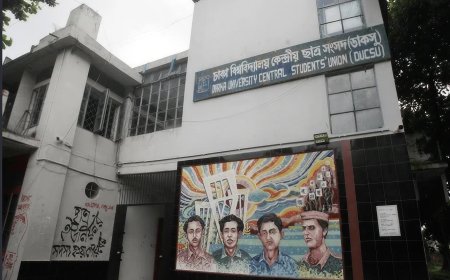
The immediate controversy is straightforward. The government has extended the official holiday for Durga Puja. In response, a platform called Insaf Kayemkari Chhatra Sramik Janata has taken to the streets arguing, in essence, that Puja belongs to Hindus, not Muslims, and therefore there is no justification for giving Muslims a Puja holiday.
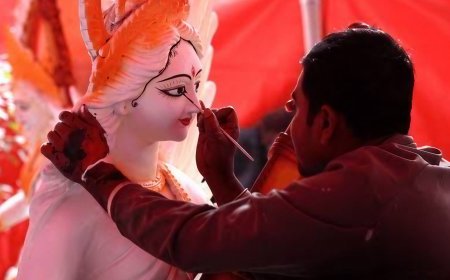
At almost the same time, idols being prepared for Durga Puja were vandalised at a temple in Mirzapur, Tangail, where the festival has reportedly been celebrated for about 85 years. New Age initially reported at least four damaged idols, while The Daily Star subsequently reported seven. Police visited the site, opened an investigation and promised security.
Put the two developments beside each other and an uncomfortable political contradiction appears. On one side, people are asking why the state should grant additional holiday time for a minority religious festival. On the other, the state has to send police to protect the very objects of worship associated with that festival.
The same citizen is effectively being asked to justify why her festival deserves a place in the national calendar while also seeking reassurance that her religious symbols will still be intact when the festival begins.
So perhaps the more useful question is not how many days of Puja Bangladesh can afford. It is this: Which religion is allowed to appear naturally in Bangladesh's public sphere, and which religion must repeatedly justify its visibility?
The first proposition from the Insaf platform is that the Puja holiday must not be increased because Puja is for Hindus, not Muslims. Fine.
Let us apply that principle consistently.
If public holidays are to be allocated according to the private religious practices of individual citizens, should Hindus, Buddhists and Christians report to work during Eid? Should Muslims and Hindus work on Christmas? Should everyone except Buddhists clock in on Buddha Purnima? Will the state now require separate attendance registers according to religion?
A public holiday is not a certificate of religious allegiance. A Hindu does not become Muslim because the office closes for Eid. A Muslim does not become Christian because Christmas is a holiday. Nor does the state become Buddhist when offices close for Buddha Purnima.
A public holiday belongs to the civic calendar of the state. In a religiously plural society, it also carries a symbolic message: Even if your community is numerically smaller, your festival is part of the collective life of the country.
Recognizing the important festival of one community does not convert everyone else to that religion. If the principle becomes, “I do not perform Puja, therefore a Puja holiday cannot belong to me,” the logical destination is not plural citizenship but a collection of religiously segregated office timetables.
Then economics enters the argument. The platform says that the economy cannot be paralysed by five consecutive days off in the name of Puja.
The sudden concern for national productivity is touching. Yet in a programme reported in August, the same organisation demanded state sponsorship for 12 Rabi ul Awwal, including a government holiday throughout the month of Rabi ul Awwal, the highest state budget allocation, special allowances for public and private employees, and compulsory programmes.
Apparently a few days associated with Puja threaten economic paralysis, while a month associated with a preferred religious occasion would allow the economy to recover miraculously and sprint. This is not an economic theory. It is selective accounting in which the fiscal value of a holiday changes according to whose religion the holiday recognises.
The next demand is that Puja should not be brought outside the mandap. Read in isolation, that might sound like a question of traffic or public order. But political claims acquire meaning from their pattern.
The same organization protested in Gaibandha in July against the construction of a Ram idol within a temple compound, describing it as a threat to communal harmony. Other published demands associated with the platform have included restrictions on Hindu religious processions and calls for action against minority organisations.
The broader principle begins to emerge: Minority religion may exist, but preferably privately, quietly and with limited visibility.
Majoritarianism rarely arrives in a single dramatic act. Its more durable method is to make the majority's religious presence appear normal while recoding the minority's equivalent presence as a concession. The majority religion in public space becomes culture; minority religion in public space becomes a problem.
Eid holidays become part of the national calendar, while Puja holidays become “holidays for Muslims because of Hindus.” Security for the majority is ordinary law and order, while protection for a Puja mandap becomes “special treatment.”
Bangladesh's constitutional history makes this especially significant. Secularism in the 1972 Constitution was not a declaration of hostility to religion. Its purpose included resisting communalism and preventing religion from becoming a basis of political discrimination.
Secularism was later removed from the constitutional framework, Islam was declared the state religion in 1988, and secularism was eventually restored as a fundamental principle while the state religion provision remained.
The present constitutional order therefore carries a historical tension within itself: Islam is the state religion, while the Constitution also promises equal status and equal rights in the practice of Hinduism, Buddhism, Christianity and other religions.
That tension matters because equal citizenship cannot mean that the majority religion defines the baseline and everyone else negotiates exceptions from it.
A related argument circulating recently asks why Durga Puja should receive special security if Eid prayers do not. That sounds like equality only if equality is confused with identical treatment. Equal protection does not require the police to deploy the same number of officers to every religious gathering regardless of risk.
It requires the state to respond to actual vulnerability so that citizens can exercise the same freedom in practice.
If one house on a street faces a credible and repeated threat of attack, providing additional protection to that house is not a privilege denied to its neighbour. It is the means by which an equal right to security becomes real.
The more revealing question, therefore, is not why a Puja mandap needs additional police. It is why citizens should need such an extensive security architecture simply to practise their religion.
Traffic congestion should certainly be regulated. So should noise. But the law should be secular in the most practical sense: It should regulate conduct rather than religious identity.
If a Puja procession unlawfully blocks a road, apply the relevant rule. Apply the same rule when a Friday congregation, Eid gathering, waz mahfil, political rally or any other event unlawfully obstructs the same public space. The legal question should be what you are doing, not which religion you belong to.
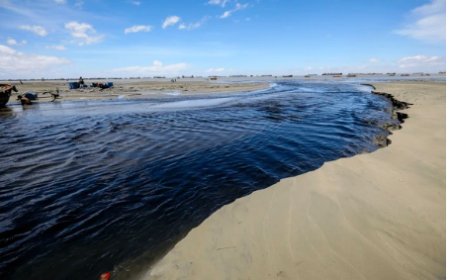
Then comes environmentalism. The statement says Puja idols must not be illegally immersed in rivers, canals, wetlands or the sea. As an environmental principle, there is nothing objectionable about regulating immersion.
If paint, synthetic material or other components pollute water, environmentally responsible rules are entirely justified. But environmental law must possess the same memory throughout the year. It must also address industrial effluent, plastic, sewage, encroachment, river filling and waste generated during other mass religious and social events, including Qurbani.
Environmental concern that suddenly awakens only when confronted by a minority ritual is better described as selective environmentalism.
The most revealing demand comes at the end. Puja mandaps, the statement says, should be compelled to protest the persecution of Muslims in India; otherwise Bangladeshi Hindus will have proved themselves supporters and instigators of that persecution.
This moves from inconsistency to a dangerous theory of citizenship. A Hindu schoolteacher in Cumilla is not a representative of the government of Uttar Pradesh.
A Hindu shopkeeper in Khulna is not a guarantor of Narendra Modi's policies. A Hindu woman in Rangpur is not a collective defendant for crimes committed against Muslims across the border.
Discrimination or violence against Muslims in India deserves criticism on its own merits. But compelling Bangladeshi Hindus to denounce it, and treating silence as evidence of complicity, is the politics of collective guilt. Reverse the mirror and its ugliness becomes obvious.
If Muslims in India were told that whenever a Muslim committed an atrocity somewhere in the world they must publicly condemn it or be presumed supporters, we would rightly recognise the demand as communal profiling. Applying the same principle to Hindus in Bangladesh does not change its character.
Modern citizenship rests on precisely the opposite proposition: Individuals are accountable for their own conduct, not collectively liable for everything done by people who happen to share their religion.
There is an additional irony. The statement begins by insisting that Puja is exclusively a Hindu matter and Muslims have nothing to do with it. Yet a few lines later Bangladeshi Hindus are made responsible for producing political statements about the treatment of Muslims in another country.
When rights are being discussed, the message is: Puja is your affair, not ours. When responsibility is being allocated, the message becomes: The conduct of Hindus across the border is also yours to answer for.
It is an ingenious political arrangement: Rights are individual, responsibility is international.
This is why these demands should not be dismissed merely as eccentric rhetoric. Together they reproduce a familiar majoritarian logic.
First redefine minority religious freedom as special treatment. Then narrow the legitimate visibility of minority religion in public space.
Finally subject minority citizens to loyalty tests based on the conduct of co religionists beyond the national border.
The final irony lies in the organisation's own name: Insaf, justice.
If justice means anything, its first requirement is consistency. If Puja holidays damage the economy, calculate the economic cost of holidays demanded for one's own religious occasions as well. If religious processions blocking roads are unacceptable, demand the same rule for every religious and political gathering.
If immersion pollution matters, apply environmental standards with equal seriousness to industrial waste, sewage, plastic and Qurbani waste. If the safety of Muslims in India matters, protest it vigorously, but do not turn a Bangladeshi Hindu into the local ambassador of the Indian state.
That is what equal citizenship requires.
If, however, one month of holiday for my religion is state patronage while three days for yours are economic catastrophe, the argument is no longer really about Puja. The question becomes much simpler: Justice for whom?
And beyond the satire lies the more serious political question. Who owns Bangladesh's public sphere?
If a citizen must repeatedly explain why her festival deserves a holiday, why her temple deserves police protection, why her religion may be visible in public, and why she should not be held answerable for another state's conduct, then the problem is not the holiday calendar. The problem lies in our imagination of equal citizenship.
A democracy is not tested by how comfortably the majority can inhabit public life. The harder test is whether a citizen who belongs to a smaller community can say, without apology, qualification or a loyalty test: This state is mine too.
Dr. Lubna Ferdowsi is an academic and researcher based in England.