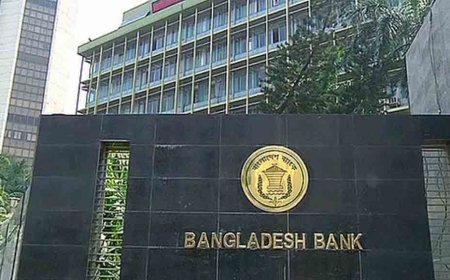













































































Banks are Flush with Cash, but Businesses are Starved of Credit
A bank can hold substantial cash yet still be financially weak if years of loan losses have eroded its capital. This distinction is especially important in Bangladesh.

Bangladesh’s banking sector is facing a striking paradox. Banks are accumulating cash, and liquidity is rising, yet little of that money is reaching businesses and productive investment. Private-sector credit growth fell to just 4.47% in June, the lowest rate in 33 years.
It stayed below 5% for four consecutive months, from March through June. At the same time, banks placed a record Tk 1.5 trillion with Bangladesh Bank through its Standing Deposit Facility in June.
At first glance, abundant liquidity may seem reassuring. It is not. It is unfolding as the banking sector struggles with one of the most severe episodes of non-performing loans and capital weakness in its history.
By the end of March, non-performing loans had reached Tk 5.89 trillion, equivalent to 32.26% of total outstanding loans. Almost one taka out of every three lent by the banking system is now classified as non-performing.
Put these numbers together, and the underlying problem becomes clearer. Bangladesh does not simply have a shortage of money. It has a problem converting savings into productive investment.
Financial intermediation, one of the most fundamental functions of a banking system, is not working effectively. To understand why, it is important to distinguish liquidity from capital.
Liquidity enables a bank to meet withdrawals and conduct day-to-day operations. Capital serves as the bank’s financial cushion against losses. When borrowers default, or assets lose value, capital absorbs the losses.
A bank can therefore hold substantial cash yet still be financially weak if years of loan losses have eroded its capital. This distinction is especially important in Bangladesh.
According to the World Bank, the banking system’s aggregate capital-to-risk-weighted-assets ratio had fallen to negative 2.6% by the end of December 2025. Abundant system-wide liquidity should therefore not be mistaken for banking-sector health.
The roots of this weakness run deep. Years of poor credit assessment, related-party lending, politically influenced loan approvals, repeated rescheduling, and weak recovery practices have damaged bank balance sheets. When almost one-third of loans are non-performing, extending new credit is no longer simply a matter of whether a bank has money.
Banks must also ask whether a new borrower will repay and, if the loan defaults, whether the bank has sufficient capital to absorb the loss. Yesterday’s bad lending therefore constrains the banking system’s ability to make good loans today.
But blaming banks alone would overlook the other half of the problem. Credit demand is weak as well. Businesses do not borrow simply because banks have money.
They borrow when they see profitable opportunities to build factories, purchase machinery, adopt technology, or expand production. High borrowing costs, weak domestic demand, energy shortages, and economic uncertainty have made new investment less attractive.
If an existing factory cannot operate at full capacity because of unreliable gas or electricity supplies, why borrow at a high interest rate to build another one?
The weakness is evident in the data. Private-sector credit growth stood at 4.72% in March, 4.75% in April, and 4.98% in May, before falling to 4.47% in June.
Bangladesh Bank has set a private-sector credit growth target of only 6.8% for December 2026, suggesting policymakers do not expect a rapid revival.
This raises an obvious question: If banks have so much money, where is it being used? Part of it is returning to the central bank.
Deposits at banks through Bangladesh Bank’s Standing Deposit Facility reached a record Tk 1.5 trillion in June. Another portion is being invested in government treasury bills, bonds, and other relatively low-risk assets.
From an individual bank’s perspective, this is rational. Government securities can offer attractive returns with considerably less credit risk. Banks do not need to assess a company’s cash flow, evaluate management, monitor collateral, or spend years trying to recover a defaulted business loan.
Here lies another paradox. What makes sense for an individual bank may not necessarily be desirable for the economy. If banks can earn acceptable returns by placing funds with the central bank or buying government securities, their incentive to undertake the more difficult work of identifying and financing productive businesses diminishes. Yet that process is essential to investment and employment.
Government borrowing adds another dimension. In fiscal year 2025-26, the government borrowed approximately Tk 1.68 trillion net from the banking system, substantially exceeding the revised target.
It would, nevertheless, be misleading to describe the current situation simply as “crowding out.” Private credit is weak, in part, because businesses themselves are reluctant to borrow.
Every taka lent to the government is not necessarily a taka taken from a willing private borrower. The risk could become more significant when investment recovers.
If businesses return to banks seeking funds while a large share of bank balance sheets continues to finance the government, competition for credit could intensify. Private borrowers could then face reduced access to funds or renewed upward pressure on interest rates.
There is another complication. Excess liquidity is an aggregate measure for the banking system. It does not mean every bank is equally liquid or equally healthy. A strong bank may have substantial deposits and excess cash but little appetite for new lending.
At the same time, a weak bank may face capital shortages, depositor concerns, or liquidity pressure. Aggregate liquidity can therefore mask big differences among institutions.
This unevenness also underscores the limitations of monetary policy. After maintaining a tight monetary stance to contain inflation, Bangladesh Bank reduced its policy rate from 10% to 9.5% in early August. Lower rates should gradually reduce borrowing costs and make some investments more viable.
The policy may help, but interest-rate cuts alone cannot repair damaged bank balance sheets. They cannot recover non-performing loans, replenish depleted capital, or restore credit discipline. Nor can lower rates automatically create profitable investment opportunities for businesses facing weak demand, uncertainty, or inadequate energy supplies.
Economists sometimes compare this problem to “pushing on a string.” A central bank can make money more readily available, but it cannot force banks to find creditworthy borrowers or compel businesses to invest when expected returns do not justify the risks. Bangladesh therefore needs to address both sides of the credit market.
On the banking side, the first requirement is to recognize the true extent of loan losses. Viable banks that need capital must be recapitalized under credible restructuring plans, while institutions without a realistic path to independent viability require orderly restructuring. Credit appraisal, approval, monitoring, and recovery standards must also improve substantially.
Banks should not simply be encouraged to lend more. They need to lend more effectively. A borrower’s capacity to generate cash and repay debt must once again be the foundation of credit decisions, rather than political influence, personal connections, or established relationships.
Otherwise, attempts to accelerate lending today will create another generation of bad loans tomorrow. The demand side requires an equally serious response. Reliable electricity and gas supply, policy consistency, improved law and order, faster regulatory decisions, and a predictable business environment may do more to revive productive borrowing than another liquidity injection.
Credit guarantees and refinancing facilities can help viable small and medium-sized enterprises that are constrained in their access to finance. But these programs must maintain sound underwriting standards. If credit assessment remains weak, today’s stimulus can easily become tomorrow’s nonperforming loans.
The government also needs to reconsider the structure of its financing. Stronger revenue mobilization, greater discipline in public spending, sustainable external financing, and deeper bond and capital markets would reduce pressure on commercial banks to finance both the government and the private sector.
That would allow banks to devote more of their balance sheets to their core economic role: Converting savings into productive private investment. The most important message from Bangladesh’s current liquidity surplus is not that the country has plenty of money.
The concern is that money is not reaching the parts of the economy where it can generate productive returns. A healthy banking system does more than collect deposits and hold cash.
It assesses risk, identifies creditworthy borrowers, and channels savings to enterprises that can expand production, invest in technology, and create jobs. Bangladesh’s banks have money.
Yet private-sector credit growth is at a 33-year low, nearly one-third of outstanding loans are non-performing, and the banking system’s aggregate capital position is deeply troubling.
Together, these numbers tell a larger story. Bangladesh’s challenge is no longer simply how to supply more money to banks. It is about restoring the institutions, incentives, and confidence needed to channel that money into productive investment.
Until that capacity is restored, the paradox will persist: There will be money in the banks, but too little credit for the economy.
Dr. Mohammed A. Rab is a US-based economist and freelance consultant on banking and financial risk management.