










































































Not All Work is Visible
A financially free woman is not simply one who earns. She is one whose contribution is recognised, who has meaningful control over economic resources, and who has genuine freedom to decide how her time, work and money are used.

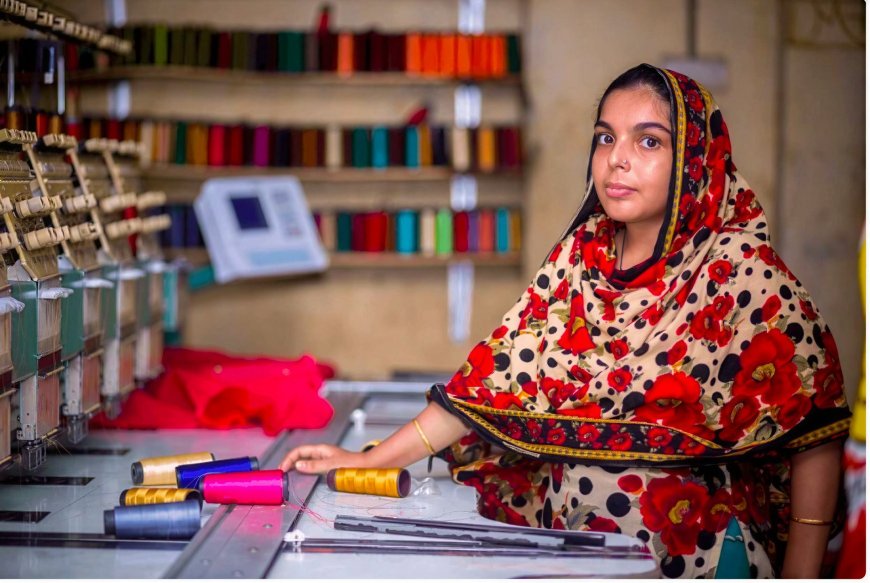
Women and men in Bangladesh work remarkably similar numbers of hours each day. Women spend, on average, about one hour a day in paid employment and six hours in unpaid domestic and care work.
For men, the pattern is almost exactly reversed: around six hours in paid employment and one hour in unpaid work (Bangladesh Time-Use Survey, 2021).
Yet because much of women’s work is unpaid, their economic positions are perceived very differently. A man who spends his day in paid employment is recognized as an income earner and provider.
A woman who does six hours of unpaid household work may instead be viewed as financially dependent on her husband, even though her labour allows him to devote his time to earning.
Money spent on her can consequently be framed as something being provided to her, rather than her share of resources generated through the combined labour of the household.
This reflects a deeply entrenched hierarchy in how society values work. Paid work is recognised because money changes hands. Unpaid domestic and care work, despite being essential to the functioning of households and the economy, is routinely undervalued.
These are long-entrenched social phenomena. What is more worrying is when organizations and financial institutions explicitly seeking to increase women’s financial freedom inadvertently validate the same hierarchy.
Women-focused micro-lending provides a useful example. Micro-lenders correctly recognized that merely issuing a loan in a woman’s name did not ensure that she controlled the business or its income -- the actual goal of the intervention.
The response has increasingly been to distinguish between nominal ownership and businesses with active female involvement -- an approach that can privilege visible, market-facing participation.
The intention is sensible: prevent women from becoming figureheads for male-controlled enterprises. But it also shows how easily a means can become an end.
Visible participation in income generation, initially used as an indicator of greater financial agency, can gradually become treated as the objective itself.
The question shifts from: “Has this intervention increased the woman’s financial agency?” to: “Is she visibly engaged in earning?”
Those are not the same thing.
Consider a couple running a small fuchka business. If the wife stands at the cart and deals with customers but has little say over the income it generates, her economic participation is highly visible while her financial agency may remain limited. This is not merely hypothetical.
The World Bank’s Voices to Choices research found that women across Bangladesh described a norm under which working women were expected to hand over much of their earnings to their husbands or families.
Now consider the reverse. Suppose she prepares the ingredients, calculates what is needed, manages supplies, and keeps track of expenses while her husband transports the cart and handles customers.
Or suppose she manages the household and cares for their children while he runs the business. Her market-facing contribution may be limited or invisible, yet she could still exercise substantial control over the household’s resources.
Visible participation is therefore a poor measure of financial agency. What matters is whether she has meaningful control over income, assets, and financial decisions.
More broadly, privileging visible market participation can overlook work that makes income generation possible while overstating the autonomy of women who visibly earn but do not control the resulting resources.
When such indicators become goals in themselves, they can also reinforce the assumption that household income belongs primarily to the person whose labour directly generates a wage or revenue -- and, by extension, that paid work is the only form of work deserving economic recognition.
Women also shoulder a disproportionate share of domestic responsibilities, much of it shaped by social expectations rather than freely chosen. This limits the time available not only for paid employment, but also for building skills, gaining experience and developing the networks that can lead to better opportunities.
One common justification for this unequal division is that men bear greater responsibility for earning. Yet that justification becomes much harder to sustain when women themselves enter paid employment and the division of unpaid work remains largely unchanged.
The World Bank’s DIGNITY survey found that, among economically active adults in low-income Dhaka communities, women spent about thirteen times as much time on direct domestic and care work as men. Mobility and safety constraints further shape where, when and how women can participate in paid work.
Thus, paid employment and visible market participation alone do not necessarily change the underlying constraints that limit women’s financial agency. A woman can enter the labour market, continue carrying most household responsibilities, earn an income and contribute it to her family—and still have limited control over economic resources.
This is the fundamental weakness in treating earning as synonymous with financial freedom.
The next phase of women’s financial empowerment interventions should therefore focus less on whether women earn and more on whether they actually gain financial agency: meaningful control over their own earnings, a genuine say over household resources, and secure access to savings and assets.
That means recognizing women’s less visible contributions to family enterprises and treating unpaid household labour as an economic contribution rather than evidence of dependence.
It also means addressing childcare, elder care, mobility and safety rather than expecting women simply to overcome these constraints individually.
Women cannot be made financially free simply by adding an expectation that they earn while leaving intact the expectation that domestic and care work remains theirs.
If interventions continually expand women’s responsibilities in the market without comparable efforts to redistribute responsibilities inside the home, they risk adding a new expectation without displacing the old one.
Bangladesh has built a vast institutional infrastructure around increasing women’s access to credit, employment and income generation.
Far less attention has been devoted to changing the household arrangements that accompany this shift—particularly whether men assume a greater share of domestic and care work as women are increasingly encouraged to take on greater financial responsibility within the household.
Paid employment is an important route to financial freedom. But it is a route, not the destination.
A financially free woman is not simply one who earns. She is one whose contribution is recognized, who has meaningful control over economic resources, and who has genuine freedom to decide how her time, work and money are used.
Mariha Tahsin is a Senior Economist at the Ministry of Finance, Government of Alberta.