






























![A Ledger of the Soul: Navigating the Allah-Bhagavant Nexus in a 19th-Century Puruṣākāra Jñāna Caupara [Gyan Chauper]](https://counterpointbd.com/uploads/images/202608/image_430x256_6a93baa3b09a7.jpg)


















The Never-Ending Story
Nine years ago, the Rohingya crossed into Bangladesh expecting to stay for a season. They are still there. The speeches have changed hands three times, but the camps have not moved.

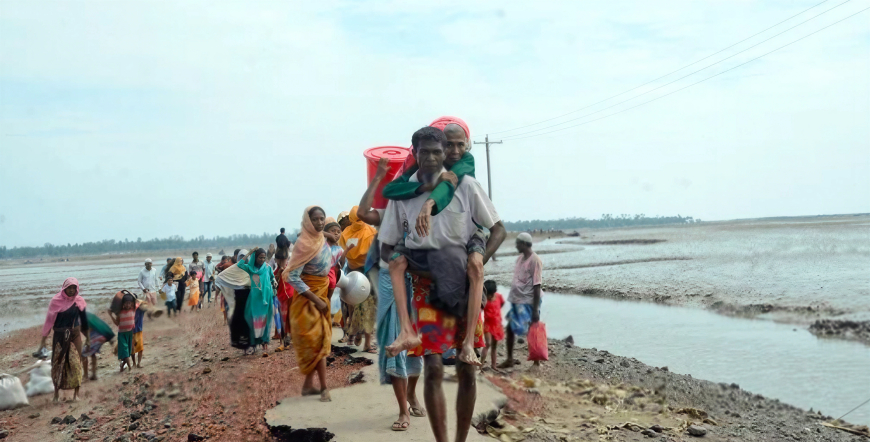
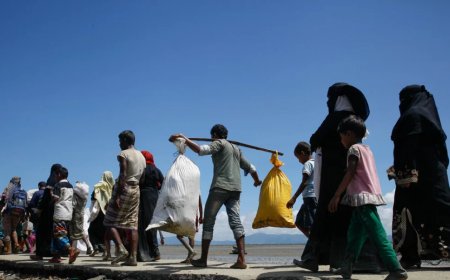
Last August marked the anniversary of nearly a million Rohingya fleeing Myanmar's Rakhine State to Bangladesh to escape from the violence, ethnic cleansing, and systemic persecution against them.
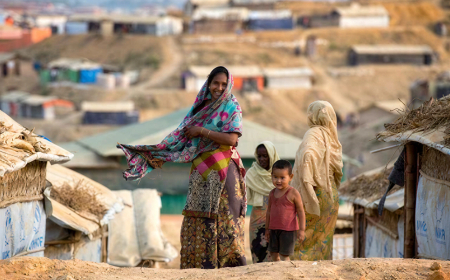
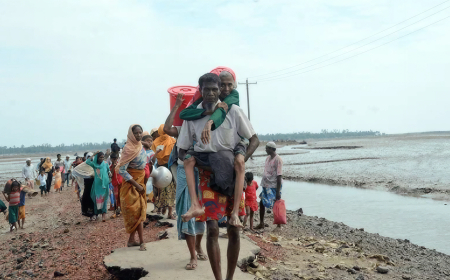
It is now nine years on, the Rohingyas are settled down in 34 different camps here, whereas the southern region Cox's Bazar has positioned itself as the largest refugee settlement in the world. The question that hangs over every anniversary remains unanswered: When do they go home?
A Broken Promise of Eid Celebration
Last year, during Ramadan 2025, the Chief Adviser of Bangladesh's interim government, Professor Muhammad Yunus, stood beside UN Secretary-General António Guterres and said that: “By the next Eid, Rohingya will be in their own land” -- it was not just a statement, but a promise he made in front of them publicly.
However, Eid has come and gone -- so far, one after that event, but the reparation did not happen. Rather, Yunus left office in February 2026, after the BNP swept one-third of the seats in Bangladesh’s first national election since the 2024 uprising, and Tarique Rahman was sworn in as prime minister.
Interestingly, Yunus attended the new prime minister's Eid gathering invitation with a ‘former’ attached to his title, and no accounting for the promise he had made a year earlier.
Nothing about the underlying reality had moved in his favour. The camps in Cox's Bazar are still overcrowded and still uncertain -- home to well over a million people, by most recent counts.
New arrivals continue crossing the border. Families that were told to prepare for return are still queuing for reduced food rations, because international funding for the Rohingya response has been shrinking even as needs grow -- the 2026 UN-led appeal asked for over $700 million and still came in roughly a quarter lower than the previous year's request.
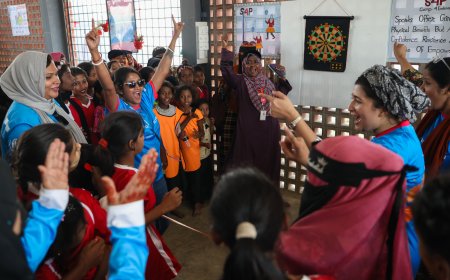
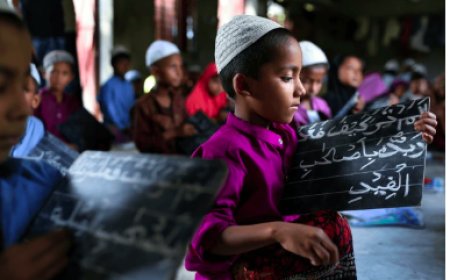
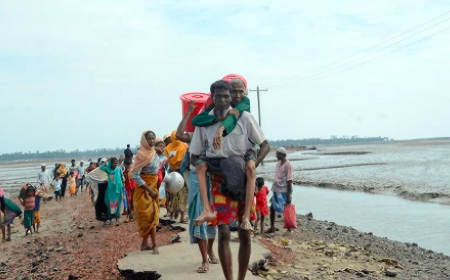
Hundreds of thousands of refugee children are out of school. Children who were meant to celebrate ‘next Eid’ at home were instead crossing bamboo bridges inside the world's largest refugee settlement, as they have every day since 2017.
So what was Yunus's statement, in hindsight?
At best, it was an aspirational line -- an attempt to project momentum while standing next to the UN Secretary-General. At worst, it was something more familiar -- political rhetoric about the Rohingya crisis, emotionally resonant, internationally appealing, and safely detached from any mechanism of accountability.
Yunus carried the weight of a Nobel Peace Prize and a global reputation into that moment. That is exactly why the words mattered -- and why their failure to hold matters more than a typical broken promise would.
But treating Yunus as the source of the problem mislead the deeper pattern of the discourse surrounding the Rohingya refugee crisis in Bangladesh.
This crisis has been reframed and repackaged by Bangladeshi leadership for years, depending on who is speaking and what moment they're speaking into.
Under Sheikh Hasina, the crisis first functioned as a humanitarian badge of honour. If you search ‘Hasina Nobel Prize Rohingya’ in Google, you may find hundreds of articles to appreciate her response to the Rohingya and demand for the nomination for the Nobel Peace Prize and the informal title "Mother of Humanity."
Her language shifted as the years wore on. At the UN General Assembly in 2017, she called the crisis a “heavy heart” situation and offered a five-point plan built around “sustainable repatriation."
Two years later, at the 74th Assembly, the framing had hardened, she described the Rohingya as a burden Bangladesh carried for a crisis “of Myanmar's own making.”
There was no sustainable repatriation. There was no permanent solution. What endured instead was the narrative infrastructure -- a set of phrases that could be redeployed depending on the political need of the moment.
Yunus didn't break from that tradition. He extended it, with more global polish and a bigger stage.
Delivered Discourse, Not Solution
The uncomfortable truth, nine years in, is that the Rohingya crisis has become a space where words move faster than policy. Promises carry no real cost when they fail.
Deadlines pass without consequence, and each new political actor -- interim government, elected government, whoever holds the office next -- inherits the same script: raise hope, engage the international community, gesture at structural realities, and let time do the rest.
Meanwhile, the facts on the ground move the other way. Border crossings continue. Humanitarian agencies, including the World Food Programme, have had to cut already-thin food assistance due to a shortage of donor funding.
The idea of ‘going home’ hasn't just been delayed -- it has become increasingly abstract, complicated further by the reality that Myanmar's military is no longer the only obstacle.
Armed groups like the Arakan Army now control large parts of the Rohingya's home territory in Rakhine State, adding a second layer of uncertainty on top of the political one.
The rhetoric, though, keeps going. The Rohingya crisis is not simply being mismanaged, but rather it is being normalized as a genre of political speech in Bangladesh.
It shows up reliably in conferences, summits, and anniversary remarks, but far less reliably in sustained policy. It generates sympathy and symbolic capital without requiring the harder, slower work of structural change.
What the New Government Should Keep In Mind
Bangladesh's new BNP-led government took office in February 2026 after a landslide win and now holds the file. In their election manifesto, they said about the “safe and gradual repatriation” of Rohingya and wish to treat the issue as both a humanitarian obligation and a foreign-policy challenge.
That framing is not new, and framing alone will not move a single family back across the border.
The government took power promising to fix the economic turmoil, restore law and order, and deliver the institutional reforms that drove the 2024 uprising in the first place.
The Rohingya file competes with all of that for attention -- but it cannot simply be folded into ‘everyday governance’ and left to the same cycle of statements.
Without sustained diplomatic pressure on Myanmar, real coordination with regional powers, and a funding strategy that doesn't collapse whenever global attention shifts elsewhere, “safe and gradual repatriation” will read like a political phrase like before, not a plan.
Because at nine years, the problem in Cox's Bazar is no longer a lack of awareness. The world knows the numbers, the conditions, the funding gaps, and the out-of-school children. The problem is the absence of consequence for anyone who promises movement and delivers none.
Until political actors -- Bangladeshi and international -- are held to the promises they make on the Rohingya crisis, “next Eid” will keep functioning as a moving discourse. A new ‘phrase’ will return every year, and is emptied of meaning a little further each time.
Nine years ago, the Rohingya crossed into Bangladesh expecting to stay for a season. They are still there. The speeches have changed hands three times, but the camps have not moved.
Ahamed Jobayer is a postgraduate in International Relations from South Asian University, New Delhi.