































![A Ledger of the Soul: Navigating the Allah-Bhagavant Nexus in a 19th-Century Puruṣākāra Jñāna Caupara [Gyan Chauper]](https://counterpointbd.com/uploads/images/202608/image_430x256_6a93baa3b09a7.jpg)




















When History Depends on Who Feels Like Including It
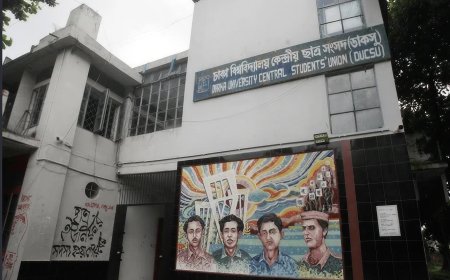
The controversy over DUCSU’s refurbished museum is not really about whether Jinnah belongs on the wall. It is about something more consequential: Who gets to decide which parts of Bangladesh’s political past remain visible.

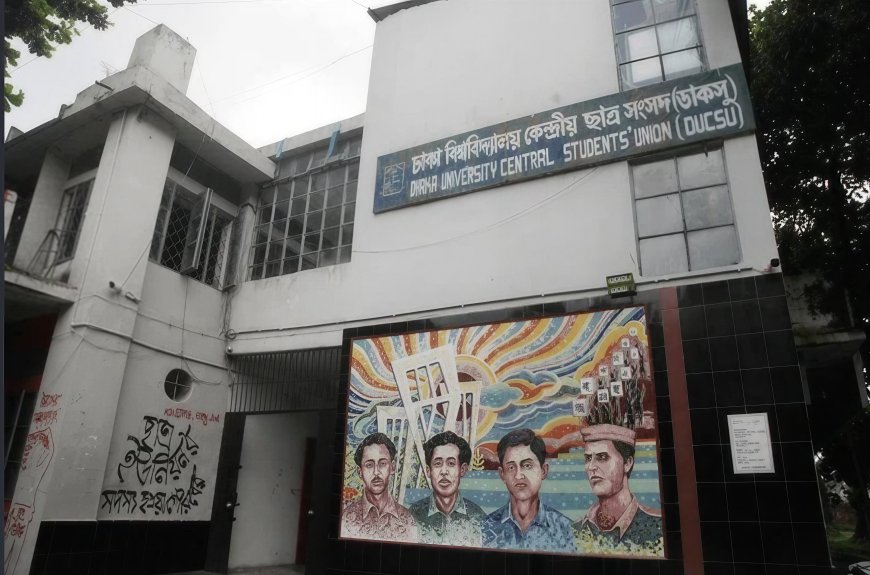
Is the DUCSU museum a museum of history, or a photo album arranged according to political preference?
In the newly refurbished collection, Muhammad Ali Jinnah is visible, while almost every major chapter of Sheikh Mujibur Rahman’s political life between 1947 and 1971 has effectively disappeared.
I am not arguing that Jinnah’s photographs should be removed. Jinnah unquestionably belongs in a historical museum. The 1948 photograph of him at Dhaka’s Racecourse, where he declared that Urdu alone would be the state language of Pakistan, should be there too.
A museum of history should show both those who shaped resistance and the faces of the state power against which that resistance emerged. Jinnah’s presence, therefore, is not the problem.
The problem is who is made visible in which chapter, who is deliberately made invisible, and what story that pattern of inclusion and exclusion asks the visitor to believe. That is why the new DUCSU museum looks less like an exercise in preserving history and more like an exercise in politically editing it.
According to a report by bdnews24.com, the section covering 1947 to 1971 contains no significant image of Sheikh Mujibur Rahman associated with the Six Point Program, the Agartala Conspiracy Case, the 1969 Mass Upsurge, the 1970 election or the March 7 speech.
Yet the section covering 1972 to 1975 includes newspaper cuttings featuring Mujib, a headline about the absence of an opposition party, images of the 1974 famine, and a photograph from the weddings of his two sons.
In other words, Mujib has not been erased completely. He has been selectively retained at precisely the point in his political life where it is easiest to construct a case against him.
This is a question of historiography. Historical narratives are produced not only by what is displayed, but also by what is omitted, from which period it is omitted, and what causal story that omission encourages a viewer to construct. One does not have to ban a historical figure altogether to distort the record.
It is enough to preserve the chapters that support a predetermined verdict while removing those that complicate it. The most revealing explanation came from DUCSU’s Liberation War and Mass Movements Affairs Secretary, Fatima Tasnim Juma.
Asked why Mujib was absent from the 1947 to 1971 section, she replied: “I did not feel like it, so I did not include him.” It is a short sentence, but an extraordinary case study in the politics of historical curation.
A university museum is not someone’s private drawing room, where a photograph goes up today because one likes it and comes down tomorrow because one no longer feels like seeing it.
Personal inclination is not a method of historical inquiry. Historical curation requires sources, chronology, context, significance and proportionality.
Once a curator’s political preference determines which events are visible, the exercise ceases to be neutral curation and becomes a politics of selection.
That distinction matters here because the question is not simply whether Mujib appears somewhere in the museum. The question is which Mujib appears. The controversial Mujib of 1972 to 1975 is visible.
The Mujib of the Six Point Program is not. The Mujib of the Agartala case is not. The Mujib connected to the 1969 Mass Upsurge is not. The leader whose party won the 1970 election is not. The speaker of March 7 is not.
The result is almost prosecutorial. The biography has not been removed.
The prosecution file has been retained while much of the defence evidence has disappeared. If the defence is that the museum is displaying events rather than individuals, then that principle has to be applied consistently.
If Jinnah’s 1948 language declaration is an event, why is the Six Point Program not an event? Why is the Agartala case not an event? Why is the 1969 Mass Upsurge not an event? Why is the 1970 election not an event? Why is March 7 not an event?
Or has the definition of a historical event quietly become this: An episode in which Mujib can be criticized counts as history, while an episode in which his political importance must be acknowledged counts as personality worship?
Mujib’s political centrality between 1966 and 1971 is not a matter of contemporary party loyalty. It is documented history.
The Six Point Program placed extensive autonomy for East Pakistan at the centre of political mobilisation.
The Ayub regime treated the programme as a serious challenge, arrested Mujib, and later made him the principal accused in the Agartala Conspiracy Case.
Banglapedia records that the case generated widespread agitation and culminated in the Mass Upsurge of 1969, forcing the government to release him unconditionally on February 22, 1969.
Here Dhaka University’s own history becomes especially important. Banglapedia’s account of the 1969 Mass Upsurge notes that the Eleven Point Program incorporated the Awami League’s Six Points, that the demand for Mujib’s release and withdrawal of the Agartala case became a major priority, and that DUCSU and other student leaders played a significant role in the uprising.
After Mujib’s release, the All Parties Students Action Committee organised a mass reception at the Racecourse on February 23, where Tofael Ahmed, on behalf of the committee, bestowed on him the title “Bangabandhu.”
So when DUCSU makes Mujib disappear from its visual account of 1969, it is not merely editing the biography of a politician.
It is also severing an important relationship in the history of its own student movement. It is rather like cutting a grandfather out of the family photograph and then insisting that the family history remains intact because everyone else is still in the frame.
The same problem becomes even harder to defend in relation to the 1970 election. Under Mujib’s leadership, the Awami League won 160 of East Pakistan’s 162 directly elected National Assembly seats and, with the seven reserved women’s seats, held 167 of the 169 seats allocated to East Pakistan.
Banglapedia describes the result as an overwhelming mandate for the Six Point Program. The Awami League consequently emerged as the majority party in Pakistan’s National Assembly.
How, then, does one exhibit the 1970 election while making the leader of its majority party disappear? Is this history, or a magician’s sleight of hand?
The votes remain. The result remains. The constitutional crisis remains.
Only the political actor around whom much of the meaning of that result was organised has vanished. That is not archival preservation. It is ideological editing.
The treatment of March 7 makes the contradiction sharper still. UNESCO has placed The Historic 7th March Speech of Bangabandhu Sheikh Mujibur Rahman on its Memory of the World International Register.
UNESCO describes the speech as a documentary record of the political crisis that followed the refusal to transfer power after the Awami League’s majority in the 1970 election, and of the struggle that led to Bangladesh’s independence.
No one is required to admire Sheikh Mujibur Rahman. But when a university museum presents the political history of 1971 while consciously marginalising the principal speaker at an internationally recognised historical moment, the issue can no longer be dismissed as resistance to a personality cult. It becomes a question of historical proportionality.
Keep Jinnah’s photographs. But keep them with history attached. Display the 1948 Racecourse photograph and explain why his language policy generated such fierce resistance in East Bengal.
Trace the genealogy of the Language Movement. Show the relationship between the centralizing tendencies of the Pakistani state and the growth of Bengali political discontent. Do not turn Jinnah into a cartoon villain, but do not turn him into a decorative ancestor either.
The same standard should apply to Mujib. Show Mujib’s authoritarian regime from 1972 to 1975 as critically as the historical record demands, but show his central role in the political mobilization that led to Bangladesh’s independence with the same historical honesty. Those truths do not cancel each other.
A society unable to hold both at once is not studying history. It is choosing a camp. To recognize Jinnah’s historical agency while deleting Mujib’s agency from the same narrative is not neutral curation. It is closer to film editing, except the object being edited is a nation’s political memory.
There is a larger problem here than Jinnah versus Mujib. Bangladesh has a persistent political habit of rearranging the furniture of national history whenever power changes hands.
One government elevates a leader almost to the level of political sanctity. Its successor removes him from the wall. A third political force arrives and constructs a new genealogy of its own.
Eventually the archive ceases to function as an archive. Institutional memory becomes the drawing room of the latest victor. There is also a striking historical irony in any attempt to turn Jamaat, Jinnah and contemporary Islamist politics into one uncomplicated ideological family tree.
Historian Ali Usman Qasmi makes that conflict explicit in his Cambridge University Press chapter: “Differentiating between Pakistan and Napak istan: Maulana Abul Ala Maududi’s Critique of the Muslim League and Muhammad Ali Jinnah.”
Qasmi shows that Maududi’s political thought was sharply critical of the Muslim League and of the ideological content of its claim to represent Indian Muslims.
Political scientist Seyyed Vali Reza Nasr makes the tension clearer in The Vanguard of the Islamic Revolution: The Jama’at i Islami of Pakistan.
Nasr records that Maududi regarded the Muslim League as essentially a “one man show,” kept his distance from it, and that Jamaat did not support the League in the crucial 1945 election.
Yet it would also be too simple to describe Maududi as merely opposed to Pakistan. His disagreement concerned what kind of state Pakistan should become and the ideological foundations on which it should be built.
After Pakistan was created, Jamaat pursued its Islamic political programme within the new state. That history makes any simple contemporary family tree rather awkward.
If political actors claiming Maududi’s intellectual inheritance now present Jinnah as an uncomplicated historical ancestor, one is entitled to ask whether this is ideological continuity or a recasting of the past for present needs.
Before adopting a new grandfather, it may be worth reading the old family litigation.
My central objection, however, is not to Jamaat, Shibir, the Awami League, or any single political party. It is to the political culture in which a change of power is followed by a change of history on the wall.
That is why the phrase “I did not feel like it” matters so much. Was August 5, 2024 a retroactive time machine? Did the fall of Sheikh Hasina alter the result of the 1970 election? Did the Six Point documents change? Did the records of the Agartala case disappear? Was the chronology of the 1969 student movement rewritten? Did UNESCO remove the March 7 speech from the Memory of the World Register? No.
The past did not change. Political power did. That is the distinction that matters. Politics can control institutions in the present. It cannot legitimately exercise a retroactive veto over evidence.
The responsibility of an institution such as DUCSU is therefore greater, not smaller. Dhaka University was itself an actor in the Language Movement, the 1969 Mass Upsurge, the politics of 1971, and later democratic movements.
Its museum is not simply displaying somebody else’s history. It is displaying its own. In that setting, “I did not feel like it” is not an adequate curatorial explanation.
If a university arranges history according to preference rather than evidence, what intellectual standard can it reasonably demand from ordinary political activists?
Do not remove Jinnah. Do not reduce Mujib to selected fragments either. Put both in context.
Include Bhashani, Suhrawardy, Tajuddin Ahmad, M A G Osmani, Ziaur Rahman, student leaders, Language Movement martyrs, freedom fighters, dissenting voices, military rule and democratic movements.
Where praise is warranted, give it. Where indictment is warranted, document it. And if the strongest curatorial principle of a university museum really is “I did not feel like it, so I did not include him,”
perhaps a small plaque should be placed at the entrance: “DUCSU Museum: History displayed here may change according to mood rather than evidence.”
Dr. Lubna Ferdowsi is an academic and researcher based in England.