




































![A Ledger of the Soul: Navigating the Allah-Bhagavant Nexus in a 19th-Century Puruṣākāra Jñāna Caupara [Gyan Chauper]](https://counterpointbd.com/uploads/images/202608/image_430x256_6a93baa3b09a7.jpg)



















The Developed World Created the Climate Crisis. They Need to Pay to Fix It.
There is no room to view this incident as merely an isolated natural disaster. It is essentially a reflection of the utter failure of global climate politics and an unequal global structure.

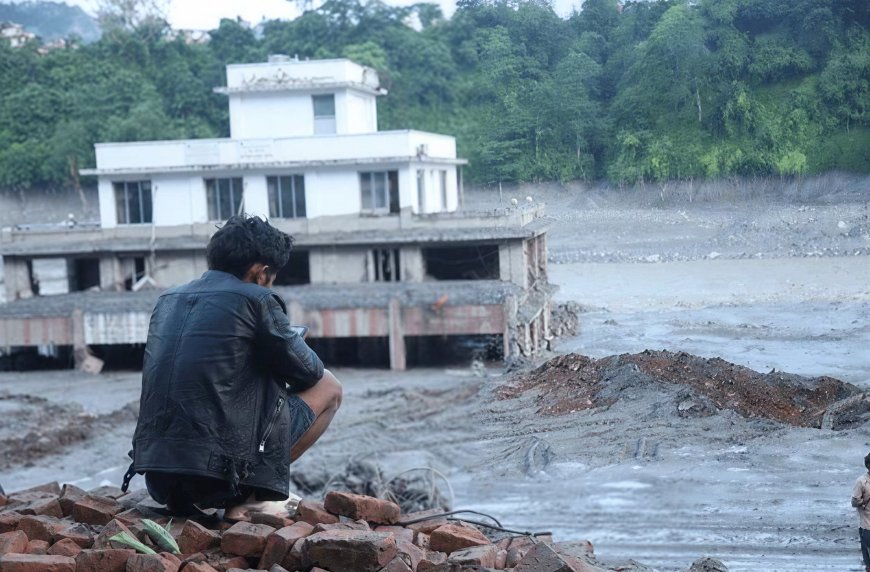
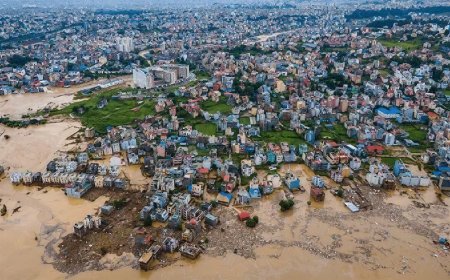
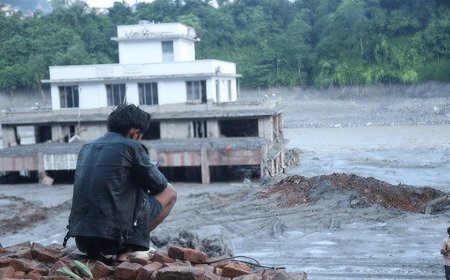
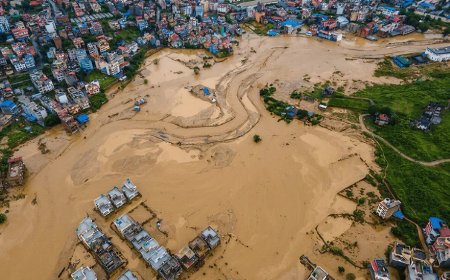
Zero point one percent. Nepal's contribution to global greenhouse gas emissions is even less than this. Yet after a glacier collapsed in Langtang National Park on August 26, the mixture of mud, stone and ice surged down the Trishuli River for about a hundred kilometers.
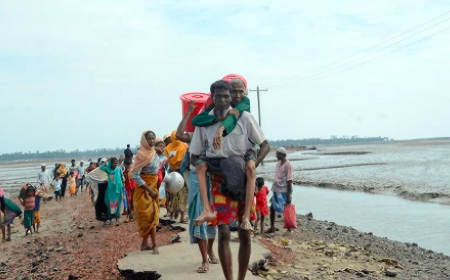
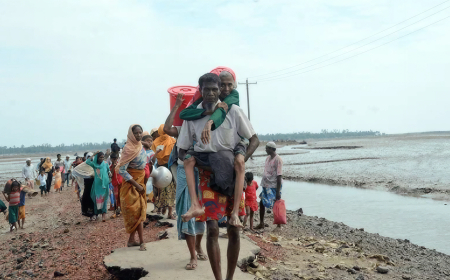
It washed away the Rasuwa and Nuwakot districts, leaving behind a financial toll of nearly five billion dollars. About 1,300 people died and several thousand more remain missing. The country that did not create this terrifying crisis of global warming is now paying the heaviest price.
There is no room to view this incident as merely an isolated natural disaster. It is essentially a reflection of the utter failure of global climate politics and an unequal global structure.
Satellite image analysis reveals that from January to August of this year, the Langtang Lirung glacier was shifting at an average of ten millimeters per month. But weeks before the collapse, this pace suddenly increased abnormally. Permafrost in mountainous regions has begun to melt due to climate change.
The melting of this ice layer multiplies the risk of glacial collapse. The Melamchi River flood in 2021 and the glacial lake outburst in the same area in 2025 had been giving the Himalayan region of Nepal the exact same warning for years. The question is therefore not why it happened but what happens next.
Right here, the gap between the promises made by the developed world and harsh reality is most nakedly exposed.
Nepal has formally applied to the UN's Loss and Damage Fund for the first time. Policymakers of the country hope that the board will provide them with grants as compensation rather than loans. Their immense loss and extreme future risks due to climate change are already well established.
But digging into the internal calculations of this fund reveals a picture that is quite literally a grand deception. The total size of the entire fund currently stands at around 350 million dollars.
Initially, it was 250 million dollars and later another 100 million was added under international pressure. Yet in the first round alone, nearly 180 project proposals have been submitted from different parts of the world. Their combined financial demand has already crossed 2.8 billion dollars.
According to the rules, a country can receive a maximum of 20 million dollars. A simple calculation shows that against Nepal's five-billion-dollar loss, their potential receipt is zero point one to a maximum of 0.4%. The Asian Development Bank did provide an immediate grant of five million dollars, but standing amid the ruins, it is nothing more than a merely symbolic amount.
The problem is not limited to the inadequacy of the monetary amount as there is also an issue with the extremely slow pace of the process. The fund started accepting applications last December and closed in June. The July board meeting pushed the final decision on their first financing to this coming December.
That means there is a massive gap of nearly a year from the opening of the fund's doors to the money reaching the hands of an affected country. Nepal's devastating flood occurred exactly in that empty space between July and December.
Climate disasters will not strike according to the schedule of the Loss and Damage Fund board meetings. But our international financing system remains stuck in that old, slow and bureaucratic project approval mold.
From here emerges the much-discussed debate of loan versus grant, which is essentially the moral centerpiece of this entire climate discussion. If a poor country already burdened by foreign debt is forced to rebuild itself with borrowed money, its revenue deficit will deepen further and sovereign economic risk will increase.
Yet the high-emitting countries and multinational corporations that created this crisis by burning fossil fuels for years are again emerging as lenders through international financial institutions and reaping profits from interest. Climate finance can never be a conditional loan but must be entirely grant-based.
This is not cooperation from the developed world but rightful compensation for historical emissions and centuries of ongoing injustice.
Many criticize the tendency to broadly label every natural disaster directly as the sole consequence of climate change as a hasty move. Drawing the line between how much global climate change is responsible and how much local geological structure is involved behind a specific geographical event is not always scientifically easy.
If these cautions are ignored, the discussion will sound one-sided and indirectly hand arguments over to the opposition. But even accepting that scientific caution, the foundation of the main argument does not weaken. No matter where the share of responsibility lies, the risk of damage is always distributed completely unequally.
We see the same picture looking at Bangladesh. Bangladesh is also a low-emitting yet highly vulnerable country on the same list. Our coastline is constantly eroding, the sea level is rising at almost twice the global average, islands and shoals are vanishing into the sea, while saltwater intrusion makes the surviving arable land barren and forces millions to leave their home.
When our turn for ultimate destruction comes in a major disaster, we too will have to face the exact same slow-paced fund, the same unequal sharing of 350 million, and the same loan versus grant debate.
The path to resolving this crisis is crystal clear, with a deficit existing only in goodwill.
First, climate finance must be entirely converted into a grant-based model.
Second, we must step out of this deception called the Loss and Damage Fund and immediately empower it with adequate capital.At the same time, an automated process must be created to respond quickly in emergency situations.
Third, a significant portion of the foreign debt of climate-vulnerable countries needs to be waived immediately so they can create fiscal space in their own budgets for disaster management.
AL Sharia is an environmental writer, organizer, and columnist.