


































![A Ledger of the Soul: Navigating the Allah-Bhagavant Nexus in a 19th-Century Puruṣākāra Jñāna Caupara [Gyan Chauper]](https://counterpointbd.com/uploads/images/202608/image_430x256_6a93baa3b09a7.jpg)




















The Art of War
As Hasina professes a desire to return to Dhaka, then both governments should commit to taking steps to allow her to do so. Not as a returning prodigal daughter, but as a fugitive accused and convicted of crimes against humanity.

“If you know the enemy and know yourself, you need not fear the result of a hundred battles. If you know yourself but not the enemy, for every victory gained you will also suffer a defeat. If you know neither the enemy nor yourself, you will succumb in every battle.”
-- Sun Tzu
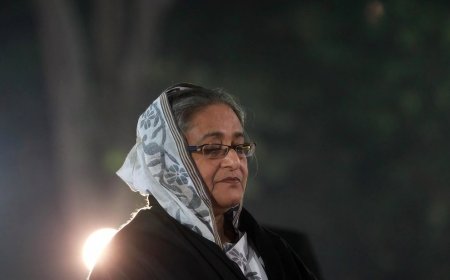
Now that the dust is settling from the August 5 anniversary of Sheikh Hasina’s flight from Bangladesh and her decision to hold a press conference in New Delhi on that same date to announce her “planned return,” it is worth analyzing her motives as well as the reactions from the Indian and Bangladeshi governments.
Less than six months after Bangladesh’s February elections seemingly opened the door for rapprochement between Delhi and Dhaka, the fallout from Hasina’s press conference threatens to derail a hoped for reset in bilateral relations. How did the two sides get to this point, and more importantly, what can be done to get their relationship back on track?
I would imagine that Sheikh Hasina and her inner circle are quite pleased with the results of their press conference. Her announced plans to return to Bangladesh in December grabbed headlines in the region and beyond, distracting attention from the commemoration of the anniversary of her flight from Dhaka.
Despite ongoing criminal proceedings against her and her cronies in Dhaka, the prospect of her eventual return will no doubt keep some of the funds from her well-heeled international supporters flowing as they invest in her party’s longer-term prospects.
At the same time, the specter of Hasina’s return will also prompt those within her party who might have been contemplating a break from her to think twice before sticking their necks out.
Finally, Hasina and her advisors were no doubt worried about the prospects of improved relations between India and Bangladesh’s new government, and what it could mean for her future and hoped to disrupt the positive momentum seen since February.
What is most remarkable is that Hasina was able to accomplish the above simply by promising to do something which she clearly has no intention of doing.
After months of relative quiet, the Indian right wing media ecosystem has now resumed its apocalyptic coverage of events in Bangladesh, inviting back the usual former diplomats and retired generals who will echo Awami League talking points about threats to Indian interests emanating from Dhaka.
Bangladesh is again being portrayed as a breeding ground for extremists, a proxy for Pakistan and China, and a killing field for members of minority communities.
Sheikh Hasina’s words are being taken at face value as talking heads echo her pronouncements.
Indian commentators have taken great offense to a press statement issued by Bangladesh’s Foreign Ministry in the wake of Hasina’s appearance.
In many ways, this hearkens back to the pre-election period, during which Professor Yunus and the interim government were India’s public enemy number one.
There has been a great deal of discussion about whether the Indian authorities should have allowed Hasina’s press conference to take place.
In their defense, Modi government spokespersons have highlighted freedom of the press and noted that they played no role in organizing a private event.
While this may be true, it only tells part of the story. What the official line obscures is the reality that the Indian authorities most certainly could have prevented Hasina from participating in the press event.
Either by reminding her of the conditions attached to her asylum and threatening to withdraw her protections and privileges or through technical means, the India authorities could have silenced Hasina.
They certainly understood the likely outcome of allowing her to speak, having been explicitly warned by Bangladeshi officials in the days prior to her appearance.
The question, then, is why India allowed Hasina to sabotage efforts to reset New Delhi’s relationship with Dhaka -- something that Indian authorities had been working towards for many months?
I do not pretend to have access to Indian decision making, so can only speculate. While one possibility is simple incompetence, I would prefer to give the Indian state the benefit of the doubt and assume that what took place was the result of deliberate action.
My best guess is that at least some in the Indian establishment thought that allowing Hasina to speak would be a way to put pressure on Dhaka and show that India had other cards to play vis a vis Bangladesh.
It has been widely reported that India had hoped (or even expected) that PM Tarique’s first international trip after assuming office would be to New Delhi.
As such, his decision to travel to Malaysia and China likely provoked both dismay and a bit of pique within India.
If the decision to allow Hasina’s press appearance to go forward was intend as muscle flexing by India, then this has spectacularly backfired as it failed to consider the delicate political situation that PM Tarique and his party face.
While it is true that the Bangladesh Nationalist Party gained a strong mandate through its election victory in February, less than six months later PM Tarique is still consolidating his position.
The unexpected economic shocks caused by the US war with Iran and disruption of energy supplies has reduced the new BNP government’s freedom of maneuver and has forced it to be much more responsive to public opinion.
Allowing Hasina to speak at the very moment when emotions in Dhaka were most raw with the anniversary commemorations understandably placed the BNP government in a corner.
The strong reaction from the Foreign Ministry and other officials was as predictable as it was popular across the Bangladeshi political spectrum.
In this context, the idea that PM Tarique would now be able to accept India’s invitation to attend the upcoming BRICS summit in New Delhi becomes much more unlikely.
So, assuming that Bangladesh and India’s long-term interests still require a diplomatic rapprochement, where do they go from here?
With the BRICS summit likely off the table, diplomats from both sides should turn their focus to the United Nations General Assembly meeting in New York in late September.
Famously, PM Modi snubbed then Chief Advisor Yunus by refusing to meet with him on the margins of UNGA, citing scheduling issues. India should not repeat this mistake.
Instead, New York offers a prime opportunity for PM Modi and PM Tarique to meet face to face as equals in a neutral setting.
The issues between India and Bangladesh are too complicated to resolve in a sideline meeting. This high-level engagement, however, can signal both sides' commitment to resuming efforts to reset their relationship considering Bangladesh’s new reality.
As for Hasina, it is important for both Bangladesh and India to call her bluff and stop allowing her to dictate the terms of their future engagement.
As Hasina professes a desire to return to Dhaka, then both governments should commit to taking steps to allow her to do so. Not as a returning prodigal daughter, but as a fugitive accused and convicted of crimes against humanity. The same goes for her cohorts who accompanied her to India.
Bangladesh could send a military transport to collect all of them to return to Dhaka to face justice for their crimes. Whether (or more likely not) they return, this joint commitment by Dhaka and Delhi to treat Hasina and her cronies as fugitives will not only open the door both to a better relationship between the two countries -- but, more importantly -- allow healing and ultimately reconciliation to take place in Bangladesh.
Jon F. Danilowicz is a retired American diplomat of the Department of State.