







































































The Ganges Treaty and the End of Discretionary Diplomacy
Turning water into a nationalist symbol may mobilize sentiment, but it has never produced water -- and it has often delayed the reordering of ties that scarcity now makes unavoidable.

In 2026, Bangladesh and India find themselves at a hydrological inflection point where inherited modes of managing water relations can no longer navigate emerging constraints.
Bangladesh is increasingly behaving as a sovereign equal, something that is long overdue, while India is adjusting, unevenly, to the erosion of discretionary influence that once shaped the relationship.
This long-postponed normalization has not arrived fully formed, but it is no longer completely avoidable. Water sharing is where this unfinished transition now becomes impossible to defer.
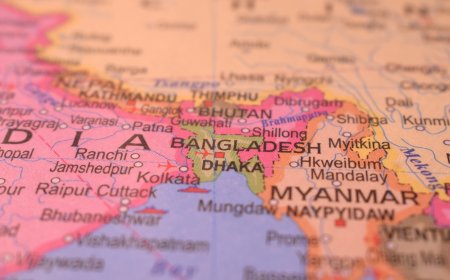
As the 1996 Ganges Water Sharing Treaty approaches its December 2026 expiry, a deadline the incoming administration will face in its first months, water emerges as the first domain where the costs of postponing normalization are material rather than rhetorical.
Unlike diplomacy, water does not respond to reassurance; unlike sentiment, it does not bend to habit. Seasonal scarcity, upstream-downstream asymmetry and mounting environmental pressures are forcing choices that cannot be indefinitely delayed. If a mature state-to-state relationship is to take shape, it will be tested here.
The difficulty with water sharing lies not in the absence of goodwill but in the presence of structure. River flows are governed by hydrology, not intent; negotiations are shaped as much by domestic political constraints as by bilateral understandings.
For Bangladesh, the approaching renewal of the Ganges treaty is often framed as a test of sincerity or friendship. That framing obscures the deeper issue. Water sharing has always been a test of bargaining realism -- of how a relationship that never fully transitioned to a sovereign, state-to-state footing manages scarcity under asymmetry.
Water is uniquely resistant to political abstraction. Unlike trade or transit, it becomes zero-sum at the margin, particularly during the dry season when timing matters as much as volume.
Scarcity sharpens incentives, compresses room for compromise, and exposes the limits of discretionary arrangements.
Even between cooperative neighbours, agreements negotiated in principle have historically proven difficult to sustain once flows decline and competing demands intensify.
This is not a recent complication; it is a structural feature of the basin that earlier modes of management deferred rather than resolved. The limits of unilateral control have also been evident for decades. Large upstream interventions such as the Farakka Barrage were conceived in an era when river management was treated as a largely national undertaking.
Over time, however, these inherited infrastructure choices have generated environmental and political spillover effects that complicate their original logic.
Sedimentation, ecological stress, and recurrent flooding in Indian states such as Bihar underscore a broader reality: Long-standing attempts to manage river systems through unilateral engineering have produced costs that cut across borders and jurisdictions.
This does not negate India’s upstream advantage, but it does demonstrate that discretionary dominance has never translated cleanly into stability -- for India or for Bangladesh.
That complexity is compounded further by geography upstream. Much of the dry-season flow that sustains the Ganges system originates in Nepal, a reminder that the basin has always been inherently multilateral, even when negotiated bilaterally.
Decisions taken downstream or midstream are shaped not only by bilateral choices, but by hydrology and third-party geography that neither side fully controls. The absence of Nepal from formal arrangements has not simplified management; it has merely concealed the basin-wide constraints that existing models failed to address.
For Bangladesh, acknowledging these constraints is not an act of concession but of sovereignty. Dhaka has limited coercive leverage over upstream flows, but restraint in this domain is not the product of weakness. It reflects a strategic choice to move away from discretionary dependence toward institutionalized engagement.
Moral arguments and legal claims may be justified, but they do not automatically translate into negotiated outcomes. Public outrage, however understandable, has historically hardened positions rather than improved them.
In a relationship long shaped by asymmetry, overestimating leverage risks reproducing the very dynamics that this structural shift seeks to escape. Bangladesh’s preference for rules-based approaches must be read in this context.
Its accession to the UNECE Water Convention does not create automatic leverage over upstream neighbours, nor does it substitute for negotiation. It signals, instead, a deliberate posture: one that anchors sovereignty in predictability, transparency, and institutional norms rather than personal understandings or episodic accommodation.
That posture may be slow to yield results, but it reflects a conscious effort to complete a transition that remained unfinished after 1971. This recognition, however, does not imply fatalism. Bangladesh does possess leverage, though it is slow, cumulative, and institutional rather than dramatic.
This leverage lies less in the ability to compel outcomes than in the capacity to shape processes -- to privilege routine, data-driven engagement over episodic bargaining, and predictability over discretion. Long-term cooperation frameworks, joint monitoring, and transparency matter precisely because trust in water negotiations is built incrementally and eroded quickly.
Progress in this domain has rarely been the product of pressure; historically, it has emerged from sustained institutional depth -- something the bilateral relationship has only intermittently pursued. Such depth now necessitates moving beyond a bilateral locus to include Nepal at the institutional level, making shared data the baseline for all hydrological planning.
There are already limited but instructive examples of what similar institutional logic can look like. Recent power-trading arrangements involving India, Nepal, and Bangladesh -- including the export of Nepalese hydropower to Bangladesh through Indian transmission infrastructure -- do not resolve disputes over water sharing.
But they illustrate a model of interaction that treats upstream, midstream, and downstream interests as linkable through incentives rather than discretion.
What is striking is not their novelty, but how closely they resemble the kind of standardized, sovereign cooperation that should have become routine long ago. Such approaches also intersect with India’s longer-term strategic interests.
India’s conduct as an upstream and middle riparian in South Asia inevitably shapes the norms it is seen to uphold.
By demonstrating that upstream advantage can be exercised within predictable, rules-based arrangements with downstream neighbours such as Bangladesh, India strengthens its position when arguing for restraint, transparency, and institutionalized cooperation on rivers it shares with China.
In a region where upstream power carries increasing weight, precedent matters. Norms consolidated closer to home are precisely the ones India will wish to see respected further upstream. The principal risk in the present moment lies in misreading this structural adjustment.
The emergence of a more sovereign, rules-based Bangladesh-India relationship does not eliminate asymmetry, but it does change how that asymmetry is managed. Treating India’s domestic constraints -- particularly those shaped by federal politics and inherited infrastructure -- as bad faith rather than structure risks foreclosing pathways that require time and patience.
Turning water into a nationalist symbol may mobilize sentiment, but it has never produced water -- and it has often delayed the reordering of ties that scarcity now makes unavoidable.
Normalization, then, is not a new ambition but an old one deferred for too long. In domains governed by physical limits, such deferral carries costs. Water does not allow for prolonged reliance on inherited habits or discretionary management.
As scarcity deepens and environmental pressures accumulate, the space for ambiguity narrows, regardless of political comfort on either side. The renewal of the Ganges water-sharing treaty will therefore test not goodwill, but whether both states are prepared to complete a transition that should have begun decades ago.
The deeper risk lies not in disagreement, but in continued misalignment of expectations. Bangladesh has begun to anchor its relationship with India in a rules-based, state-to- state logic long associated with sovereign equality.
If India continues to treat this adjustment as temporary -- a deviation rather than a correction -- the eventual transition risks becoming sharper, more transactional, and less forgiving of ambiguity.
Water offers an opportunity to manage this overdue normalization deliberately rather than by default. Whether that opportunity is taken will reveal how ready the relationship is to become what it was meant to be after 1971.
Nazrul Islam is a policy-focused opinion columnist and entrepreneur with experience across healthcare, ICT, fertilizer, and chemical retail.