What Does Dr. Khalil's Victory Mean for Bangladesh?
At a time when Bangladesh has often found itself on the defensive internationally, this victory offers a welcome opportunity for national confidence and unity.

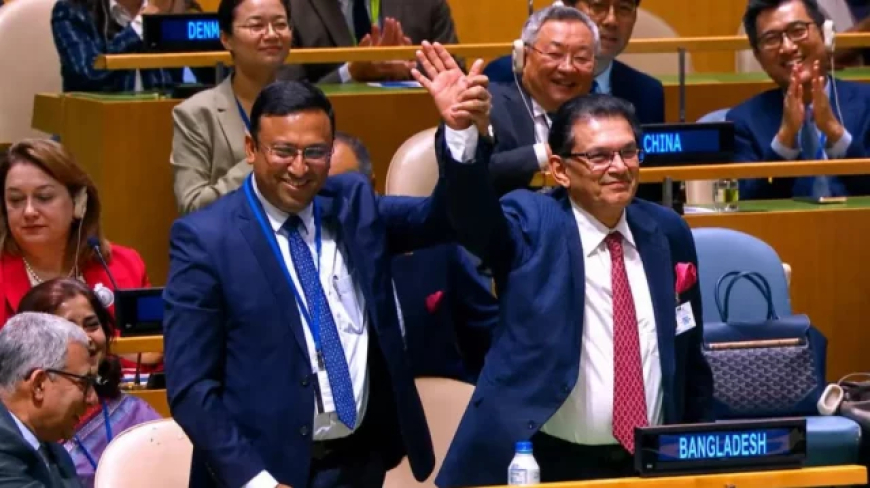
The election of Bangladesh’s Foreign Minister, Dr. Khalilur Rahman, as President of the 81st Session of the United Nations General Assembly (UNGA) represents a significant diplomatic achievement for the country. It comes at a time when Bangladesh has faced sustained political scrutiny, external criticism, and numerous foreign policy challenges.
The decision by Prime Minister Tarique Rahman, within barely one hundred days of assuming office, to nominate his Foreign Minister for such a highly contested international position was both bold and calculated.
The risks were considerable. A defeat would have carried diplomatic consequences and could have been interpreted as a reflection of Bangladesh’s international standing. The victory, therefore, is all the more noteworthy.
Dr. Rahman’s election brings Bangladesh back to a position it last held 40 years ago, when Foreign Minister Humayun Rashid Choudhury was elected President of the 41st Session of the UN General Assembly in 1986. Such opportunities are rare and highly competitive.
What makes the achievement particularly impressive is the short period available for campaigning. Despite limited time to mobilize support, Dr. Rahman secured victory with 99 votes out of 193 member states, defeating Cyprus’ candidate, Ambassador Andreas Kakouris, who received 91 votes. The narrow margin itself illustrates the intensely contested nature of the election.
The presidency of the General Assembly rotates annually among the UN’s regional groups. This year it was the turn of the Asia-Pacific Group to nominate a candidate. The outgoing president is former German Foreign Minister Annalena Baerbock.
While Dr. Rahman’s personal credentials undoubtedly contributed to the outcome, Bangladesh’s own standing in the international community also played a decisive role. His long service within the UN system provided him with extensive professional networks and credibility among member states.
Yet no candidate can succeed solely on personal reputation; the support extended to him was also a vote of confidence in Bangladesh itself.
This aspect deserves particular attention. Over the past two years, Bangladesh has been subjected to relentless criticism and negative narratives in various international forums and media outlets. Our larger neighbour, along with sections of an unusually active media establishment, repeatedly projected Bangladesh through a prism of instability and uncertainty.
Against that backdrop, the election result carries special significance. It demonstrates that such narratives failed to seriously damage Bangladesh’s international image or diminish its diplomatic credibility.
The victory is also a tribute to the professionalism of Bangladesh’s diplomatic missions around the world. Our ambassadors and diplomats undertook an intensive campaign in support of the candidacy, engaging governments and international partners across continents. Their efforts deserve national recognition.
What Does Bangladesh Gain?
The most immediate benefit is enhanced international visibility. Bangladesh has once again attracted positive global attention, reinforcing its image as a constructive and responsible member of the international community.
It would be unrealistic, however, to expect the president of the General Assembly to directly shape major international decisions. The office carries prestige but limited executive authority. Nevertheless, it provides an important platform for agenda-setting, consensus-building, and quiet diplomacy.
In this capacity, Dr. Rahman can help sustain international attention on issues of particular importance to Bangladesh. The Rohingya crisis remains one of the largest humanitarian challenges facing the country, while climate change continues to pose an existential threat to millions of Bangladeshis.
As one of the countries most vulnerable to rising sea levels, extreme weather events, and environmental degradation, Bangladesh has a compelling case to place these concerns higher on the international agenda.
Although the president of the General Assembly cannot dictate outcomes, he can influence discussions, encourage dialogue, and facilitate greater awareness among member states. Sometimes, in diplomacy, visibility itself is a form of influence.
A Presidency During a Turbulent Era
Dr. Rahman assumes this responsibility at a particularly difficult moment in world affairs.
The international system is under strain from multiple crises. Armed conflicts continue in various regions. Geo-political rivalry among major and middle powers is intensifying. Energy insecurity, economic fragmentation, and strategic competition are reshaping global politics.
The wars in Gaza and elsewhere in the Middle East continue to generate profound humanitarian consequences, while the authority of international law is increasingly being challenged.
These developments will inevitably dominate much of the General Assembly’s agenda during his tenure. Presiding over debates involving deeply divided member states will require exceptional diplomatic skill, patience, and balance.
Given the demands of the position, Dr. Rahman has already indicated that he intends to serve as a full-time president. It would therefore be prudent for the government to provide him with the necessary flexibility to devote his full attention to this important international responsibility.
What Does This Mean for Dr. Khalilur Rahman?
For Dr. Rahman personally, the election represents a remarkable milestone in a distinguished career.
Until his appointment by Professor Muhammad Yunus as National Security Adviser and High Representative on Rohingya Issues and Priority Affairs, he was relatively unknown to the broader Bangladeshi public. Within diplomatic and academic circles, however, he was already recognized for his long service within the United Nations system and his extensive international experience.
His subsequent appointment as Foreign Minister surprised many observers and generated considerable debate. Some questioned the choice, while others remained sceptical of his role and influence. Yet over time he has demonstrated competence, professionalism, and an ability to earn the confidence of the country’s political leadership.
One fact is now beyond dispute: He enjoys the trust of Prime Minister Tarique Rahman and has largely justified that confidence through performance and results.
At the age of 72, Dr. Rahman will formally assume the presidency with the opening of the 81st Session of the General Assembly on September 8.
While the office is largely ceremonial and carries no executive authority, it nevertheless occupies a unique place within the international system. The president presides over General Assembly deliberations, facilitates negotiations among member states, and participates in regular consultations with the president of the Security Council. The position also requires engagement with global leaders, international organizations, and conflict-affected regions.
For one year, Dr. Rahman will become one of the most visible international advocates for peace, development, multilateral cooperation, and dialogue.
A Moment of National Pride
At a time when Bangladesh has often found itself on the defensive internationally, this victory offers a welcome opportunity for national confidence and unity.
Credit is due both to Prime Minister Tarique Rahman for making a bold and forward-looking nomination and to Dr. Khalilur Rahman for vindicating that confidence through a hard-fought diplomatic success.
More importantly, the election has elevated Bangladesh’s profile on the world stage at a moment when the country needed a positive story around which its people could rally.
For that reason alone, the achievement deserves recognition as a significant milestone in Bangladesh’s contemporary diplomatic history.
Ashraf Ud Doula is a freedom fighter, a retired Major, former Secretary to the GOB, and served as Bangladesh Ambassador to several countries. He can reached by email at [email protected]