





































































The Nuclear Poison Pill in the US Trade Deal
The recent trade agreement with the US could stop Bangladesh from building any more nuclear power plants.

Bangladesh recently signed an Agreement on Reciprocal Trade (ART) with the United States. Much has been written about this agreement, but one clause has been largely overlooked: The clause dealing with nuclear reactors and fuel rods.
In Article 4.3, Clause 5, we see the following text:
“Bangladesh shall not purchase any nuclear reactors, fuel rods, or enriched uranium from a country that jeopardizes essential US interests except for the procurement of proprietary materials for which there are no alternative suppliers or technologies or materials contracted prior to entry into force of this agreement required for existing reactors.“
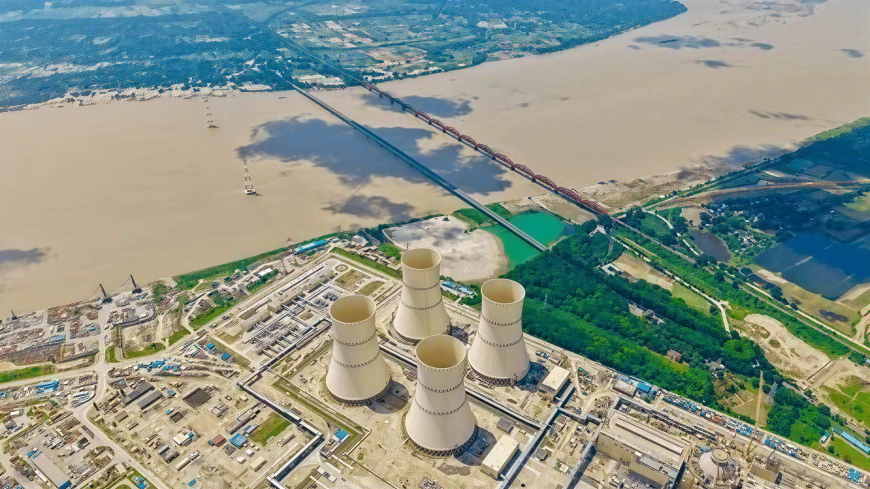
Bangladesh already has one nuclear power plant built by Russia’s state-owned nuclear power company. It is clear that the above clause is intended to stop us from buying any more reactors from Russia or China, the countries which might “jeopardize essential US interests.”
Fortunately, we can still import fuel rods (hollow metal rods filled with uranium oxide pellets) from Russia for our existing reactors. However, if we build any new reactors after having signed the ART, we will not be able to import fuel from Russia or China for those reactors without facing penalties (for violating the ART).
For most countries in the world, used (or “spent”) nuclear fuel is a headache. Fresh nuclear fuel is not very radioactive or dangerous. It contains both uranium-235 and uranium-238.
In a nuclear reactor, uranium-235 atoms in the fuel are bombarded with neutrons, making some of them fission (split into smaller atoms), producing energy.
The fission of uranium atoms produces lighter elements (fission by-products) some of which emit dangerous gamma radiation. So spent nuclear fuel is much more radioactive than fresh nuclear fuel.
In a reactor, some of the uranium-238 atoms in the fuel absorb neutrons and become plutonium, which is radioactive for tens of thousands of years, and can be used to make nuclear weapons.
As spent fuel contains plutonium, storage of spent fuel requires security; agents of a rogue state could theoretically steal the spent fuel, extract plutonium, and make a nuclear weapon.
Fortunately for us, Russia signed an agreement (in 2017) obliging it to take back the spent fuel rods used at Rooppur. This will save us the headache of storing spent fuel as radioactive waste. Russia will reprocess (recycle) the spent fuel rods into new fuel rods.
Spent fuel is removed from the reactor because it has accumulated certain substances (fission by-products) which stop the fission reaction. However, spent fuel rods still contain about 90% of the original uranium, and also some plutonium (which is also valuable as reactor fuel).
In Russia, uranium and plutonium will be extracted from the spent fuel rods, and used to make new nuclear fuel rods. This dramatically reduces the volume of of radioactive material which will have to be stored as waste. Certain fission by-products are dangerous gamma emitters, and still have to be stored as radioactive waste.
However, once the (long-lived) plutonium has been removed, the remaining waste is dangerously radioactive for centuries, not for millenia. After reprocessing spent fuel, the remaining waste contains neither uranium nor plutonium, and cannot be used to make nuclear weapons.
At present, only Russia, China, and France are reprocessing spent nuclear fuel.
The US does not reprocess spent fuel; they are building expensive facilities to keep it in storage for thousands of years. As long as the US does not reprocess spent fuel, they will not agree to take any spent fuel back from Bangladesh; they will not willingly increase their radioactive waste storage headache.
The US obviously wants future nuclear power plants in Bangladesh to be built by American nuclear companies. But if that happens, the spent fuel from those reactors will have to be stored (for thousands of years) in Bangladesh.
Other countries have sparsely populated deserts or mountains where spent nuclear fuel can be stored; Bangladesh does not. Forcing Bangladesh to store spent fuel from future nuclear reactors will ensure that no future nuclear reactors will be built in Bangladesh.
Many will say, why do we need nuclear reactors? Why not replace fossil fuels with solar and wind power?
Unfortunately, solar power and wind power are intermittent. Solar power arrays produce power for no more than 8 hours a day. Industries and cities need continuous power. Solar power can be made continuous by adding batteries, but the cost of batteries makes continuous solar power more expensive than nuclear power.
Utilities in low income countries will not be able to afford massive batteries to back up solar power plants; they will find it more economical to operate fossil fuel power plants at night (and on cloudy days). Investing in solar power means we will be stuck with fossil fuel power for 16 hours every day.
We can’t afford to be stuck with fossil fuel power. Bangladesh needs to replace fossil fuel power with affordable, continuous, non-fossil power; otherwise we will not be able to avoid a climate catastrophe.
With present technology, affordable, continuous, non-fossil power means nuclear power, not solar or wind. That’s why we need nuclear power partners like Russia, who are willing to take back and reprocess spent nuclear fuel.
Kazi Zahin Hasan is a director of Kazi Farms Limited. He has a BA in Economics from Oberlin College, and a master’s degree from Columbia University.