

































































The Doctor on the Motorbike
The image of Aall remains striking precisely because he was an outlier. He did not speak the language of diplomatic balance. He spoke about calories, mortality and responsibility. He insisted that humanitarian action was not morally neutral when people were dying.

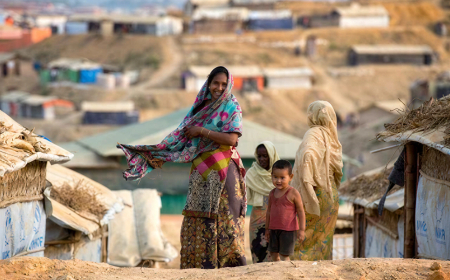
In 1978, when tens of thousands of Rohingya fled violence in northern Arakan and crossed into Bangladesh, an unusual figure appeared in the camps near Cox’s Bazar.
He was not a diplomat, not a politician, and not part of the grand machinery of international conferences. He rode a small motorbike between the camps, slept simply, and spent his days measuring rations, mortality rates and the slow collapse of human bodies.
His name was Dr Cato Aall, a Norwegian food and nutrition specialist working with the UN system. What he documented during those months would become one of the most damning accounts of humanitarian failure in modern refugee history.
Nearly half a century later, his warnings carry an uncomfortable resonance as Rohingya organizations once again align themselves with repatriation agendas that remain politically attractive but structurally dangerous.
Aall was not supposed to become a central figure in the story. He was a technical adviser, one bureaucrat among many. Yet his reports stand out precisely because he refused to behave like one. While officials debated logistics and politics, he focused on a simple fact: people were starving.
The refugees in Bangladesh were receiving around 1,300 calories per day, far below survival needs. Aid was pledged in abundance. Food existed in warehouses. But distribution failures, political calculations and administrative indifference produced what Aall described as an “artificial famine-like situation.” By the end of 1978, around 10,000 refugees, most of them children, had died.
What made Aall remarkable was not only his technical analysis but his clear-eyed description of institutional behaviour.
Before arriving in Bangladesh, Cato Aall was already shaped by decades of refugee work far beyond South Asia. In the 1960s and early 1970s he worked with refugee organisations in southern Africa, including the International Refugee Council of Zambia, where he reportedly rushed to meet new arrivals, helped design settlement projects and sought funding from Norway.
He was also involved in solidarity initiatives linking Norwegian schools with African institutions during the anti-apartheid era, part of a wider movement that treated refugees not as passive recipients of aid but as people caught in political struggles.
This background helps explain why, when he reached the camps of Cox’s Bazar in 1978, he reacted so sharply to policies that reduced survival to an administrative calculation.
According to Aall, officials from major UN agencies dismissed his concerns in language that now reads like an indictment of the entire system. A UNHCR representative reportedly argued that, “after the Second World War we survived on 1,000 calories a day in Germany.
” A WHO representative insisted there was “no serious nutrition problem among the refugees,” warning instead about diarrhoea and other disease outbreaks.
UNICEF’s representative was even more dismissive, telling him: “All talk about calories is bullshit to me.” The World Food Program’s position, he recorded, was simply that “the allocated food is sufficient.” The message was consistent: data was inconvenient, and starvation was negotiable.
One of the most revealing moments came during a refugee-relief coordination meeting in Dhaka on July 12, 1978.
According to Alan Lindquist, then head of the UNHCR sub-office in Cox’s Bazar, Syed Ali Khasru, secretary of the Ministry of Relief and Rehabilitation, ended a discussion about the adequacy of food rations with a blunt statement: “Well, gentlemen, it is all very well to have fat, well-fed refugees.I must be a politician, and we are not going to make the refugees so comfortable that they won’t go back to Burma.”
Lindquist wrote that none of the UN agency heads present objected to the use of food as political leverage.
Aall recorded a similarly explicit exchange, in which a ministry representative asked: “Do you want to create a honeymoon for the refugees? I want them to go home.”
Aall replied that while there was no case for overfeeding refugees, it was indefensible to underfeed them.
The two accounts leave little doubt about the political logic at work -- deprivation was being treated as a means of encouraging return.
One outcome of the meeting, he later wrote, was that he was barred from attending further discussions of that kind.
Aall, who was focused on calorie requirements and mortality data rather than diplomatic messaging, understood immediately what such thinking would mean in practice. When rations fell below the survival level, deaths rose. He watched that relationship play out week after week, documenting it in graphs that bureaucrats preferred not to read.
In the report he later published, Aall included a photograph of a severely malnourished 12-year-old refugee girl. She died only a few days after the picture was taken. His caption carried a restrained but devastating anger -- she “did not survive the discussion about the size of her ration.”
The line reduced the entire relief failure to one child’s fate. While officials argued over calories, she ran out of time.
Aall watched this unfold with growing disbelief. He tried to raise alarms through the system, wrote reports, produced graphs showing the direct relationship between falling food supply and rising mortality, and appealed to senior UN officials. The response was bureaucratic paralysis. His warnings were labelled “difficult,” “unrealistic,” or simply ignored.
The tragedy, as he saw it, was not the absence of resources but the absence of moral clarity. People were dying while institutions remained detached. Aall’s intervention did not earn him greater influence.
The historical importance of Aall’s work lies not only in the deaths he documented but in the political logic he exposed. Repatriation was already being framed as a desirable outcome, and humanitarian conditions became part of the pressure mechanism pushing refugees towards return.
One of the enduring myths of 1978 is that repatriation simply happened. It did not. The Rohingya resisted it for months. They refused to return to the country from which they had fled. Officials attempting to collect refugees were chased from the camps. Government "motivation meetings" were broken up. Police opened fire.
In places such as Kutupalong and Ghundum, the resistance spilled into hunger strikes, confrontations, and open violence. It was the desperate defiance of people who understood that the choice before them was not repatriation or uncertainty, but survival or exposure to the same terror they had fled. Only under escalating starvation and coercion did returns begin to increase.
The line between assistance and outright coercion blurred in ways that would echo through later Rohingya crises.
Aall’s work extends far beyond the history of one failed relief operation. For the humanitarian sector, he represents a warning about what happens when technical evidence is subordinated to political convenience. For host states, his reports show the human cost of using aid and mobility restrictions as instruments of policy. And for the Rohingya themselves, his story offers a different lesson: that historical memory matters.
The cycle of displacement and return has repeated for decades, partly because each phase begins as though the previous one never happened. Aall’s blunt insistence that starvation could be measured, predicted and prevented stands as a reminder that suffering was not inevitable; it was produced by choices.
In early 1979, the crisis finally broke into international view when The Observer published Geoffrey Lean's article under the stark headline "Thousands of children are starving to death." Drawing on material that had circulated among aid workers and officials, much of it shaped by Aall's warnings and data, the report exposed what had until then remained largely hidden from international attention.
Public attention forced movement where private diplomacy had failed. International scrutiny intensified, food deliveries improved, and rations were eventually restored. Mortality rates declined soon after. The change demonstrated what Aall had argued all along -- the disaster was not inevitable, and it could be reversed when political will shifted.
Decades later, I tracked down Geoffrey Lean, who says he has worked as an environmental journalist for 56 years . Alan Lindquist’s account of the relief operation had credited Lean’s Observer article with helping force the crisis into public view, but Lean told me he had never realised the extent to which it had influenced events on the ground.
The report was one assignment among many in a long career. Yet his wife, he recalled, had always believed that the story might matter more than they knew. Looking back, the episode feels almost accidental -- a journalist receives leaked information, writes a piece, and only much later learns that it helped push a stalled system into action.
I also contacted Carlo Aall, the son of Dr. Cato Aall, now an academic in Norway, specialising in sustainable development and climate policy. He remembered his father’s insistence on one thing above all else: calories mattered. Discussions about politics or diplomacy came second to whether people were being adequately fed.
Carlo told me he had little idea at the time how significant his father’s work in Bangladesh had been. For him, those years were simply part of a wider life spent moving between crises. Only when I made contact did he learn that his father’s persistence had helped expose a humanitarian failure many preferred to overlook.
Carlo told me something else that sharpened my understanding of his father’s stance in Bangladesh. Before Cox’s Bazar, Cato Aall had worked during the Nigerian-Biafran war, one of the most defining famine crises of the twentieth century. He had written about relief, nutrition and health problems during that conflict, drawing directly from field experience.
Biafra was a moment when starvation became a global political weapon and humanitarian response was entangled with sovereignty, blockade and propaganda. Carlo said his father rarely dramatised those years, but they marked him.
Cato’s sister, Ingrid Aall, now Professor Emeritus of Art History at California State University, Long Beach, believed the experience had marked him even more profoundly. As Carlo recalled her view, Biafra had affected Cato “for life, on his soul,” making it impossible for him simply to return to Norway and resume the comparatively settled existence of a husband, father and medical doctor.
It suggests that his later movement from one humanitarian crisis to another was not merely a career choice, but in some sense a life from which he could no longer retreat.
The lesson he carried forward was simple and technical, and that is when food falls below survival levels, mortality follows. That was not ideology. It was physiology. By the time he arrived in Bangladesh, he had already seen what happens when nutrition becomes subordinate to politics.
Carlo Aall introduced me to Olav Albert Christophersen, a colleague and friend of Cato Aall who had worked alongside him in southern Africa. Christophersen offered a stark legal framing for what Aall was witnessing in Bangladesh. In his view, the use of food rations as political leverage against a civilian refugee population sat uncomfortably close to principles prohibited under humanitarian law.
Starvation, he argued, was widely recognised as an unacceptable method of coercion, and the deliberate withholding or manipulation of food could not be separated from broader debates about unlawful means of warfare and collective punishment. Seen through that lens, Aall’s increasingly isolated objections were not simply technical disagreements about nutrition but a defence of basic humanitarian norms.
Christophersen also recalled Aall’s practical obsession with solutions rather than rhetoric. Nutrition, calorie thresholds and food composition were not abstract matters to him; they were the difference between survival and death. Aall’s concern with fish protein concentrate and balanced rations reflected the mindset of a field practitioner who believed policy must be anchored in measurable human needs.
Looking back, Christophersen said he was “very strongly impressed” by the extent to which Aall pushed against institutional complacency, describing him as almost alone in combining the integrity and technical knowledge needed to challenge governments and international agencies at a moment when few others were willing to speak plainly.
Today, nearly fifty years later, echoes of that period are hard to ignore.
The Rohingya remain largely confined to camps around Cox’s Bazar. International aid is shrinking. Political actors across Bangladesh increasingly frame repatriation as the only solution.
At the same time, some Rohingya representative organisations have begun issuing statements aligning themselves closely with host-state narratives, congratulating political leaders and signalling readiness to cooperate with repatriation efforts long before questions of citizenship, safety, accountability, restitution and consent are resolved.
This is where the shadow of Dr Cato Aall returns.
His work reminds us that repatriation language can sound humane while masking deeper pressures. Words such as dignity, return, and solutions can coexist with conditions that leave refugees with little real choice. In 1978, humanitarian operations became entangled in political imperatives to show progress. Today, the risk is that history repeats itself under different branding.
The problem is not that Rohingya organisations speak about repatriation. Return to Myanmar remains the aspiration of many refugees themselves. The problem is what gets left unsaid. When organizational statements emphasise cooperation with state agendas but fail to foreground citizenship guarantees, security arrangements, and genuine voluntariness, they risk becoming intermediaries in a process driven more by political optics than refugee rights.
There is a painful irony here. A Norwegian outsider riding a motorbike through muddy camps seems, in retrospect, to have understood the structural dangers more clearly than some of today’s institutional actors. Aall saw how humanitarian systems could drift toward managerial logic, where efficiency and political pragmatism overtook the lived realities of displaced people.
He was also blunt about how easily moral responsibility dissipated inside bureaucracies. Each agency deferred to another. Technical objections were treated as inconveniences. By the time officials acknowledged the scale of the disaster, thousands were dead.
The contemporary moment is obviously different. The scale, geopolitics and actors have changed. But this history has taken on renewed urgency because Bangladesh has just held elections that returned the Bangladesh Nationalist Party (BNP) to power. The irony is difficult to ignore.
During the first major Rohingya influx in 1978, a BNP-led government under Ziaur Rahman oversaw a relief operation in which refugees were starved as pressure for rapid repatriation mounted.
In the early 1990s, under Prime Minister Khaleda Zia, another BNP administration presided over a repatriation drive widely criticised for coercion and abuse.
Today, those episodes are frequently recalled in BNP rhetoric as examples of ‘successful’ repatriation, a framing echoed by party leader and Prime Minister Tarique Rahman.
The party’s return to government therefore sits uneasily alongside the history that figures like Aall tried to document. The BNP remembers 1978 and the 1990s as blueprints for success; Aall’s data shows that the first of those ‘successes’ was built on “artificial famine.”
Yet the underlying dynamics remain familiar -- donor fatigue, pressure for visible progress, and the temptation to present repatriation as movement even when conditions inside Myanmar remain deeply uncertain.
What Aall’s story offers is not a simple historical parallel but a warning about memory itself. Refugee crises are long. Organisations change leadership, generations shift, and political incentives reshape discourse. Over time, hard-earned lessons fade. Institutional amnesia sets in.
For Rohingya organisations navigating survival within restrictive political environments, alignment with host-state priorities may appear pragmatic. But pragmatism without historical memory can be dangerous. The past shows how quickly the language of solutions can become the machinery of pressure.
The image of Aall remains striking precisely because he was an outlier. He did not speak the language of diplomatic balance. He spoke about calories, mortality and responsibility. He insisted that humanitarian action was not morally neutral when people were dying.
His reports ended with a plea that relief systems should include independent voices willing to challenge the consensus when necessary. A watchdog, he said, that could bark and bite when needed.
Nearly half a century on, the Rohingya crisis has become one of the world’s longest-running refugee situations. The temptation to prioritize movement over justice is growing again. In such a moment, remembering the Norwegian doctor on a motorbike is of critical importance.
It is a reminder that humanitarian history is filled with warnings written in advance, often by those who refused to look away.
The question now is whether anyone remembers them.
Shafiur Rahman is a journalist and documentary filmmaker focused on the Rohingya crisis, displacement, and border politics across Bangladesh-Myanmar. He publishes the Rohingya Refugee News newsletter.