

































































Inside Bangladesh's New Youth Culture
This asymmetry raises an uncomfortable question: If globalization is presented as a two-way exchange, why does cultural traffic so often move in one dominant direction?

In recent years, a couple of fashion shows in Dhaka have celebrated "local fashion" through silhouettes borrowed from Paris, Seoul, and Tokyo. Young Bangladeshi hip-hop artists rap over beats originated in the Bronx, New York City.
Dhaka cafes now routinely serve ramen, sushi, and Korean fried chicken as markers of sophistication. Even Dhaka's street food carts now serve momos, pizza, and tacos. This scene is not merely a consumer spectacle; rather, it is a practice of cultural making.
Across Dhaka and other urban hubs, young people are adopting, adapting and contesting foreign food, fashion and lifestyle forms -- a process that scholars describe as cultural globalization and hybridization.
But is it merely a result of globalization or a passive acceptance of foreign culture?
If we dig deeper into this phenomenon, we may ask: whose culture it is and who is practicing it?
Well, the possible answer could be that culture is not a given, but it is what people practice. And in this era of globalization, the youth now have exposure to global culture through the media or the internet.
Although culture is not a static reality, it is more like a flowing river, where foreign influence is quite normal in almost every culture. But what we understand by cultural normalization is not normal at all through the lens of the Italian thinker Antonio Gramsci. He suggests that what we know by "normal cultural practice" or "common sense" may not be the normative aspect of culture.
The question he raised is: "Who do the powerless consent to be dominated by those who are in positions of power?" Through the concept of hegemony.
The term "Bengali" or "Bangladeshi culture" is an emotional part of any Bangladeshi's heart. But we can raise the question: What exactly is Bengali/Bangladeshi culture?
Well, let me help you to find the answer in a witty way.
If we can spot what is foreign culture with certainty, we can easily spot what is left over, and that should be the Bengali culture.
Let me make it easier for you. Imagine you have a list of dishes, and you know which are foreign but not which are local. Now you can easily deduce the regional from the foreign. However, no culture is entirely free from foreign influence. Influence from other cultures is a typical phenomenon, but mimicking is not, as it leads to a fractured identity for individuals.
If we examine the history of the colonial era in Bengal from the mid-18th century to the 20th century, we can observe how we adapted the culture of the British colonizer into our lifestyle, including the constitution, official language, education system, and formal official dress code.
Even up until today, what we understand by formal attire is the attire that the British colonizer used to wear. In any formal environment, we replace our style of salutation by calling Sir or Madam instead of Ustaad or Jonab.
Harvard Professor Homi K. Bhaba notably remarked that the colonized often mimic the colonizers in any colonial rule. The mimic here is not a mere imitation by the colonized, but it is much complex than that. In the process of mimicking, the individual may lose their own personal identity, which may give some sort of inferiority complex and a sense of alienation from their own cultural roots. They may become the "mimic men" who belong to neither the colonizer's world nor fully to their own.
A novel by V.S. Naipaul, The Mimic Men (1967), explores the post-colonial search for authenticity. The protagonist Ranjit Ralph Singh, an exiled Indo-Caribbean politician, is writing his memoirs from London. Singh is an educated yet aimless man of Indian descent who feels like an outsider in both his homeland and England.
Because he struggles to mimic European ways, this leads him to a profound cultural vacuum and self-deception. This novel is known for its psychological depth, where the protagonist feels an intense sense of not belonging anywhere and is trapped between cultures. Although it has a profound colonial legacy, colonialism distorts cultural identity and creates a hollow personal figure.
Let's move forward from the colonial era to the 21st century's cultural hybridity, where we need to follow specific trends, speak in certain manners, use certain jargon, wear clothes in a particular fashion, and watch certain things due to peer pressure in order to be relevant in our peer group.
Think about someone who is not aware of a trendy Netflix series that is about to release next week, or someone who does not know how to eat with chopsticks, or someone who has never heard of a popular Korean dish (e.g. ramen). What impression do you think s/he would create? Certainly not cool, right?
There's a constant peer pressure on the youth to be relevant and cool. We are constantly exposed to the ocean of foreign movies, songs, fashion, and lifestyles. Now we watch movies on foreign OTT platforms that have little relevance to the socio-economic reality of our country.
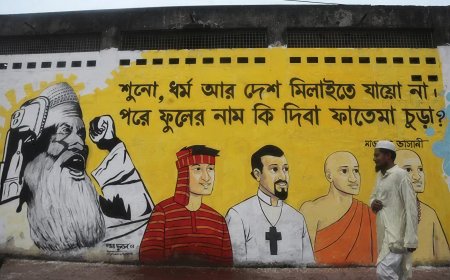
We now start liking foreign cuisines, hip-hop music, using graffiti as a language of protest, and foreign-influenced attire (streetwear, Western dresses, imported sneakers) to an extent where it has become our go-to lifestyle.
In this process of new cultural formation, resisting conformity is perceived as abnormal or outdated. Therefore, from our entertainment choices to our cuisine and lifestyle, everything we do seems pretentious to some people, just to be relevant or cool in the peer group. Sometimes, it appears as trendy or usual; therefore, we follow it.
These shifts in youth practices suggest that cultural change in Bangladesh is not merely a collection of isolated preferences but part of deeper systemic dynamics that align with the lens of Gramsci, who might argue it is not a simple cultural shift; rather, it is just a passive acceptance that he would like to call cultural hegemony (dominance) from a power group.
Gramsci argued that dominant cultures exert power not only through force but by shaping what counts as "common sense" in everyday life, particularly what people take for granted as normal behaviour, taste, and aspiration.
In the Bangladeshi context, the enthusiasm of global fashion aesthetics (from Korean-inspired clothing to beauty products), the rapid interest in Korean and Western entertainment, and the incorporation of foreign food practices into daily routines reflect more than individual choice. It also gives the signal of how global cultural forms have become normalized within youth lifestyle.
An empirical cross-sectional survey of 1,500 students from five universities shows that 54% of respondents identify more as a part of global culture than with indigenous Bangladeshi culture, and it also suggests a measurable sense of affiliation with globalized cultural forms among youth.
Scholarly and media accounts document the emergence of Hallyu ("Korean Cultural Wave") and its influence on Bangladeshi youth fashion, aesthetic values, consumer preferences (food and beauty products), and entertainment tastes. Research also suggests that K-culture adoption is not simply a matter of imitation, but rather a process of glocalization where local and Korean elements combine.
A 2020 attitudinal survey with more than 100 participants shows that ~66% of participants expressed a passionate interest in learning the Korean language, which was directly tied to Hallyu fandom (K-pop/K-drama). It further shows that Korean cultural influence is affecting personal educational choices and identity markers among Bangladeshi youth.
A media report also confirms that K-culture fan communities, namely BD K-Family, organized an event that drew 4,000 participants in Dhaka as an attempt to create a cultural bond between the two nations.
Analytical commentary on K-culture's effects on consumer behaviour in Bangladesh also documents the expansion of market demand for Korean fashion, cosmetics, and food products. So, it illustrates how cultural influence translates into economic cultural consumption patterns.
Media report also suggests that youth preferences for Korean skincare, food (ramen), and visual entertainment have been linked to visible changes in buying patterns and lifestyle choices, primarily through online store platforms and social media trends.
All these statistics serve as an indicator of the Korean cultural influence among the youth. Similarly, the influence of other countries can also be observed among youngsters in the same manner.
This suggests that what appears to be a natural cultural expression may also be influenced by structural forces, such as social media trends, and platform algorithms, which shape youth tastes toward transnational ideals and sensibilities. Such patterns complicate a simple narrative of cultural hybridization by inviting us to ask whether everyday cultural preferences are also embodiments of a new hegemonic order that normalizes global cultural dominance in subtle, taken-for-granted ways.
This is no longer a question of mimicking the colonizers, now it's about giving consent to foreign ideas as common sense or popular attitudes accepted by the ordinary masses. Whoever fails to comply with that sense may be seen as old-fashioned or irrelevant.
If we have to be fair, we must also acknowledge the logic of hybrid identity and glocalization (globalization + localization). In an era of globalization, foreign cultural influence is neither unusual nor inherently destructive, because cultures have always borrowed and evolved through contact with foreign influences.
Bangladeshi youth do not simply copy global trends; they blend the hip-hop with Bangla lyrics, streetwear with local symbols, and foreign cuisines with familiar tastes. This process also reflects agency and creativity rather than blind imitation. Yet the imbalance lies elsewhere.
Cultural exchange today is rarely reciprocal. While Bangladeshi youth actively consume foreign films, music, fashion, and food, there is little evidence of Bangladeshi culture being embraced abroad on a comparable scale. Bangladeshi cinema or music rarely circulates globally as symbols of aspiration or modernity in the way Korean or Western cultures do.
This asymmetry raises an uncomfortable question: If globalization is presented as a two-way exchange, why does cultural traffic so often move in one dominant direction? Hybridization, then, may co-exist with inequality where local creativity flourishes, but global recognition and influence remain unevenly distributed.
Saif Radoun is an academic based at Independent University, Bangladesh.