





















![A Ledger of the Soul: Navigating the Allah-Bhagavant Nexus in a 19th-Century Puruṣākāra Jñāna Caupara [Gyan Chauper]](https://counterpointbd.com/uploads/images/202608/image_430x256_6a93baa3b09a7.jpg)




















The World Hanging on a Bamboo Pole
The distance between Bangladesh and the World Cup cannot be measured in kilometres. It is measured in institutions, accountability, planning, and political will. Perhaps one day, when the World Cup comes around again, one flag on that bamboo pole will sell just a little more than the rest.

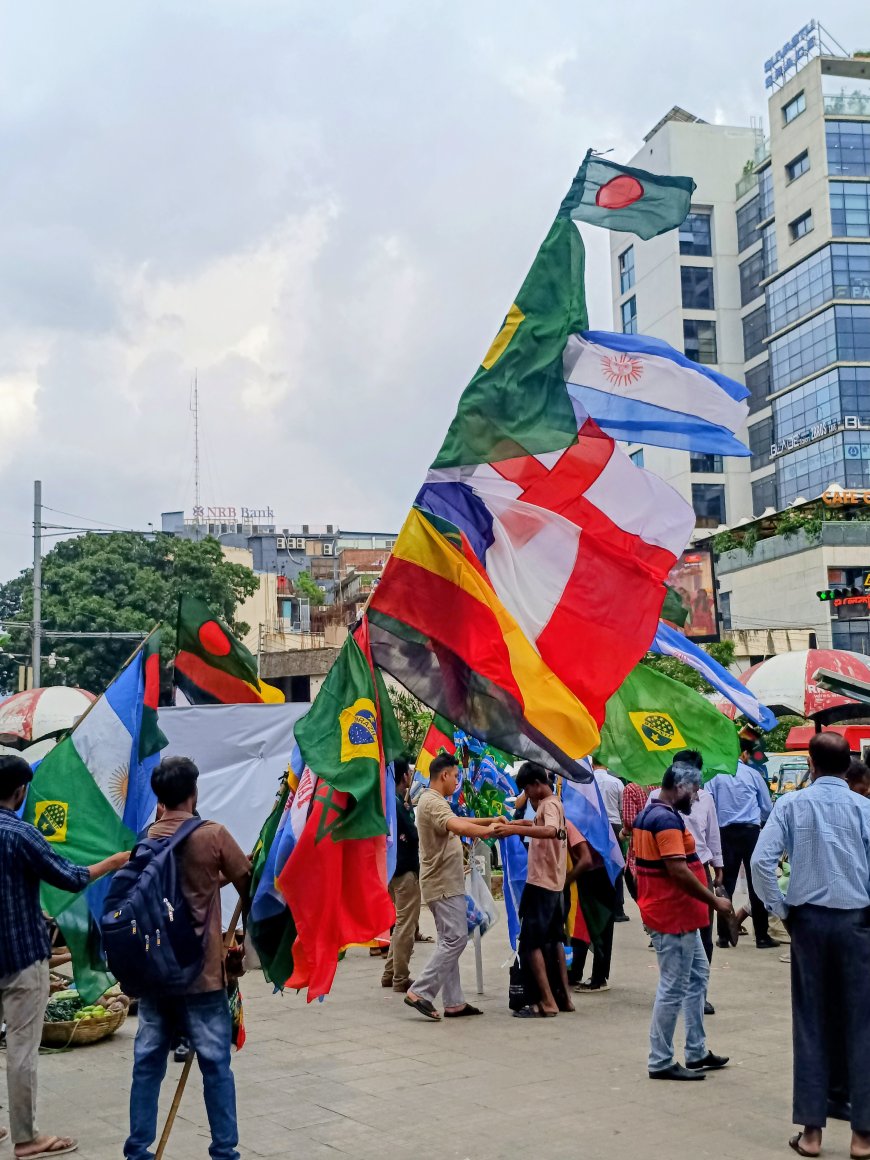
When you climb up to a rooftop these days, flags are fluttering on every roof you can see. Walk down to the street and you will spot a bamboo pole balanced on the shoulder of a weathered man, carrying the identities of a dozen nations across the whole of Dhaka.
Strangers in the jerseys of two different teams pass each other and trade a small smile, the kind that carries an unspoken message: This time, the World Cup is ours. At midnight, when every household light is supposed to be off, they switch back on instead. That is how you know, every four years, the World Cup has returned.
This kind of football fever has gripped Bengalis for a long time. There was a time when supporters of Brazil and Argentina dominated the numbers, but football's globalization has now reached even the rooftops of Bangladesh.
Somewhere you will see Portugal, somewhere France, somewhere Spain, even Saudi Arabia. For a few weeks, the whole country turns into a kind of makeshift United Nations.
This year is no different. A nearly two-thousand-foot-long Brazilian flag was paraded through Matbaria in Rajshahi. A farmer named Amjad Hossain in Magura displayed a seven-and-a-half-kilometre German national flag.
Mintu Mia of Brahmanbaria spent seven lakh taka to put together a five-kilometre South Korean flag. The frenzy is bigger than ever this time, because the tournament has grown from 32 teams to 48.
For Saklayen, who sells flags on the streets of Gulshan, this season feels like Eid. Before December 16 or March 26, he sticks to selling only the Bangladeshi flag.
The moment the World Cup arrives, his bamboo pole fills up with the whole world. Brazil, Argentina, Portugal, Spain, Saudi Arabia, England, all hanging side by side. The small flags go for 20 taka, the medium ones for 100.
The jersey market is just as heated. Brazil and Argentina jerseys are selling the fastest at Gulistan and the Samabay Twin Tower market, while Bashundhara City and Jamuna Future Park stay crowded from morning to night. From fan editions to Thai editions, prices range somewhere between 220 and one and a half thousand taka.
That bamboo pole on Saklayen's shoulder might be the most beautiful symbol of the World Cup. Up there, the rich and the poor, the powerful and the weak, the champions and the ones who have never qualified, all hang at the same height.
A country with nuclear weapons and a country still fighting poverty, a country that has lifted the trophy and a country that has never even reached the tournament, all share the same bamboo. In the real world, a nation's worth gets measured by its economy, its military, its diplomatic weight. On Saklayen's pole, every country costs the same.
I got my first flag in fifth grade, during the 2010 World Cup. I still have it, tucked away as a keepsake. Whenever the World Cup comes around, our house splits into three camps: my father supports whichever team looks like it's about to win, my mother is for Argentina, and I have always been with Brazil.
Like countless families across Bangladesh, football here becomes the most joyful kind of family division there is.
I actually started supporting Brazil out of stubbornness, because everyone around me kept pushing me toward Argentina. That little rebellion eventually turned into real love. That is the beauty of football. Even people on the other side of the world start to feel like your own.
Fathers stay up past midnight, eyes half closed, watching the matches. Plenty of kids fall asleep before the final whistle and wake up sulking, because how else are you supposed to join the conversation with friends at school if you do not even know who won and who lost overnight?
And yet, in the middle of all this celebration, Saklayen carries one regret.
“If only Bangladesh could play in the World Cup!”
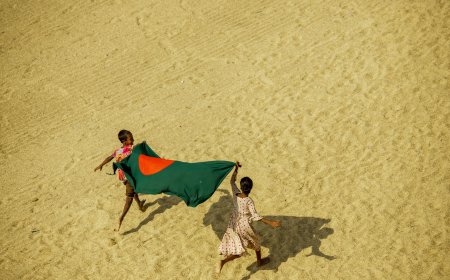
The dream visible in his eyes when he says this is really the dream of a hundred million people. He believes that if Bangladesh ever played in the World Cup, the entire country would turn red and green. Everyone on the streets would wear the national jersey. Offices, shops, tea stalls, Facebook feeds, all of it would belong to one team.
Bangladesh.
And that is where this whole conversation lands on an uncomfortable question: How much do we actually love football, and how much do we love our own football?
Curacao, a tiny island in the Caribbean, is playing in this World Cup. Its population is just one hundred and fifty-six thousand, smaller than a single large police-station area in Dhaka. And yet, there they are.
Bangladesh is not.
At first glance, the comparison feels unfair. For Bangladesh to qualify, it has to get through Asia's toughest qualifying path, up against Japan, South Korea, Australia, Iran, Saudi Arabia. Curacao plays in a region where the road is comparatively easier.
But the question does not go away, because in the end this is not really a story about population. It is a story about institutions.
Curacao did not reach the World Cup on talent alone. They went looking for players in their diaspora, plugged them into a development structure, and stuck to a long-term plan. They understood that modern football is not just played on the pitch anymore. It is played through scouting, administration, development, accountability, and institutions.
Bangladesh has its own diaspora too, in England, Italy, Canada, the United States. And for the first time in a long while, some of that potential finally seems to be turning into something real. Hamza Choudhury's arrival has reshaped what Bangladeshi football allows itself to imagine. Tickets for his debut sold out in the blink of an eye. Shamit Shome from Canada, Fahamedul Islam from Italy, the arrival of these diaspora players has taught people to believe again that the red and green jersey can carry a big dream too. After a long time, the question “when will Bangladesh go to the World Cup?” no longer sounds like a joke.
On the other side, the women's football team has won the SAFF Championship back to back and qualified for the Asian Cup finals. Across the various age groups, Bangladeshi football looks more promising today than it has at any point before.
But optimism and institutions are not the same thing. There have been disputes over salaries and match fees for the women's players. The Bangladesh Football Federation has repeatedly faced questions over financial irregularities and accountability. In a country where even the players who bring home international success cannot be certain about the money owed to them, emotion alone cannot carry a team to the World Cup.
And yet this country is connected to the World Cup, even from outside the field.
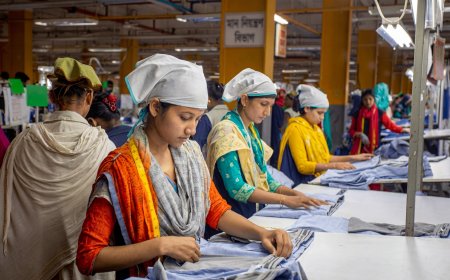
A large share of the jerseys made by the world's biggest sportswear brands, Nike, Adidas, Puma, are stitched together in Bangladeshi garment factories. Which means the players running around on the World Cup pitch may well be wearing clothes made here. Even without a place on the field, Bangladesh has an invisible presence at the tournament.
There is another story too. In 2022, Bangladesh's support for Argentina became such a talking point that Argentine players, coach Lionel Scaloni, and international media all ended up discussing it. A lot of people around the world came to know Bangladesh through football. Riding that wave, Argentina reopened its embassy in Dhaka in 2023 after a forty-five-year gap, a rare example of sports diplomacy at work.
We did not play in the World Cup, but we were part of its story.
Still, the question lingers.
Will we keep investing forever in other countries' dreams, or will we one day build a team the whole nation can stand behind under a flag of its own?
That bamboo pole on Saklayen's shoulder, somewhere on a Gulshan street, might be the most beautiful symbol of the World Cup. Argentina is there. Brazil is there. Saudi Arabia is there. Cape Verde is there. Curacao is there. For a few weeks every four years, every country hangs at the same height.
But once the tournament ends, reality returns.
Some countries play in the World Cup.
Some countries watch it.
Some build players.
Some buy flags.
Some build institutions.
Some borrow dreams.
Bangladesh's problem has never been a lack of passion for football. The problem is that we often devote more energy to celebrating the game than to building it.
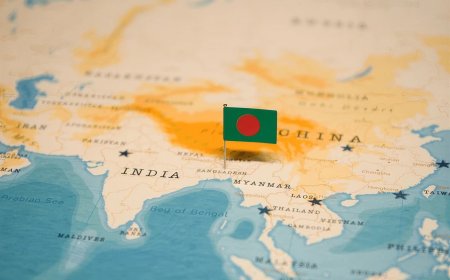
The distance between Bangladesh and the World Cup cannot be measured in kilometres. It is measured in institutions, accountability, planning, and political will.
And perhaps one day, when the World Cup comes around again, one flag on that bamboo pole will sell just a little more than the rest.
The red and green flag.
Nafew Sajed Joy is a Bangladeshi researcher, writer, and environmentalist whose work sits at the intersection of academia, journalism, and social advocacy.