



























































From the Classroom to the Street
Bangladesh has always educated its citizens twice -- once in its institutions and once in its streets. The classroom teaches what the nation wants to be. The street teaches what the nation truly is.

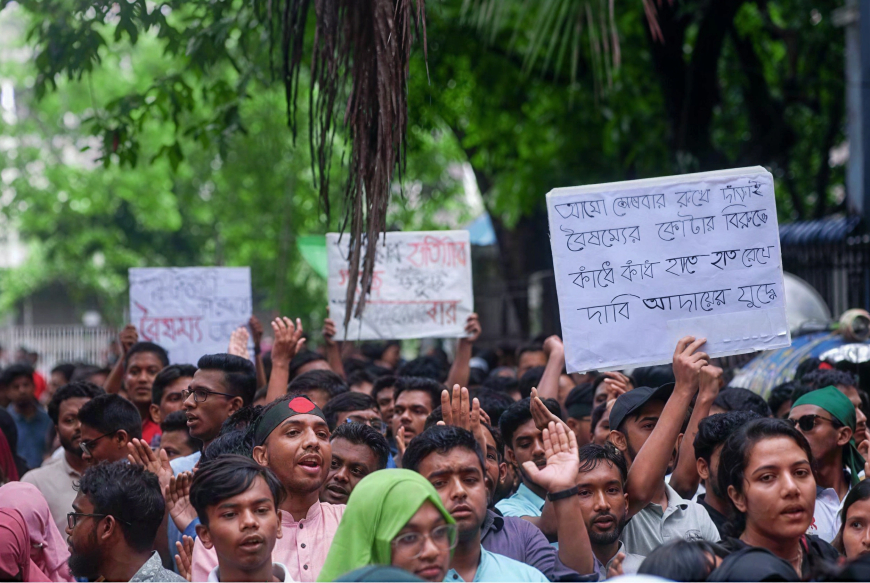
She hadn't planned to be there. Riya was a third-year sociology student at Dhaka University; she had spent the morning preparing for a mid-term examination. By afternoon, she was standing at the intersection of Shahbagh, her textbook in her bag, a homemade placard in her hands that said: “We did not come here to fail your system.
We came to clean it up.” When asked why she left her studies that day, she paused, then said quietly: “Because staying in the classroom started feeling like a lie.” That sentence contains an entire political education.
Beginning in July 2024, tens of thousands of Bangladeshi students took to the streets to demand reform of the quota system for government jobs, which they claimed promoted inherited privilege over meritocracy.
What began as a narrowly focused protest quickly turned into something more: A vote on the future of youth in Bangladesh.
The government's first reaction was dismissal and a crackdown, which only exacerbated the students' determination. Campuses had been turned into command posts, and streets into classrooms, and a generation declared with remarkable clarity that it was done with being managed. This was not though an exception. It was less an aberration than a homecoming.
Bangladesh has never been governed without its students. The whole nation was shaped by the students' struggle.
In February 1952, young men and women defied the law in Section 144 in the streets of Dhaka in order to protect the Bengali language, and a number of them lost their lives.
The bloodshed near Dhaka Medical College that day did not merely preserve a language; it sowed a democratic consciousness, which no other government has ever been able to eradicate.
The most significant uprising of the masses that toppled the Ayub Khan military regime in 1969 was led by students, who turned that anger into a structured opposition. Two years later, in 1971, university campuses became centers of support for the Liberation War.
Then, in 1990, students once again gave the anti-autocracy movement its moral support that ultimately brought the dictatorship of Ershad to an end and reinstated electoral democracy. Each generation inherited the same classrooms and the same streets.
Each generation eventually chose the streets when it was provoked enough. What distinguishes 2024 from these earlier moments is not the spirit -- that has remained remarkably consistent -- but the tools, the velocity, and the self-awareness.
Students of today are aware of their history. They understand that they belong to a long lineage of student activism. And that knowledge renders them more intentional and more determined.
To understand why a student has left a classroom, one needs to know what that classroom has been providing.
According to Meghna Guhathakurta, a researcher and former professor of international relations at Dhaka University, a growing sense of betrayal now runs through Bangladeshi youth -- a gap between the promise of education and the opportunities it actually delivers.
That betrayal, she writes, is not merely economic but existential: These young people did everything right, and the door was still closed. Psychologists call this moral injury -- the injury caused not by danger, but by injustice observed and experienced without any meaningful way to respond.
When students mobilized in 2024, they were not simply protesting a quota policy. They were protesting the burden of a system that had trained them to be fiercely competitive toward a future that was quietly stealing from them behind their backs.
It is not despair that transforms frustration into mobilization, however, but hope -- in particular, the belief that change can be made through collective action.
The students of Bangladesh have a history. They have witnessed the power of collective action firsthand. And that memory serves as fuel.
One of the most significant characteristics of the new wave of youth movements in Bangladesh has been the high-profile, unapologetic presence of young women.
They were not marginal actors -- they were organizers, spokespersons, and very often the ones who found themselves at the front when matters became dangerous. This cannot be without purpose.
A generation of Bangladeshi women has been raised with greater access to education and labor, and has been faced with structural ceilings at every step.
They have seen female garment workers sustain the national economy with little political representation. They have navigated campuses where harassment is routine and accountability is rare. They have confronted the hypocrisy of a nation that loves to showcase women's empowerment on global stages yet will not secure them in their own streets.
Young women had no reservations when the protest space was opened in 2024. The street provided an opportunity to be taken seriously, which many thought was lacking in the institution.
Their involvement was a demand for protection, recognition, and voice, and acknowledgment, layered over the quota complaint like sediment accumulated over decades.
The contribution of social media to contemporary youth mobilization cannot be overlooked in any credible analysis of it. The 2024 movement in Bangladesh was not initiated on the street, but on the screens.
The student complaints, which had long been smoldering, quickly came to a boil thanks to Facebook posts, viral videos, and coordinated hashtag campaigns. The flow of information moved beyond any institution's control. Students organized themselves before any formal leadership had emerged.
This reflects global trends, whether it be the initial enthusiasm of the Arab Spring, the 2019 student protests in Chile, the leaderless opposition in Hong Kong, or the anti-CAA protests in India.
In each of these cases, digital platforms did not generate the movement; they accelerated mobilization and broadened its horizons.
In Bangladesh, it took days to organize a protest instead of months. Yet digital mobilization has its contradictions.
Online movements are susceptible to misinformation, internal divisions, and the short-attention span economy.
Viral momentum and structural change are not the same thing. Some of the student leaders of 2024 recognized this tension -- the challenge of turning trending solidarity into meaningful political change. As one activist put it, everyone shares the video; fewer stay once the cameras move on.
It would be naive to speak of "youth" as a monolithic category. Bangladesh's protest landscape is shaped significantly by class.
Students at public universities -- Dhaka University, BUET, Jahangirnagar University -- have historically driven major movements, partly because they carry the greatest stake in the state's promise of meritocracy and partly because their institutional culture has longer traditions of political organization.
Students from private universities, often from more affluent families, have increasingly joined -- a shift that reflects both broadening grievance and growing political awareness across class lines.
Yet rural youth, those navigating underfunded district-level colleges, remain structurally underrepresented in national protest narratives, their voices absorbed into statistics rather than speeches.
A genuinely transformative youth politics in Bangladesh will eventually have to bridge this gap -- between the student at Dhaka University whose protest makes headlines, and the student in Rangpur whose identical frustrations never reach the national conversation.
The key question that follows any Bangladeshi student movement is also the most difficult one: What comes next?
History offers a cautionary example. Movements manage to eliminate a particular hindrance — a policy, a ruler, a law — and then fade away, leaving behind no institutional change or new political structure.
The energy is captured, hijacked, or simply drained. The student activist of yesterday becomes the party functionary of tomorrow, and the cycle repeats itself.
There were signs of both potential and vulnerability in the 2024 movement.
Some student leaders were remarkably politically mature, showing well-disciplined messaging, coordination, and clear demands. Others were soon drawn into the gravitational field of party politics, their autonomy eroded before their demands were fully met.
Political scientist Ali Riaz has suggested that to achieve lasting change, youth mobilization needs to move beyond protest to participation -- beyond the spectacular act of taking to the streets to the mundane, unheroic act of establishing civic institutions, contesting elections, and holding the government to account in the long term.
It is at that transition that most movements collapse. That is where the real challenge for this generation lies. Riya finally took her mid-term exam, which she had been late for, with special permission in a half-empty hall. She passed.
She will tell you, should you ask her, that she learned more on that street in one afternoon than she had in months of lectures.
That is not an argument against education. It is an argument for expanding what we count as education.
Bangladesh has always educated its citizens twice -- once in its institutions and once in its streets.
The classroom teaches what the nation wants to be. The street teaches what the nation truly is. Through both, this country has produced its most politically literate generation yet.
They come with their textbooks and their placards. They understand the space between the two, and they no longer care to deny that it exists.
The question is not whether the youth will keep mobilizing in Bangladesh. The real question is whether the state, the political establishment, and society will finally learn to meet them not with tear gas and dismissal but with the institutional seriousness they deserve.
A country that continues to take back its students to the streets has not failed its children. It has betrayed itself.
Abdulla Al Rahat is a youth activist and independent researcher, currently pursuing a Master’s degree at Islamic University, Kushtia.