








































![A Ledger of the Soul: Navigating the Allah-Bhagavant Nexus in a 19th-Century Puruṣākāra Jñāna Caupara [Gyan Chauper]](https://counterpointbd.com/uploads/images/202608/image_430x256_6a93baa3b09a7.jpg)



















Two Weeks to Sharpen Bangladesh’s AI Budget
The budget should tie its connectivity targets to affordability so that rural and low-income citizens can actually use what is being built, not just live within range of it.


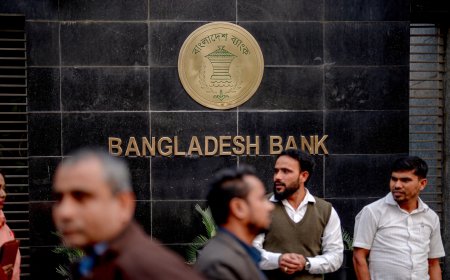
For more than a year, I have been making a single, consistent argument about Bangladesh and AI: Vision is cheap; execution isn't. I have made it across Dhaka Tribune, Counterpoint BD, and Medium. So when Finance and Planning Minister Amir Khosru Mahmud Chowdhury presented the FY2026-27 budget on June 11, that was the lens I brought to it.
The Jatiya Sangsad has less than two weeks to pass it. The budget has real provisions for AI, and that is worth acknowledging. But there is room to sharpen it before passage. Here is what I see: What the budget gets right, three things that should be strengthened, and three things not in it that should be added.
What the Budget Gets Right
Let me start with the credit, because it is earned. The Tk 500 crore startup and innovation fund is a real commitment. For years, I have written that our AI ecosystem runs on talent and ambition with almost no formal capital behind it. This allocation begins to change that. It signals that the government understands the connection between investment and competitiveness.
The tax architecture is also thoughtful. Full VAT exemptions for startups on domestic and imported services through 2035, sharply reduced turnover taxes for early-stage ventures, and import duty relief on high-tech hardware and networking gear. These are the kinds of structural supports a real technology ecosystem needs.
And the modernization ambitions are bold. AI integration into public administration, into smart city development and citizen services, into education, and into the "One Citizen, One ID, One Wallet" framework. Executed well, these could transform how the state serves its people. AI is on the agenda. That is a starting point.
Three Things to Strengthen
This isn't about finding fault; it’s about mechanical optimization. The next turns of the same operational crank I have been describing for a year. And crucially, most require no new money and no new legislation, only the will to act before June 30.
Ring-fence the AI capital: The Tk 500 crore fund bundles AI together with electronics manufacturing and general youth entrepreneurship. I understand the appeal of a broad innovation mandate, but deep tech AI competes poorly in that arena. Evaluating it is harder; it shows results more slowly, and when lumped into a general youth entrepreneurship pot, it is invariably the first thing to be deferred or diluted. The fix costs nothing.
A circular from the ICT Division designating a dedicated sub-tranche of Tk 100 to 150 crore specifically for AI research and computing would ensure the money reaches the sector it was meant for.
Treat talent as an emergency, not a line item: I have said this in every piece I have written. We produce only 2,000 AI-capable graduates a year. Our competitors produce tens of thousands. The numbers we need are in the tens of thousands through rapid training, industry apprenticeships, and serious diaspora engagement. Traditional curriculum reform is a ten-year play; we have a two-year window. The budget should signal that the situation is an emergency, not a long-term aspiration.
Put governance before deployment: The budget announces AI integration into public administration, citizen databases, and education. That is ambitious. But there is currently no oversight body, no procurement standards, and no framework to ensure these systems are ethical, accountable, and safe.
The government should not deploy AI into public systems without basic safeguards in place. Adding a governance requirement to the budget's own AI mandates costs nothing and protects the government's own modernization agenda.
Three Things to Add
Three things are missing from this budget and should be included.
National computing infrastructure: Every serious AI workload in Bangladesh runs on foreign servers under foreign terms of service. The budget should begin addressing this. Even a modest initial allocation toward domestic high-performance computing would signal that digital sovereignty is a priority, not just a talking point.
Bangla language AI: Bangla, the language of 230 million people, remains woefully underrepresented in the systems that shape the future. The budget does not address this. The math is simple: Building a competitive foundational Bangla model from scratch could easily exceed Tk 300 crore, more than the entire five-year AI policy budget.
But that does not mean we give up. It means we fund the achievable path: Fine-tuning high-performing open-source models on well-curated Bangla data through a public-private consortium. The budget should put real money behind this, not as an aspiration but as a funded line item with a deliverable and a deadline.
Connectivity to affordability: The 5G coverage targets are ambitious. But coverage without access is a press release, not a policy. The budget should tie its connectivity targets to affordability so that rural and low-income citizens can actually use what is being built, not just live within range of it.
The question was never whether Bangladesh could afford to invest in AI. The question, as always, is whether we can afford to do it slowly. We cannot. Let us move.
Dr. Zunaid Kazi is a futurist and technologist who has been at the forefront of AI for over four decades. He is a Founding Council Member of MillionX Bangladesh and the founder of Knowtomation. He writes on AI policy for Counterpoint BD, Dhaka Tribune, and Medium.