



























































Whose History Gets to Stay on the Wall?
Historians genuinely disagree about how much of the Bengal famine's death toll is attributable to policy versus war-driven scarcity that no government could have fully solved, just as historians and communities genuinely disagree about how the Nakba should be contextualized alongside the displacement of Jews from Arab lands.
In the space of a single month this summer, two museums on two continents found themselves at the centre of the same argument, dressed in different clothes.
In Winnipeg, the Canadian Museum for Human Rights opened “Palestine Uprooted: Nakba Past and Present,” a modest 11-metre display on the 1948 displacement of some 750,000 Palestinians.
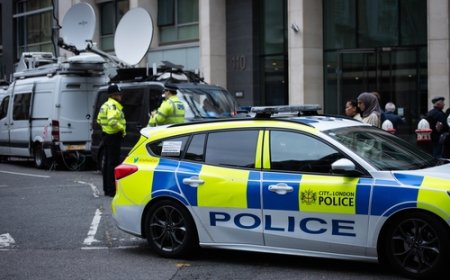
In London, the National Portrait Gallery quietly let a Turner Prize-winning artist's video installation be withdrawn after 50 peers, led by Winston Churchill's own grandson, denounced it as a "barefaced lie."
Both exhibits dealt with mass suffering tied to the machinery of empire and war. Only one survived contact with power.
That contrast is the real subject of this piece -- not because the two histories are identical (they are not), but because the “institutional reflexes” they triggered are so recognizably different, and so revealing of whose discomfort a Western public institution is built to absorb, and whose it isn't.
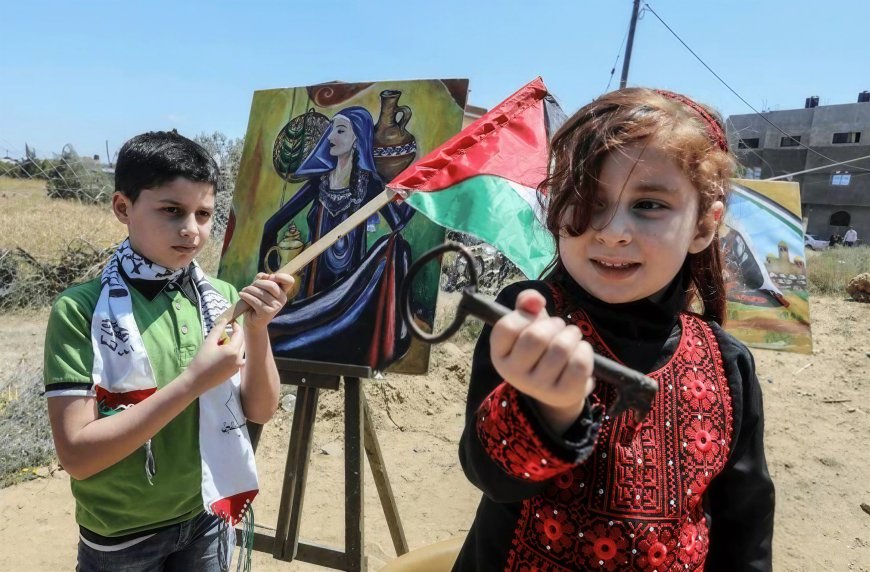
The Nakba exhibit had been four years in development before it opened on June 27. It told a specific, bounded story: the displacement of Palestinians during the 1948 war, illustrated through personal artifacts -- replica property deeds, a set of house keys a Winnipeg family carried out of what is now Israel, embroidery, testimony.
The museum was explicit that it was telling one community's experience, not attempting a comprehensive history of the conflict.
That did not stop it from becoming, in the words of one arts publication covering it, an exhibit "born in controversy" before a single visitor had walked through the door. An Israeli advocacy group threatened legal action pre-opening.
A museum trustee resigned, calling the exhibit "intellectually dishonest" for not giving equal space to the roughly 850,000 Jews displaced from Arab countries after 1948.
Canada's heritage minister toured the exhibit and publicly said parts of it "should be rectified" -- despite his own office insisting, in the same breath, that the government has no business dictating museum curation.
Competing petitions for and against the exhibit each drew over 11,000 signatures. The museum held its ground. The exhibit stayed up, unaltered, running through November 2028.
What is notable is not that the exhibit drew criticism -- serious historical arguments were made on both sides about context, omission, and the museum's consultation process, and those arguments deserve to be taken seriously rather than waved away.
What is notable is that despite ministerial pressure, a board resignation, legal threats, and a genuinely fierce public fight, the institution did not fold. The story stayed on the wall.
Contrast that with “Persistence,” Helen Cammock's 40-minute film, which had been running at the National Portrait Gallery since September 2025 as part of a contemporary portraiture program.
In it, Cammock described "the wilful starvation of the Indian population by Winston Churchill" during the 1943 Bengal famine, which killed an estimated three million people, and drew a parallel to Oliver Cromwell's campaigns in Ireland.
The film had been on public display for ten months without incident. Then Lord Roberts of Belgravia -- a Churchill biographer -- organized an open letter, joined by more than fifty peers including Churchill's grandson, Sir Nicholas Soames.
The letter called the film's claim "foul and vile" and "historically ludicrous," arguing that Churchill had in fact ordered shipping diverted, even at cost to the war effort, to relieve the famine. Within weeks, Cammock "voluntarily" withdrew the piece.
The gallery insisted it had not pressured her out; Cammock's own statement -- "I do not accept this pressure. To question, challenge and explore ideas and histories is vital to a healthy society" -- suggests otherwise.
To be fair to Lord Roberts and Soames: they were not denying that three million people starved. Their argument was narrower and more defensible on its face -- that intent matters, that "wilful starvation" implies a deliberate policy of murder rather than wartime negligence and imperial callousness, and that Churchill's own directives show he did not want Bengalis to starve.
But that argument does not survive close contact with the historical record, and it's worth being precise about why. Leo Amery, Churchill's own Secretary of State for India, recorded in his diaries that Churchill blamed the famine on Indians "breeding like rabbits" and reportedly asked why Gandhi hadn't died yet if the famine was so bad.
Historian Madhusree Mukerjee's “Churchill's Secret War” documents that Britain continued exporting grain out of India during the famine, that offers of food aid from Canada and Australia were turned down or delayed, and that shipping capacity was repeatedly prioritized for the Mediterranean and stockpiling in Europe over relief for Bengal.
Amartya Sen's Nobel-winning work on famine established that the 1943 famine was not primarily a food-availability crisis at all -- there was enough grain in India that year -- but a failure of distribution and entitlement, worsened by wartime price controls and the denial of relief that Whitehall had the power to authorize and chose, for long stretches, not to.
None of this requires believing Churchill drew up a starvation plan on a napkin. It only requires acknowledging that a man who could organize the evacuation of Dunkirk and the D-Day landings had the administrative capacity to move grain, and for the better part of a year, largely didn't.
So the peers were technically right that no memo exists ordering genocide -- and substantively wrong that the famine was simply bad weather Churchill tried his best to fix. Cammock's phrasing was blunt, but the underlying historical case for serious British culpability is not fringe; it is mainstream, well-sourced scholarship.
And yet it was that account -- not a legally aggressive threat, not a resignation, not a cabinet minister's public rebuke -- that proved fatal to the exhibit. A polite letter from fifty peers was enough.
It also matters who was doing the pressuring, and from where. In Winnipeg, the museum faced a sitting cabinet minister, a resigning trustee, and an advocacy group threatening litigation -- the full weight of formal political and legal power -- and treated all of it as commentary to be noted, not instruction to be obeyed.
In London, the pressure came from outside government entirely: A backbench-adjacent group of peers and a family member, with no legal authority over the gallery whatsoever. On paper, the National Portrait Gallery had every institutional justification to hold firm that the Winnipeg museum did not. It simply chose not to use it.
I did not come to this comparison as an outside observer. My mother's family was uprooted from their home during Partition, one of the largest forced displacements in modern history, and both of my parents witnessed the famine's aftermath firsthand -- the starvation, and people dying in the streets of Kolkata, close enough to touch.
That is not an abstraction I found in an archive. It is the house my family no longer lived in, and the bodies my parents stepped around.
The artist Zainul Abedin, who sketched Bengal's famine victims in charcoal and ink as they were dying in 1943, left behind some of the most unflinching visual testimony of that year -- gaunt bodies, children reduced to bone, the quiet obscenity of a famine unfolding in a British-administered province that was, by the government's own wartime logistics, still ‘exporting’ rice.
Those sketches sit in the same moral category as the keys and property deeds in the Winnipeg exhibit: Personal, physical evidence that a catastrophe happened to real people, not a contested abstraction to be argued into non-existence.
It is also worth being precise about why the grain didn't move, because the "it was just a typhoon" defence collapses under the same logistics that supposedly justified the shortage.
Wartime priorities did draw shipping away from Bengal -- grain and vessels were being diverted to feed Greek civilians and soldiers after Italy's occupation, and denial policies aimed at slowing a possible Japanese advance through Burma saw boats and rice stocks in coastal Bengal deliberately destroyed or requisitioned, on the theory that they might otherwise fall into Japanese hands.
Both were real wartime considerations. Neither required three million Bengalis to starve to death to be honoured; they required a colonial administration to weigh Bengali lives against other priorities, and to keep weighing them that way for the better part of a year while people died in the streets of the city my parents called home.
The Nakba, likewise, was not a natural disaster. It happened within the specific administrative and legal architecture of the British Mandate for Palestine -- a mandate Britain had accepted from the League of Nations, administered for three decades, and then exited in 1948 having produced, through its own policies of land allocation, immigration control, and eventual military withdrawal, exactly the conditions under which the war and mass displacement that followed became possible.
Both catastrophes, in other words, trace back to the same imperial habit: London (and its colonial administrations) treating the lives and land of subject peoples as a variable to be balanced against London's own strategic and military priorities, war after war, decade after decade.
Here is the uncomfortable symmetry. In Winnipeg, an institution absorbed sustained, high-level political pressure -- including from a sitting federal minister -- to alter an exhibit about a foreign, ongoing conflict, and it declined. In London, an institution absorbed a single open letter about its own country's imperial past, and the piece was gone within weeks, dressed up as the artist's free choice.
It's not that Western institutions are incapable of holding difficult exhibits under pressure -- Winnipeg proves they can. It's that the pressure lands differently depending on whose history is being disturbed.
A story about a conflict thousands of miles away, involving other people's ancestors, can survive ministerial disapproval and legal threats because the discomfort it produces is, for the institution, largely external.
A story that names the institution's own national mythology -- Churchill as the indispensable saviour of civilization, not also the administrator of a colonial famine -- turns out to be far more fragile, because the discomfort is internal, and internal discomfort has more people with the standing and the social capital to make a phone call.
This is worth resisting the temptation to overstate. The two exhibits are not equivalent in scale, evidentiary contestation, or political stakes, and treating every uncomfortable colonial fact as settled beyond argument is its own kind of dishonesty.
Historians genuinely disagree about how much of the Bengal famine's death toll is attributable to policy versus war-driven scarcity that no government could have fully solved, just as historians and communities genuinely disagree about how the Nakba should be contextualized alongside the displacement of Jews from Arab lands.
A good-faith argument about context and proportion is not hypocrisy; it's how institutions are supposed to work.
What crosses into hypocrisy is the asymmetry in which arguments get to "end" the conversation. In Winnipeg, "this exhibit lacks context" produced four years of consultation, a public fight, and a decision to keep going.
In London, "this claim is foul and vile" produced silence and a quiet withdrawal within weeks, over a history most serious economic historians treat as substantially, if not entirely, the product of British policy choices.
A society that can hold open a fresh, contested, foreign wound for two and a half years, but cannot hold open an 80-year-old domestic one for 18 months, has told you something true about itself -- not about which history is more painful, but about which pain it has practised looking away from the longest.
MK Aaref writes on culture, history, identity, and geopolitics from a South Asian and diasporic perspective.