



























































Life of a Paiki in Dhaka
For those unfamiliar with the cultural tapestry of Dhaka, your obligation as a paiki is to run as a spiritual messenger from one local shrine to another during the 7th to 10th day of Moharram -- entirely barefoot, enduring the burning asphalt and the direct heat.

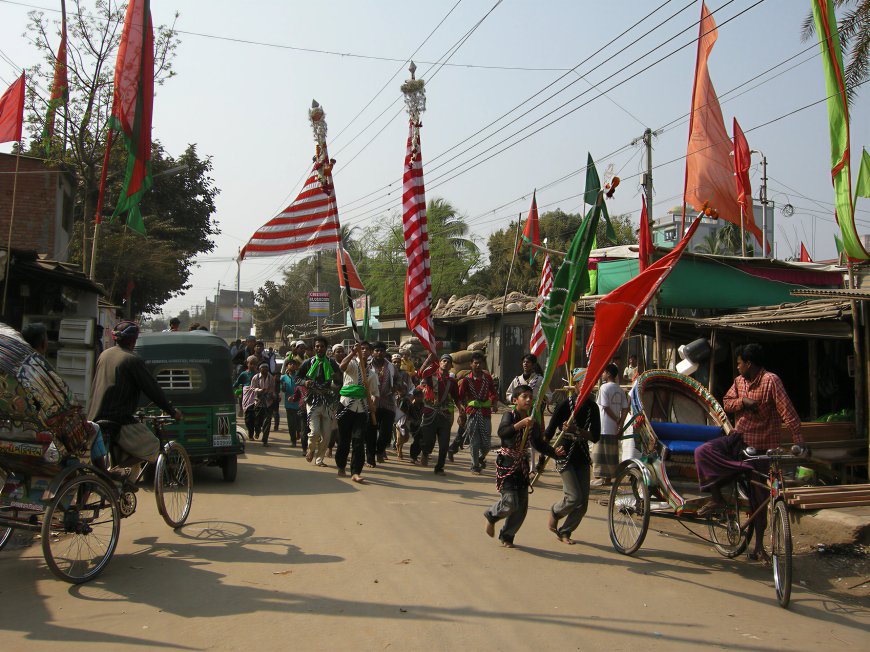
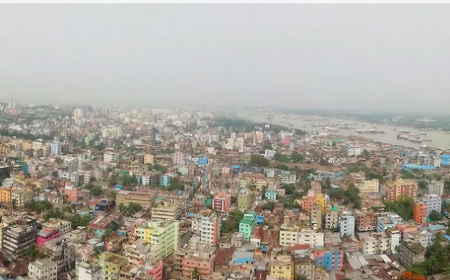
Last month, Muharram celebrations were held across the country, but most notably in Dhaka -- a city with a long-standing history tied to the festival.
Today, I want to share a story about an unusual sight that many of you have likely seen on Dhaka's streets but found puzzling. This is the story of the enigmatic people running through the streets with colorful flags.
My birth was not a quiet affair; it was a full-blown family emergency. On the day I made my grand entrance into the world, my mother was locked in an exhausting battle with prolonged labour, her vitals rapidly deteriorating. Seeing her sister-in-law in this state, my aunt seemed to suddenly remember something.
Sprinting through the streets of old Dhaka she headed towards the historic Husseini Dalan -- the central Shia shrine of the city. Years earlier, when my mother was struggling to conceive, my aunt had ceremoniously snapped shut a padlock at the shrine, binding a solemn vow (manat) to the heavens to grant her sister-in-law a baby.
Now, her heart was racing she reached the gate, searching frantically for the old lock hoping it was still there. Without a second thought, as soon as she saw it, she snapped it open, and almost instantly, I was born. I was less of a new-born and more of a collective sigh of relief.
Before my arrival, the social toll on my mother had been unrelenting. For eight agonizing years, she and my father had tried for a child, but the child had remained elusive and had refused to be born. The condemnation, as usual, was targeted towards my mother. She felt she constantly had to live under the scrutiny of a harsh neighbourhood tribunal.
In the deeply traditional corners of our community, a woman's inability to conceive was treated as nothing less than a moral failing. The community gossip derogatorily branded her bajhin or baj: The barren woman, and there were whispers that she was a sinner whose womb Allah had closed as a punishment. She had even cried out one day: “Allah, give me a child, any kind of child, even one without eyes or without limbs, I don’t care, make me a mother Allah.”
As soon as the lock was unlocked, I exploded onto the scene like an unbridled pony, my birth breaking the curse. I was born during Muharram, the sacred first month of the Islamic lunar calendar when young boys with vows in their names are affectionately referred to as paiki, while they charge across our city, running from imambara to imambara.
The connection between my sudden burst into the world and the joyours shouts of paikis ringing through our street outside was not lost on my uncle who, in a frenzy of immense relief and joyous gratitude cried out "he shall be a paiki!" thus immediately binding me to a lifelong subcontinental custom, one seen in a poor light by the educated lot and especially prevalent amongst the poorer communities of northern India.
For those unfamiliar with the cultural tapestry of Dhaka, a paiki is a horse who stands in for a traditional votive ritual practiced primarily by sections of the Bihari Muslim community during the first ten days of Muharram. As a paiki, you are ceremonially bound with vibrant, multi-coloured ropes and bells tied tightly around your waist and shoulders.
Your obligation is to run as a spiritual messenger from one local shrine to another during the 7th to 10th day of Moharram -- entirely barefoot, enduring the burning asphalt and the direct heat. Some families make vows that their children will be a paiki for a year, some for three or five, and some, feeling very grateful and zealous, such as my uncle, declared that in my blessed case it would be no less than a lifelong commitment.
As I approach my 50s now, I look back at my teenage years in the 1980s and early 90s, and what this commemoration meant for me. The sighting of the Muharram crescent moon was the absolute axis of my world. The moment the moon was declared, my mother shifted into full project-manager mode.
I was placed under a strict regime of spiritual house arrest while she ensured I was sheltered from draft, disease, and fatigue. I needed peak physical and athletic form for the gruelling four-day sprint that spanned from the 7th to the 10th of Muharram.
As for my formal education? I absconded from the classroom entirely during those days. They were holy days and I would extend my absence even after the 10th of Muharram (Ashura) on the grounds that I needed a proper, post-ritual recovery. Recognizing the deep cultural roots of the ritual within the community, our local school administration was incredibly accommodating and let us disappear without requiring formal notices or enforcing detentions. So I was happy.
On the 7th of Muharram, designated as the first official ritual day, the routine followed a specialised itinerary. After a late afternoon shower and a light meal, my grandmother would hustle back from the local market loaded with ritual provisions. She bought traditional sweets like Sakkar Pala (crystallized sugar diamonds), Lukum Dana (tiny sweet globules), and syrup-dripping Jalebis, alongside the essential Nara or Baddi -- the braided, colorful cotton ropes, and bells.
She would also grab several packs of incense sticks. We would then march to the local Imambara, the congregation hall dedicated to mourning the tragedy of Karbala. In our camp, practically every narrow lane housed its own Imambara, each managed by a spiritual custodian known as a Mujabir.
Our alley's shrine was overseen by a grandfather-like figure everyone called Nana, so it was known as Nana Ka Imambara. After offering Fateha (prayers for the deceased) and reciting select verses from the Quran over the sweets and incense, Nana would tightly bind the colorful Paik around my torso. From that exact moment, footwear was strictly forbidden. I was officially a paiki for the following three days.
During those three days, my life was supposed to copy that of a horse, sprinting across the hot tarmac from one neighbourhood Imambara to the next. The next day, the 8th of Muharram, the scale escalated dramatically. I would merge with the legendary Bholu Group, a massive, roaring procession of young men.
Our cohort would sprint from Geneva Camp in Mohammadpur toward Townhall Camp, and then make the long and ardous (especially during the summer months) trek into the historic heart of Old Dhaka to pay respects at the grand Husseini Dalan and the historic Bibi Ka Rowja.
Other ultra-endurance paiki cohorts would run all the way to the industrial hubs of Narayanganj and Adamjee -- a staggering 30 to 40 kilometers away from central Dhaka, their feet calloused and bleeding. Navigating the chaotic, vehicle-choked main avenues of Dhaka required organization. Our group was spearheaded by an elite protocol team.
Armed with nothing but plastic whistles, split bamboo sticks (lathi), and pure audacity, the older boys would sprint ahead to clear traffic, carving a path right through the middle of the crowded roads. As we ran, we belted out traditional, rhythmic chants like a synchronized stadium choir, our voices echoing off the concrete:
“Jambe Charya! Jambe Hazi Husain! Jambe Maula Muskil Kusha Ali! Jambe Pak Panjatan! Panjatan Ka panch nara ek nara hyderi! Ya Husain! Ali Ali ya Ali!”
There were dozens of other intricate Urdu and Persian Urdu chants, but the passage of decades has stolen them from my memory. Whenever our group arrived at a destination Imambara, we would pause to catch our breath and chug glasses of heavily sweetened sharbat -- essentially coloured water with mounds of white sugar to keep our energy from crashing.
We would then perform the Jhum, running in continuous, rhythmic circles around the central standard (Alam) of the Imambara while a reciter (Ustad) belted out elegiac Urdu poetry in a haunting, lyrical cadence. We repeated this gruelling cycle on a loop until the day of Ashura.
Eventually I walked away from the ritual permanently. The departure was a slow accumulation of physical exhaustion, shifting social dynamics, and an acute sense of self-consciousness. The final time I was a paiki was in 1996. I had just completed my Secondary School Certificate (SSC) exams. As my analytical brain began to develop, I started questioning the theological validity and historical myths behind these localized camp rituals.
I asked the elders for scriptural justifications, but I met with vacuity. Simultaneously, the religious landscape around us was shifting. Orthodox, practicing Muslims -- largely influenced by the reformist Deoband school -- began stringently denouncing these syncretic practices. They condemned our paiki tradition, characterizing it not as an act of devotion, but as shirk (polytheism) -- the ultimate, unforgiving sin in Islam.
However, my decision to quit wasn't sparked by this theological debate. It was delivered via a deeply humiliating experience in a crowded vegetable market. It was 11:30 AM on the 8th of Muharram 1996. Hundreds of us had started our high-speed run from Geneva Camp toward the Townhall Camp.
Just as our massive, shouting wave entered the congested lanes of Townhall market, my close friend and fellow paiki, Hasan, suddenly doubled over, clutching his abdomen in excruciating pain. He went entirely pale and told me he couldn't take another step. Without breaking stride, the roaring momentum of our procession swept past us, leaving us behind. Suddenly, with the procession gone, we stood alone.
Two sweaty, heavily roped teenagers, completely isolated, slowly limping backward through a mundane crowded marketplace.
Without the safety of the massive paiki group, the marketgoers viewed us with open hostility. Stripped of the religious procession, we didn't look like sacred devotees fulfilling a solemn vow; we looked like two clowns. People pointed fingers, jeered, laughed, calling us jokers. At that exact moment, the spiritual romance of the paiki tradition completely vanished.
I found myself viewing myself through their eyes -- trapped in what suddenly felt like an undignified, deeply embarrassing situation. I felt less like a custodian of an ancient tradition and more like a glorified stage monkey highlighting my status as a Bihari standing in front of a mocking locals and high class audience. The experience was profoundly painful, but it provided the jolt I needed to sever my ties with the ritual.
The universe chose that very evening to add a dramatic, undeniable exclamation point to my decision. Hours after we limped home, Hasan was rushed to the hospital for an emergency surgical intervention; his sudden abdominal pain had been an acute case of appendicitis. The trauma of the day was becoming a nightmare.
Terrified, conflicted, and thoroughly disillusioned, I locked myself inside my room for the remaining two days of the festival. On the morning of the 10th of Muharram, while the rest of the camp wept, I quietly untied the colourful cotton ropes from my shoulders, released myself from my “paikness,” and never ran barefoot again through the streets of Dhaka.
Noor Islam Pappu used to live in Geneva Camp and has engaged in freelance research and coordination for international universities; writing real-life stories is his growing interest.