




































































The Unfinished Promise of Police Reform
Abu Sayed's killing -- and the statement later made by the police officer convicted of his murder -- did not simply expose failures in the conduct of individual officers. Together, they illuminated deeper structural weaknesses within policing and compelled the nation to confront fundamental questions about accountability, professionalism, and the relationship between the police and the public.

"I was only performing my official duty. I committed no crime."
These words, spoken by a police officer convicted in the murder of Abu Sayed, raise an uncomfortable but necessary question: What does it mean when an officer convicted of killing a citizen still believes he committed no crime?
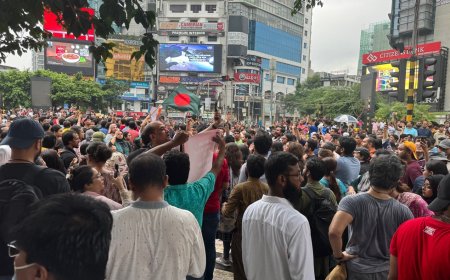
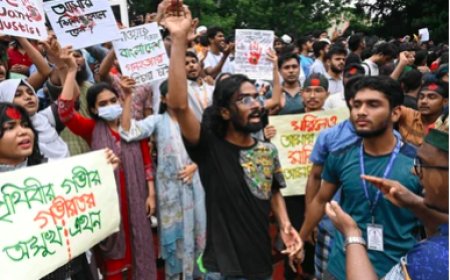
As Bangladesh commemorates the second anniversary of the July Uprising, the killing of Abu Sayed remains one of its defining moments. The death of the uprising's first martyr became a turning point that helped transform a student-led protest over the public sector quota system into a nationwide mass uprising.
Beyond its symbolic significance and its enduring place in the nation's collective memory, however, the incident exposed a deeper and often underexplored issue: The profound crisis in the relationship between the police and the public.
That crisis did not begin with Abu Sayed's killing, nor did it end there. Rather, it unfolded throughout the uprising through repeated allegations of excessive use of force, arbitrary arrests, mass detention, pellet injuries, headshots, and other forms of violence.
What July ultimately revealed was not simply the actions of individual officers, but a deeper institutional problem -- one that brought questions of police reform, accountability, and democratic policing into mainstream public and policy debate. Nearly two years later, despite one of the most comprehensive police reform agendas in Bangladesh's history, much of that momentum has faded.
The convicted officer's statement offers an important clue as to why. It suggests that the problem extends beyond individual misconduct or personal morality. It points instead to the institutional incentives, organizational culture, and understanding of professional duty that shape police behaviour.
If we are to understand why police reform has struggled to maintain momentum, we must first ask a more fundamental question: What kind of institutional environment can lead an officer to believe that carrying out an unlawful order is simply part of performing his duty? Police reform, therefore, is not only about changing laws or institutions; it is also about transforming the incentives, norms, and organizational culture that shape how policing is understood and practiced.
The Incentive Problem
The answer lies in the institutional incentives that shape police behaviour. Police organizations, like any other institution, respond to systems of reward and sanction. In Bangladesh, recruitment, postings, transfers, promotions, disciplinary action, and institutional protection have long been perceived as influenced not only by professional merit but also by political responsiveness and proximity to those in power.
Whether every perception is accurate is less important than the fact that such perceptions influence organizational culture, shape officer behaviour, and ultimately affect public trust. When career advancement is believed to depend as much on satisfying powerful actors as on serving citizens, accountability to the public inevitably becomes a weaker institutional incentive.
This incentive structure helps explain why concerns over politicization, excessive use of force, arbitrary arrests, torture, enforced disappearances, and other forms of abuse persisted for years before July 2024. The uprising did not create these problems; rather, it exposed them to unprecedented public scrutiny and transformed police reform into a matter of national debate.
At the same time, any serious discussion of reform must recognize that many police officers themselves operate within difficult institutional conditions. Long working hours, inadequate welfare, limited resources, and pressure from superiors and influential actors can undermine professional policing. Officers are often evaluated not only by the quality of service they provide to citizens but also by their responsiveness to administrative and political expectations.
As a result, many become products of the very institutional environment that reform seeks to change.
This is why meaningful police reform cannot be reduced to replacing individual officers, introducing new training programmes, or adopting technical fixes. Unless the incentive structure itself changes, behaviour is unlikely to change in any sustained way. Reform must therefore focus not only on institutions and laws, but also on transforming the organizational incentives that determine what behaviours are rewarded, protected, and promoted.
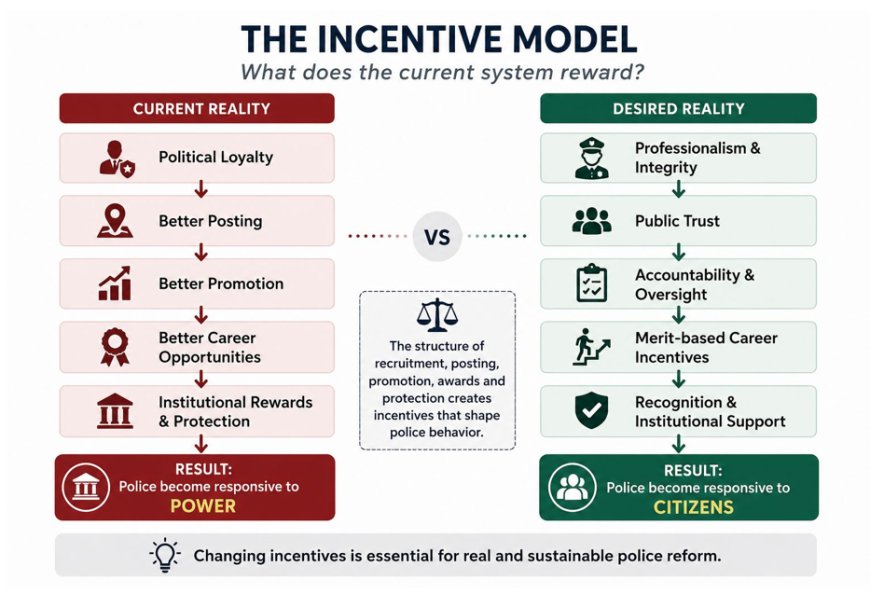
The framework above summarizes the article's central argument. Institutions reproduce the behaviours they reward. Transforming policing therefore requires changing the incentive structure that shapes everyday police behaviour.
July and the Promise of Reform
The July Uprising created a rare political opportunity for police reform. For perhaps the first time in decades, there was broad public recognition that policing in Bangladesh could not continue under the existing model. Responding to this demand, the Interim Government established the Police Reform Commission, which produced one of the most comprehensive police reform roadmaps in the country's history.
Its recommendations extended beyond procedural improvements to address deeper structural challenges, including political influence, weak accountability, police-community relations, and the institutional incentives that shape police behaviour.
The Commission also recognized the need for an independent Police Commission. Although it stopped short of recommending a detailed institutional design, it acknowledged the importance of creating an independent mechanism to strengthen accountability and reduce undue influence over policing.
The underlying logic was straightforward: Meaningful reform requires changing not only police behaviour but also the institutional incentives that shape and reward that behaviour. Without addressing those incentives, new training programmes, equipment, or administrative reforms are unlikely to produce lasting change.
Some recommendations were translated into procedural and administrative reforms during the Interim Government, including online General Diaries (GDs), glass-walled remand rooms, amendments to aspects of criminal procedure, and the adoption of the Police Commission Ordinance, 2025. However, many of the Commission's broader structural recommendations remained unimplemented.
Police reform was also largely absent from the agenda of the National Consensus Commission, and the Police Commission Ordinance ultimately lapsed after the elected government chose not to place it before Parliament for ratification.
Nearly two years after July, Bangladesh possesses a detailed roadmap for police reform, yet much of the structural agenda remains unrealized. The challenge today is no longer identifying what needs to change. It is sustaining the political commitment, public attention, and institutional momentum necessary to ensure that police reform remains a national priority.
Reform without Reconciliation?
The challenges facing police reform extend beyond institutions, legislation, and policy. They also raise a more difficult question: Can meaningful police reform succeed when the relationship between the police and large sections of society remains fundamentally fractured?
For many protesters, survivors, and the families of those killed or injured during the July Uprising, police reform is not an abstract policy issue. It is inseparable from demands for truth, accountability, justice, dignity, and guarantees of non-recurrence. Without addressing these expectations, rebuilding public trust in policing will remain extraordinarily difficult.
At the same time, the post-uprising period also exposed a different reality within the police institution. The violence resulted in the deaths of police personnel, attacks on police facilities, a collapse in public confidence, and a serious morale crisis within sections of the force. Many officers felt they were operating in an environment shaped by political decisions over which they had little control, while facing intense public hostility and institutional uncertainty.
The result is a profound deficit of trust. Many citizens continue to associate the police with repression, corruption, and political partisanship, while many police officers increasingly view the public through the lens of hostility, suspicion, or rejection. Whether every perception is justified is less important than the fact that these perceptions shape everyday interactions and complicate efforts to rebuild police-community relations.
Acknowledging this reality does not require creating a false equivalence between victims of unlawful police violence and police personnel. Accountability must remain central to any reform process. At the same time, officers who were not personally responsible for unlawful acts but suffered harm during the violence should also receive appropriate recognition, support, and, where warranted, reparations.
Such recognition is not an alternative to accountability; it is part of rebuilding an institution capable of regaining public trust.
Ultimately, sustainable police reform requires both accountability and reconciliation. Accountability addresses wrongdoing and affirms the rights of victims. Reconciliation helps rebuild the trust necessary for democratic policing. Without the former, reform lacks legitimacy. Without the latter, reform is unlikely to endure.
Bringing Police Reform Back into the Conversation
Nearly two years after the July Uprising, Bangladesh finds itself in a paradoxical position. The structural problems within policing -- including politicization, weak accountability, excessive use of force, and declining public trust -- are now widely recognized. Yet the momentum for reform has steadily weakened, even as encounters between law enforcement and citizens continue to generate controversy.
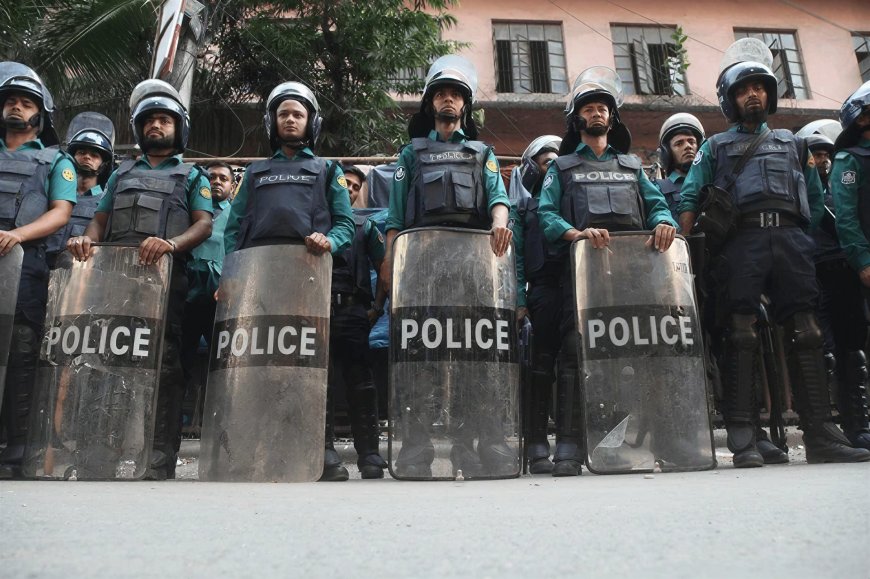
Recent incidents involving baton charges, sound grenades, tear gas, and water cannons during public demonstrations -- including the police response to protesting HSC examinees -- serve as reminders that fundamental questions surrounding the use of force, the role of the police in managing public assemblies, and institutional accountability remain far from settled.
Perhaps this is one of the most enduring institutional legacies of Abu Sayed's death. His killing -- and the statement later made by the police officer convicted of his murder -- did not simply expose failures in the conduct of individual officers.
Together, they illuminated deeper structural weaknesses within policing and compelled the nation to confront fundamental questions about accountability, professionalism, and the relationship between the police and the public. Those questions remain just as relevant today as they were in July 2024.
The challenge now is no longer identifying what needs to change. Bangladesh already possesses a detailed reform roadmap. The greater challenge is sustaining the political commitment, public attention, and societal demand necessary to implement it. Police reform cannot remain confined to commissions, experts, or policymakers.
It must become part of a sustained national conversation involving citizens, police personnel, researchers, journalists, civil society, survivors, and policymakers alike.
If the July Uprising created the political opportunity for police reform, sustaining that opportunity is now a collective responsibility.
Only through continued public engagement, informed debate, and broad societal ownership can Bangladesh transform the lessons of July into lasting institutional change and create a policing system in which professionalism, accountability, and public trust are not merely aspirations, but the institutional incentives that guide everyday policing.
Md. Zarif Rahman was a member and student representative of the Police Reform Commission and currently serves as the Research Director at Sapran, a right-based think tank. Opshora Islam Tondra is working as a researcher at Sapran.