


































































The Porcupine, the Girl, and the Double-Tap
I am profoundly thankful that Senehma exists. And I am profoundly terrified that she does. Because the world we have built demands that we learn to doubt miracles, just so we can survive the unrelenting noise of the horrors.
The first time the video appeared, it was a shaky, low-resolution phantom -- the kind of file that had been forwarded so many times through WhatsApp groups it had the grainy texture of a charcoal sketch.
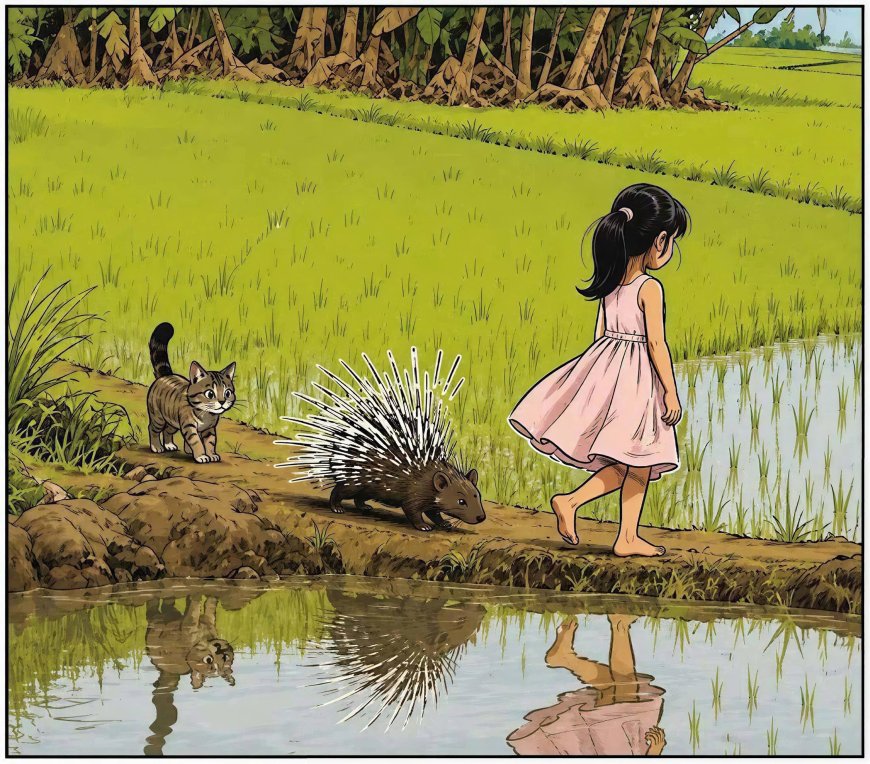
A young girl in a pale pink dress is walking barefoot along a muddy ridge in a flooded rice field. Behind her, a tabby cat follows, its tail held high like a ceremonial flag of peace. Beside the cat, a porcupine -- plump, dark, its white quills fanning out like a sudden, startled crown -- trots along the water's edge.
The reflection in the paddy is so still it looks like a painting: A perfect, unbroken mirror-image of the girl, the cat, the quills. In the distance, muscular rows of coconut trees frame the horizon, their silhouettes blurred by a humid, tropical haze. It looks like Sri Lanka. It could be Bangladesh. It looks like a fairytale.
My first instinct, watching it on my newsfeed, was to ask: Is this real?
I zoomed in, squinting at the pixels. The porcupine’s gait seemed too perfectly synchronized with the girl's steps. The color of the paddies had a slightly over-saturated, painterly glow. My brain, trained by scrolling through Midjourney art and OpenAI videos, immediately clicked into suspicion. This has to be AI.
But I couldn't look away. Because the girl -- whoever she was -- walked with a bone-deep, unself-conscious grace. She walked like someone who had never been told to be afraid of the mud. Her hair was pulled up in a messy, practical bun, and her bare feet made soft, sucking divots into the wet earth.
I paused the video.
I don't know why I zoomed in on her face. I do not recognize her. Yet, staring at the blurry pixelation, I felt a sensation I cannot accurately name -- a kind of phantom limb ache in my chest. There is a specific, visceral heaviness that occurs when you see a child of a certain age in a certain light. The memory of a childhood is not a file you open; it is a weather system that rolls in over a paddy field without warning.
You find yourself standing on the muddy bank, and she is walking away, and your chest suddenly remembers the exact, lingering weight of a five-year-old hand in yours. You suddenly smell baby shampoo.
I stared at the screen and silently begged the universe for this one video to be a fabrication.
Because, in the time it took for me to hold that breath, my thumb swiped up. The pink dress dissolved into grey concrete.
The algorithm is not a library; it is a teleportation device that lacks a moral compass. One second, I am breathing the warm, oxygenated air of a tropical afternoon. The next, I am staring at the burned-out carcass of an elementary school in Iran.
I am forced to learn what a "double-tap" is -- that chilling, militaristic euphemism for striking a rescue team after the first explosion, ensuring that no one, not even the medics, survives. The children in Menab could have been her age. They wore the same pink dresses, the same messy buns.
My thumb continues to scroll, because the dopamine loop demands I keep moving. And directly below the war report, there is another headline.
A child, raped, killed, and dismembered in Pallabi, Dhaka.
The article is brief. The police statement is sterilized and clinical. She was five years old. Five.
The girl in the paddy is five. The child in Pallabi, as the reports stated, was also five. They breathe in the exact same global second. One is celebrated as a miracle on my screen; the other is processed as a grim statistic in a forgotten police file. I am scrolling through them simultaneously, rubbing my tired eyes, struggling to let my heart process the whiplash.
I know friends who have deactivated their social media accounts this month. They aren't cowards. They are victims of a broken psychic ecosystem. Our hearts were designed to grieve deeply once -- to hold a singular, earth-shattering tragedy in our hands.
We were never meant to process a thousand horrors a day, interspersed with porcupines, and then be expected to go to work, make coffee, and pretend we have not just seen a child’s innocence shredded by the brutality of our species.
To survive the scroll, we have no choice but to grow numb. To deactivate is to say: “I cannot hold any more water.”
This brings me back to my initial, disorienting suspicion: Why was my first instinct to doubt the porcupine?
Because we live in an era where beauty is viewed as a lie until proven true. The philosophers call it hyperreality -- the total collapse of the boundary between the image and the real. The algorithm has trained us to be suspicious of sunshine. It has taught us that pure, untouched childhoods cannot survive the screen without being synthetic. My brain looked at the girl and protected me: "Don't fall in love with her; she is just a code. She is just pixels."
But she isn't pixels.
Days later, a Facebook page confirms it. Her name is Senehma. She is not from Bangladesh. She is from a beautiful village called Sinhapura in Polonnaruwa, Sri Lanka. On June 11, a woman named Prabha Silva posted the clip. The caption read: “Little porcupine brother going to the paddy field with his elder sister.”
Senehma. She has a name. She has a brother.
And that realization is somehow more terrifying to me than if she were fake. Because if she is fake, she is safe. She exists in a digital heaven where no cruise missile can find her. She cannot be double-tapped. She cannot be dismembered in a concrete alley.
But Senehma? Senehma breathes the same atmospheric air as the warheads. She walks on the same earth where my friends are turning off their screens just to survive the week. Magic, when it is real, is the most fragile substance on earth. It is made of the same vulnerable matter as our children. It can be erased with a single swipe of the thumb.
I don't know if writing this is helping me process it, or if it is just a way to pin the fluttering, chaotic butterfly of my grief onto a page so I don't have to carry it in my chest. Perhaps the only thing left to us, in this swirling digital purgatory, is the quiet act of bearing witness. To not look away from the double-tap. To not look away from the child in Pallabi. To not look away from Senehma in her pink dress.
To hold them all in the same trembling hand, knowing they are all made of the same biological fragility, and that the distance between a miracle and a murder is nothing more than the ruthless geography of a newsfeed.
I close my phone. The screen goes black. But the triptych is burnt into my eyelids -- the bristling porcupine, the little girl turning her head, and the ghostly, percussive echo of the double-tap.
I am profoundly thankful that Senehma exists. And I am profoundly terrified that she does. Because the world we have built demands that we learn to doubt miracles, just so we can survive the unrelenting noise of the horrors.
I let myself stare into the dark glass, hoping that somewhere, in the humid, heavy air of the Sinhapura rice field, she is still walking. Still unafraid. Still real. Still holding onto the quiet magic that we have all collectively forgotten how to trust.
Zakir Kibria is a Bangladeshi writer, policy analyst and entrepreneur based in Kathmandu, Nepal. His email address is [email protected]