





























































Sheikh Hasina’s Last Dance?
Hasina has nudged New Delhi to define its position on her extradition and forced the BNP to confront, sooner than it may wish, whether it truly wants her back and, if so, on what terms.
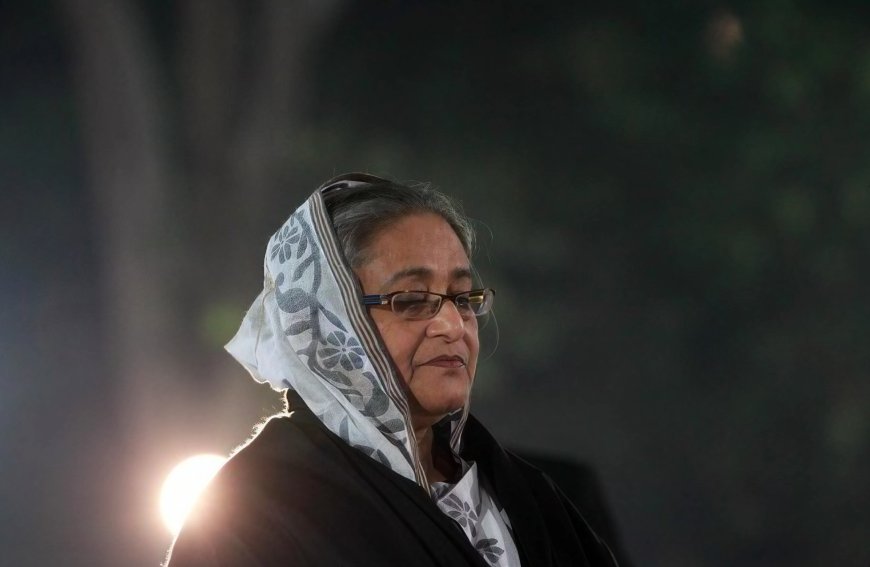
The Battling Begums, former Prime Ministers Sheikh Hasina and the late Begum Khaleda Zia, spent their careers proving premature political obituaries wrong.
Both began their leadership tenures by confronting the military regime led by General Hussein Muhammad Ershad.
Detractors questioned then whether two relatively young women with little to no political experience could shoulder the legacies of Bangabandhu Sheikh Mujibur Rahman and General Ziaur Rahman following their assassinations.
Decades later, few can deny that both women commanded loyalty and support, ironically, in a society that remains patriarchal and sexist. Family lineage gave them a baseline to build on.
Credit goes to them for developing the skills and competencies that made them the two fulcrums around whom national politics coalesced. Both drew on the lived experience of serving in public office to cement their pre-eminent statuses at the heart of Bangladeshi society without necessarily having formal political training.
During the 1/11 period, both negotiated with and pushed back against military and civil society stakeholders to varying degrees, and survived coordinated efforts by those same actors and reformists within the BNP and AL to force them out of politics altogether.
Since the late 1980s, both, along with the parties they came to personify, repeatedly sought to push one another to the margins, though their methods and reach differed.
On this scorecard, AL comes out ahead. Its campaign against Begum Zia was more sustained, systematic and severe. In hindsight, that campaign offers an academic case study in marginalizing an archrival through a legal noose buttressed by character assassination.
History delivered its own measure of poetic justice. After the 2024 mass uprising, Begum Zia, while frail and a shadow of the towering figure she once was, returned to the limelight.
Fate granted Begum Zia vindication: She left this world at her peak, hailed by sympathizers as a symbol of national unity who had resisted authoritarianism and lived long enough to watch Ms. Hasina flee to the very country her critics had long accused her of subordinating Bangladesh’s interests to.
The final arc of Ms. Hasina’s saga remains unwritten. Judging her entire career solely through the lens of 2024 would be unwise. Nonetheless, a brutal final act in power can come to define how a nation remembers a politician’s legacy. Her final act reflected a set of decisions that culminated in the expression of the worst habits of her predecessors and of her own rule.
Ms. Hasina’s policy choices led to state-sponsored violence on a scale unmatched in independent Bangladesh, with more than 1,000 people killed, according to the United Nations.
International human rights organizations have described the conduct of the state machinery under her supervision as plausibly amounting to crimes against humanity committed against the very people she was mandated to serve.
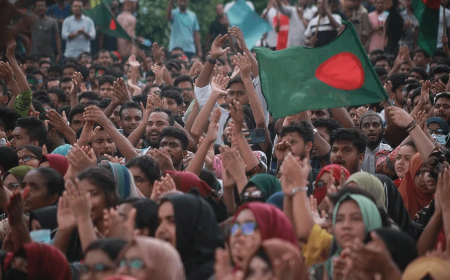
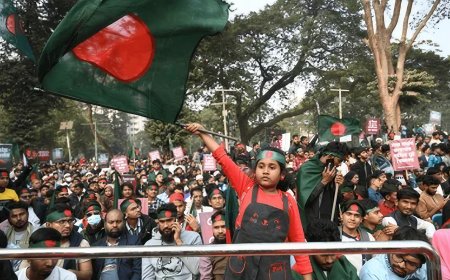
Ms. Hasina fled her country as its antagonist. The autocrat, a term Bangladeshis writ large had long been afraid to utter publicly, had fallen in a textbook example of a student-led, people-powered mass uprising.
An Exiled Autocrat Refusing to Leave the Stage
Against that backdrop, Ms. Hasina told Reuters in a recent interview that she intends to return to Bangladesh by December 2026, accompanied by AL colleagues based in India and elsewhere, and surrender before the courts.
By naming a month, she has set herself a deadline and bound herself to that timetable. Making the announcement through a reputable international media outlet, knowing it would secure airtime and be picked up globally, is vintage Ms. Hasina.
The first question is what Ms. Hasina hopes to achieve through this announcement.
First, she is presenting herself as a fearless leader who will not back down from a fight.
Second, she is positioning herself as a victim of domestic and international conspiracies and of those who resent what she regards as a successful record across her many years in office.
Third, she is subtly pushing back against unverified discussions, whether within AL or in diplomatic circles, about rebranding the party without her or another member of the Sheikh family at its helm.
Bottom line: Ms. Hasina has no intention of fading quietly in exile.
There is no doubt that Ms. Hasina is a bold, defiant and shrewd political operator.
At the same time, by the end of her final term, the AL supremo had morphed into the uncrowned monarch of an authoritarian, repressive, rights-violating, corrupt and increasingly out-of-touch regime. She may even have convinced herself that she could do no wrong.
She knows the game inside and out, but that is not mutually exclusive of the fact that her calculations tend to place her individual interests above those of her party.
The question is whether her leadership remains a strategic asset capable of re-energizing AL or has become the principal obstacle to its reintegration into the national political fold.
The organization Ms. Hasina leads today bears little resemblance to the party she inherited in 1981 or even the one she led until 2009. From 2009 onward, and especially after 2014, AL became a different creature altogether.
Its retreat from liberal democratic politics accelerated around 2014, when she came to regard competitive multiparty national elections as dispensable.
Once AL no longer had to earn consent at the ballot box to control the machinery of government, it became a cabal centred on a cult of personality and riddled with misconduct and abuses of power. Where, then, is the reckoning?
The first step towards addressing a problem is recognizing what went wrong, and that requires introspection. AL has offered no tangible sign that it has begun looking inward.
Ms. Hasina’s proposed return raises three key questions.
First, will she be allowed to return?
Second, what would her arrival mean for the post-2024 political order and the emerging settlement among the BNP, Jamaat and the NCP?
Third, can AL return to public life without confronting the reasons for its ouster?
The Road to Dhaka Runs Through New Delhi
Ms. Hasina’s return is not hers alone to decide.
To her supporters, she fled to save her life.
To the BNP government, she is a fugitive who must face the courts.
To India, she is a guest of New Delhi who received refuge as a courtesy to a long-standing ally.
Each account captures part of the picture. All three place guardrails on Ms. Hasina’s agency in deciding her own next steps.
New Delhi responded cautiously to her interview with Reuters. It stated that there had been no change in its policy regarding Ms. Hasina’s presence in India and that any extradition request was a legal matter that would be handled accordingly. It did not indicate whether it would facilitate her stated return in December.
The post-Hasina Bangladeshi administrations, led first by Dr. Muhammad Yunus and now by Tarique Rahman, have formally sought answers from India regarding her extradition.
Beyond such brief and carefully calibrated statements, New Delhi has remained publicly muted. Ms. Hasina has not shown her face publicly since fleeing to India: A telling absence that likely reflects restrictions imposed by her hosts.
That said, two points are noteworthy.
First, Ms. Hasina has retained access to the media and continued to connect with journalists.
Second, from the interim government period to the present, she has regularly appeared in virtual discussions and addressed supporters through social media.
India has raised no objection either to journalists engaging with her or to her continued political activity with members of her party. The question of whether she can board a plane to Dhaka therefore remains largely in New Delhi’s hands, with three plausible scenarios for how India may handle her case.
First, it could facilitate Ms. Hasina’s return, perhaps through a back-channel arrangement with Dhaka that removes any prospect of capital punishment.
Second, it could continue hosting her while seeking to normalize relations with Bangladesh.
Third, it could help arrange refuge for her in another country. That would allow India to take a visible step back from an issue that continues to be a thorn in efforts to regularize its bilateral relations with Dhaka.
New Delhi has disclosed little about which option it favours.
There are bureaucratic hurdles to consider, too. Ms. Hasina’s diplomatic passport was cancelled after her removal from office. Unless she holds another valid travel document, she would probably require a travel permit or other documentation issued with Dhaka’s involvement.
If Ms. Hasina were to return to Dhaka, India would have to permit or facilitate her departure. Bangladesh would determine the terms of her arrival, arrest, and court appearance.
Ms. Hasina’s ouster exposed the risks India had taken by placing all its eggs in the AL basket and served as a reality check for New Delhi’s usually sure-footed and nifty South Block.
Claims by some anti-AL elements in Bangladeshi society that a BNP-led government would bend blindly to India have also not held up. Mr. Rahman’s engagement with Beijing signalled that his government would not approach New Delhi from a position of automatic deference. His preference for visiting China before India did not go unnoticed in New Delhi.
The most important question is whether the BNP government actually wants Ms. Hasina back.
Her return would create a headache that it may have little appetite to manage in the short run. Publicly, it must insist that New Delhi return her to face justice. Behind closed doors, it may see little advantage in dealing with the consequences of her extradition.
But among the organized forces opposed to the AL and supportive of the 2024 mass uprising, only the BNP possesses the political capital to oversee a full trial of Ms. Hasina and her associates in their presence, along with the grassroots strength to withstand any fallout.
It is also the only party capable of lending such a high-profile process both domestic and international legitimacy. Neither Jamaat nor the NCP can claim comparable authority.
The BNP’s comparative advantage gives it leverage to tacitly nudge Narendra Modi’s government towards a fourth course. New Delhi could continue hosting Ms. Hasina in the short to medium term while advocating for the AL’s gradual reintegration through electoral politics, perhaps beginning with municipal elections, without requiring the AL president to physically return to Bangladesh.
Any preference for such an outcome would have to remain unspoken in Dhaka.
That course would serve two purposes.
First, it would place the stabilization of ties with Dhaka at the centre of New Delhi’s policy.
Second, it would offer New Delhi a middle path that avoids alienating either the AL or the BNP.
The elephant in the room is the United States.
Under Joe Biden, Washington moved away from viewing Bangladesh primarily through New Delhi’s lens and treated the relationship more directly on bilateral terms.
Under Donald Trump, the direction is unpredictable. The White House is likely to pursue a transactional relationship with Dhaka, as it has over the past year, with an emphasis on security and trade.
Washington may once again view Bangladesh through the lens of its partnership with India and its strategic competition with China, much as it did from 2009 until the onset of the pandemic.
How Ms. Hasina’s return fits into that picture remains difficult to determine.
A reasonable wager is that facilitating the return of an ousted former Bangladeshi Prime Minister who, by 2024, was no longer in Washington’s good books does not rank high among American strategic priorities in the current geopolitical climate.
A negotiated arrangement involving Washington, New Delhi, Dhaka and Ms. Hasina’s representatives cannot be ruled out. For now, there is little public evidence that such an arrangement is under active consideration.
A Shared Surrender Will Project Party Unity
Ms. Hasina’s announcement may be grandstanding designed to secure attention. It may also seek to energize the army of AL activists, prepare them for street confrontation and move the organization back to the forefront of national life.
But imagine for a moment that Ms. Hasina does in fact return.
The defining moment will come before Ms. Hasina appears before a judge: The sight of her landing in Dhaka potentially alongside scores of absconding AL leaders, stepping off the plane together and entering the custody of law enforcement.
In the public imagination, that scene will acquire significance far beyond her trial itself. In Bangladesh, the loss of power tends to alter how leaders and political parties are perceived.
Imprisonment can transform a leader associated with repression into a figure of persecution. A party condemned for authoritarianism can begin to claim victimhood at the hands of the state.
Ms. Hasina may be seeking a display of shared loyalty that did not accompany Begum Zia’s imprisonment in 2018. Begum Zia entered prison solitarily. Senior BNP leaders did not offer themselves for arrest alongside her. They chose a different path, one that may ultimately have served the party well by preserving a collective leadership capable of keeping it afloat.
Ms. Hasina, by contrast, may want senior AL leaders physically at her side through thick and thin. This would project a party still united behind her and prepared to share her fate.
Her announcement also raises questions about the conduct of her trial. Legitimate concerns remain about gaps in adherence to due process. Those concerns will attract far greater scrutiny if Ms. Hasina returns to Bangladesh and is allowed to appeal her conviction.
AL Remains Trapped in Denial
In the bigger picture, AL has not confronted why the Hasina government was booted out of state power in such a dramatic fashion.
The party has shown no remorse for the human rights violations committed under its government’s watch in the lead-up to the mass uprising. Nor has it acknowledged the wider sources of pent-up public frustration that accumulated over its four consecutive terms in office.
These included damage to the banking and financial systems, money laundering and, more broadly, outlandish levels of corruption, a deliberate effort to destroy the culture of credible elections, the deterioration of the education system, enforced disappearances, extrajudicial killings and the politicization of the judiciary and civil service -- structural problems that have become so deeply ingrained that repairing the harm will take years, not months.
That will also require politicians to reject the methods that came to define how AL practised politics during its final six or seven years in office. Whether they will do so remains a big if.
And yes, the consequences Bangladesh will continue to face because of how AL governed extend far beyond what is outlined here. The party should never forget that.
AL’s messaging portrays the mass uprising as an internationally engineered, domestically supported and military-backed Islamist coup.
That argument has gained little traction beyond highly committed supporters. One suspects that even some within its base recognize the limits of the claim.
The visibility of Islamist forces after the mass uprising does not turn the mass uprising against Ms. Hasina into an Islamist conspiracy. Vis-à-vis the expression of popular will, a cross-section of Bangladeshi society, from the extreme right to the extreme left and everything in between, rejected her government.
People may naturally be angry or disappointed that pro-uprising forces have failed to meet their expectations after August 2024. That frustration cannot erase what the people witnessed: An AL regime operating with unmistakable authoritarian instincts and ferocity.
This brings Bangladesh to the unresolved question of what happens next to AL. Any genuine process of truth and reconciliation must begin with an admission from Ms. Hasina and her allies that they bear categorical responsibility for their downfall.
Their refusal to acknowledge wrongdoing makes a mockery of the principles foundational to restorative justice. It is difficult to argue for such a process when AL continues to insist that it did nothing wrong.
None of this means that AL can simply be banished and forgotten. By conservative estimates, AL likely retains the support of between 20 and 25% of the electorate.
In a way, Ms. Hasina has thrown a googly at her opponents and key international players by naming a month for her proposed return and banking on support that emanates from two sources: Loyalty to her father and an emotional attachment to AL because of its role in 1971.
Those writing Ms. Hasina’s political obituary have been wrong before. She has repeatedly demonstrated an ability to return from positions that looked terminal.
It remains more plausible that she has played her final innings in the pursuit of state power. Age and the odds are against her ever governing Bangladesh again, but she is far from being out of sight or out of mind.
As political historian Mohiuddin Ahmed observed during a television talk show, Ms. Hasina will return only when two conditions are met: she is guaranteed immediate access to power and assured that she and her family will be safe and secure. Few are better placed to interpret how she is prone to assess her options, given his decades spent chronicling her life and career.
This may be Ms. Hasina’s last dance, and one thing is certain: She will not go quietly. It may also compel AL to decide whether its revival depends on Ms. Hasina or requires moving beyond her.
Either way, Ms. Hasina, who over the years has come to embody a my-way-or-the-highway exercise of power, cannot script this final performance alone.
Mir Aftabuddin Ahmed is a Canada-based public policy columnist with more than 150 articles published across Bangladeshi and Canadian media and policy outlets. He currently serves as a Policy Development Officer with the City of Toronto. He can be reached at [email protected]. The views expressed are his own.