





































![A Ledger of the Soul: Navigating the Allah-Bhagavant Nexus in a 19th-Century Puruṣākāra Jñāna Caupara [Gyan Chauper]](https://counterpointbd.com/uploads/images/202608/image_430x256_6a93baa3b09a7.jpg)




















Beijing Before Delhi
The significance of this visit lies in whether Dhaka brings the political alignment and focused preparation to match it. The advance preparation of specific project proposals, the investment conference architecture, and the push on FTA negotiations suggest it does.


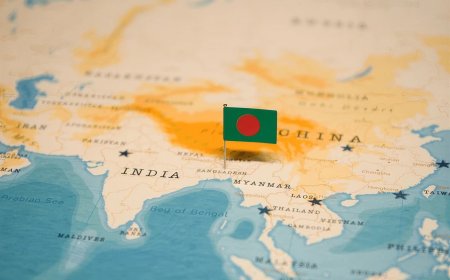
When Bangladesh's Prime Minister Tarique Rahman boards a flight to Beijing between June 23 and 26, he will be making a statement that no diplomatic communiqué could fully capture.
A BNP-led government choosing Beijing as its first major state visit destination after a landslide election victory last February is certainly optics-rich. But anyone who looks beyond the symbolism will find a story that has been quietly building for years.
Bangladesh's relationship with China has always been more complicated than the headlines suggest.
The political history is worth recalling. The BNP is not a newcomer to this relationship. Late President Ziaur Rahman, the party's founder, was instrumental in establishing Bangladesh-China diplomatic ties, and both BNP governments under Khaleda Zia maintained warm bilateral relations with Beijing.
The narrative of BNP skepticism toward China was largely a product of domestic political positioning during the Hasina years, not a fundamental foreign policy orientation.
During the 15 years Sheikh Hasina held power, China became Bangladesh's largest trading partner, a position it has held for 15 consecutive years, and its single largest source of external financing.
Between 2015 and 2025, Chinese investors committed over $30 billion to Bangladesh's infrastructure and manufacturing sectors, and by March 2025, when Chief Adviser Muhammad Yunus met President Xi Jinping, total Chinese investment had reached nearly $42 billion.
The political reality during those years, however, told a different story. The Hasina’s government was economically intertwined with China while being politically anchored to India. Delhi commanded the political relationship; Beijing built the infrastructure.
The Tarique Rahman government has inherited a deep and durable economic partnership with China that successive governments have only sought to deepen.
What the Numbers Say
Bangladesh currently has financing proposals exceeding $9 billion pending across three institutions: $4.34 billion in project loans from the Chinese government, $3.8 billion through the Asian Infrastructure Investment Bank, and $1.2 billion from the New Development Bank.
Priority projects include the Teesta River Comprehensive Management and Restoration Project, Mongla Port modernisation, a Chinese Economic and Industrial Zone in Chattogram, and new railway and digital connectivity infrastructure. An investment conference is scheduled in Beijing on June 24, with the Prime Minister attending as the chief guest.
China has arrived with its own ambitious agenda. Beijing's National Development and Reform Commission has submitted a plan proposing to expand BRI engagement across 23 specific sectors, going well beyond the roads, bridges, and power plants of earlier years to include the digital economy, green development, healthcare, maritime cooperation, cross-border e-commerce, and early-stage cooperation in Bangladesh's emerging electric vehicle ecosystem.
The FTA Calculation
Bangladesh's appetite for an FTA with China speaks to a longer-term structural calculation. The country has just secured a three-year deferral of its Least Developed Country graduation to November 2029, but the eventual loss of preferential trade treatment for its exports, particularly garments, remains on the horizon.
Locking in an FTA with the world's second-largest economy before that transition arrives is precisely the kind of forward positioning this visit creates the opportunity to begin. China has also proposed a currency swap arrangement and a memorandum of understanding on banking and financial cooperation, the building blocks of a more comprehensive bilateral economic architecture.
What the Record Shows
The history of this relationship contains a lesson both sides carry into Beijing this month.
When President Xi Jinping visited Dhaka in October 2016, the first visit by a Chinese president in three decades, the two countries signed 27 agreements unlocking $24.45 billion in soft loans alongside $13.6 billion in private joint ventures.
Bangladesh joined the BRI, the Karnaphuli Multi-Lane Tunnel was launched, and a dedicated Chinese SEZ was announced. In a single visit, China made the largest investment commitment Bangladesh had ever received from any country in its history.
What the eight years that followed demonstrated is that economic depth ultimately depends on the political alignment that sustains it. Hasina's government accepted China's investment while consistently delivering India political deference.
By the time she flew to Beijing in July 2024, hoping to secure $5 billion in budget support, the accumulated weight of those choices had left its mark. China extended 1 billion Yuan, roughly $136 million.
The visit produced MoUs and elevated the relationship to a Comprehensive Strategic Cooperative Partnership on paper, but the figure spoke plainly about what the political asymmetry of the previous eight years had cost. It was also the last overseas state visit Hasina made before the July movement swept her from power, and she fled to India.
The ghost of that visit still lingers heading into late June. The Tarique Rahman government does not carry that political baggage. A BNP administration has no inherited debt to New Delhi of the kind that defined and constrained Hasina's foreign policy for 15 years.
That absence of obligation is, paradoxically, one of the most significant assets Dhaka brings to Beijing this month. The advance preparation of specific project proposals, the investment conference architecture, and the push on FTA negotiations all suggest a government arriving with deliverables in mind, not ceremonies.
Beijing's People-to-People Engagement
There is another dimension to China's Bangladesh strategy that rarely gets the attention it deserves. Since August 2024, Beijing has been systematically building connections across Bangladesh's entire political spectrum.
Delegations from Jamaat-e-Islami and BNP both visited China at the Communist Party of China's invitation in late 2024, followed in February 2025 by a 22-member cross-party delegation spanning eight political organisations on a 13-day trip.
In April 2026, a high-level BNP delegation led by Secretary General and LGRD Minister Mirza Fakhrul Islam Alamgir met Chinese Vice President Han Zheng and CPC International Department Minister Liu Haixing in Beijing, agreeing to work toward a formal MoU on inter-party institutional exchanges.
Bangladesh's Foreign Minister visited Beijing in May 2026 at Wang Yi's personal invitation, and as recently as June 10 to 13, a parliamentary delegation attended the China-South Asia Cooperation Forum in Kunming.
Beyond political delegations, Chinese Ambassador Yao Wen stated in 2025 that approximately 20,000 Bangladeshi students are currently enrolled in Chinese universities, a generational investment that no trade statistic can fully capture.
What distinguishes China's approach is this continuity: Beijing has invested in the relationship at every level regardless of who holds office in Dhaka, and that long-term orientation is the clearest measure of how seriously Beijing takes this partnership.
Teesta, the Corridor, and the Bay
Two projects sit at the strategic heart of this visit. The Teesta River Comprehensive Management and Restoration Project remains the most politically charged item on the agenda. India had decades to deliver a Teesta water-sharing agreement and consistently failed. China stepped in with a concrete proposal, offering Bangladesh a practical pathway toward a challenge that had gone unresolved for too long.
For the northern districts, particularly across the Rangpur division, the political resonance is considerable. The Ganga Water Sharing Treaty with India is also due for renewal in 2026, adding further urgency to Bangladesh's water diplomacy.
The second project with long-run significance is the Bangladesh-China-Myanmar road connectivity corridor extending to Kunming, which would open an overland trade route between Yunnan province and the Bay of Bengal, connecting two of Asia's fastest-developing economic regions with lasting mutual benefits.
China's proposed BRI framework further includes Bay of Bengal blue economy cooperation and Mongla Port modernisation, positioning both countries as co-architects of the region's maritime future.
What to Watch
Prime Minister Tarique Rahman arrives in Beijing with a stronger electoral mandate than any Bangladeshi leader has carried in over a decade, and with a $9 billion development agenda that reflects both the scale of Bangladesh's needs and the depth of its confidence in this partnership.
China's long-standing commitment to Bangladesh's development is well documented, built across decades and governments.
The significance of this visit lies in whether Dhaka brings the political alignment and focused preparation to match it. The advance preparation of specific project proposals, the investment conference architecture, and the push on FTA negotiations suggest it does.
What both governments build from this visit will tell us more about the trajectory of this relationship than any joint statement will.
MD Talebur Islam is a geopolitical analyst, international relations commentator, columnist, and researcher affiliated with the Silk Road School (School of Global Leadership) at Renmin University of China. He can be reached at [email protected].