



























































Dhaka After Dark
The night is not one thing. It is a thousand negotiations, a million small decisions about where to stand, how long to stay, who to trust. The city's soul is not a fixed thing but a process -- an ongoing negotiation between collapse and creation.
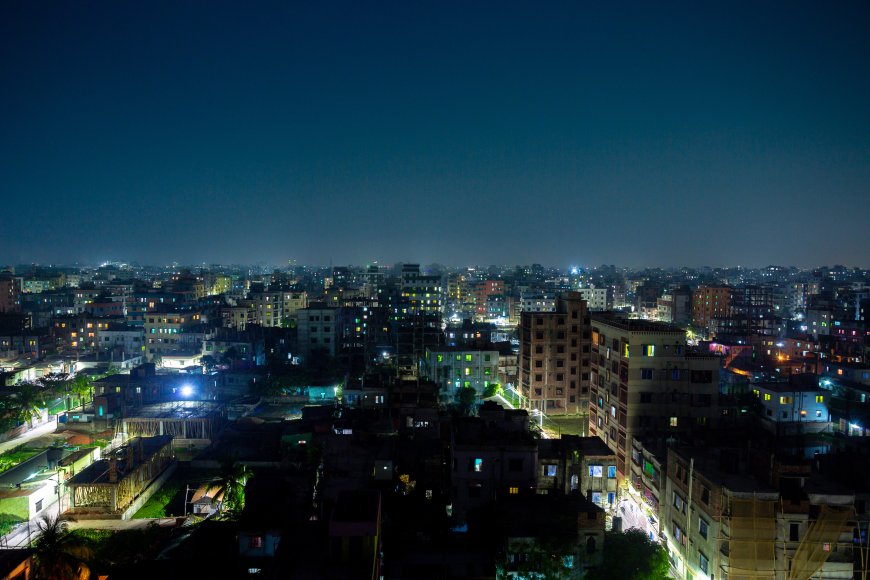
Gulshan-2 roundabout, 1:47 AM. The night guard at the empty bank has folded his plastic chair into a temporary bed, his head tilted at an angle that would terrify a chiropractor.
Across the road, three friends huddle around a single phone, sharing its hotspot because the café closed an hour ago and their dorm has no wifi.
The teenager selling roses -- he can't be more than 14 -- has learned to read couples from fifty paces: The ones who walk too close together will buy; the ones maintaining a careful six inches will not. He is right about nine out of 10.
Do we actually know our nights?
We know the daytime Dhaka -- the gridlock, the grind, the graft. We know which lanes flood in July and which ministers changed portfolios in the latest cabinet shuffle. But after midnight, the city becomes a negative of itself. The streets empty, but something else fills them. The question isn't what Dhaka does to the soul. It is: Which soul? Whose night?
The Shrinking Hour
In February 2024, The Business Standard ran a feature on 300 Feet -- that aspirational expressway in Purbachal, inaugurated in late 2023 with promises of open space and river views. The headline told a different story: "300 Feet: The late-night haven turns barren amid security concerns".
A tea-stall owner, whose name the reporter buried in paragraph twelve, described his frustration: forced to close at midnight when the army patrol begins, watching his livelihood evaporate because someone else's body was found in a lake.
74 people had died on that road in five years -- a BUET student's motorcycle crushed, a family's microbus overturned, the TikTokers who filmed themselves racing replaced by patrol cars scanning empty asphaltl.
The irony cuts deep. This expressway was supposed to be Dhaka's release valve. Now it's a crime statistic.
Judith Butler would recognise this as the precarity of public space -- who gets to occupy it, who is deemed disposable, whose bodies are allowed to linger under streetlights.
But the night doesn't announce its rules. It teaches them through absence. You learn which corners are safe by noticing that no one else is there. You learn which hours belong to you by watching who leaves when the patrol arrives.
But where do the displaced go? When a night haunt dies, its people don't vanish -- they seep elsewhere. The question is: where?
The Illicit City
In Banani, an unmarked door opens onto a staircase that smells of bleach and apple tobacco. Inside, young men and women from wealthy families smoke shisha that tests above the legal nicotine limit -- unaware, or uncaring, that they're inhaling something the narcotics department has flagged as a gateway.
The recent murder at 360 Degrees, a lounge in the same neighbourhood, hangs in the air like the smoke itself: A reminder that the line between pleasure and danger is thinner than the glass in these hookahs.
These bars survive through leaks. Police tipped off before raids. CCTVs at every angle. Street lookouts who know your face after three visits. It's not that the law doesn't know; it's that the law participates selectively.
The casino kingpin arrested at Nexus Café was running shisha, not roulette. But the infrastructure of illegality is the same -- lookouts, loyalty, the constant threat of the next raid.
Who protects these spaces, and who profits? The answer is never simple. Sometimes it's the local thana's inspector, whose nephew manages the door.
Sometimes it's the building owner, whose rent has tripled since the "security concerns" drove everyone else out. The night economy has its own politics, its own hierarchies, its own method of deciding who belongs and who pays.
The Entrepreneurial Dark
Two kilometres away, a different kind of night unfolds.
Shahriar Sazzad graduated with an ICT degree three years ago. He applied to forty-seven companies. He received three interview calls. He now sells kebabs from a cart near Agargaon, having sold his motorbike for startup capital two years ago. Today, he earns Tk 4,000-5,000 daily and has stopped looking for formal employment entirely.
Beside him, a textile engineering student -- she asked not to be named -- sells duck bhuna from a makeshift stall. She balances lab reports with food prep, terrified of RAJUK eviction notices but more terrified of the alternative. Her father's illness consumed the family savings.
Her younger brother's school fees are due next week. The night is the only time she can work without missing classes.
Muhammad Yunus once wrote that human beings are not born to follow -- they are born to create. The night becomes the only time when that creation is possible, because the day belongs to job applications that go unanswered, to interviews that never come, to a formal economy that has decided these graduates are surplus.
Ananya Roy, the urban theorist, argues that informality is not a sector but a mode of survival. These three hundred carts near the Election Commission building are not a shadow economy -- they are the economy. The only one that still works.
The Trunk Economy
Gulshan 2 junction, once known simply as "Raater Kebab er Goli," has mutated into something stranger.
SUVs with their boots open sell sushi from the boot, chips chaat from the back seat, perfumes arranged like a mobile boutique. Asia News Network calls it "Mini Bangkok, minus the regulation."
The fairy lights strung across car interiors flicker against the darkness. The smell of frying chicken mingles with car freshener. Pedestrians weave between vehicles that have claimed the road as their own, constantly aware that any car could suddenly decide to leave.
What does it mean that our most vibrant nightlife happens in liminal spaces? Car boots. Pavements. The edges of expressways where the army patrol hasn't yet reached. Is this resilience? Or is this what resilience looks like when the city refuses to build real public space?
Asia News Network ran a photo essay on this phenomenon in late 2024: Young couples eating sushi from a BMW's trunk, a family sharing plates of phuchka on the median, the whole scene lit by headlights and hope.
The images went viral, shared by Dhaka residents who recognized something true in them -- that the city's soul isn't in its glass towers or its shopping malls, but in these improvised spaces where people make the night their own because the day has no room for them.
What the Lights Hide
NASA's Black Marble imagery captures Dhaka at night -- not as poetry, but as data.
The Night Light Development Index reveals what the naked eye misses: Biman Bandar's NLDI of 0.910, the highest income disparity in the city. Rich and poor breathe the same dark air there, but under different constellations. Pallabi at 0.665. Turag at 0.640. Khilkhet at 0.587.
These are not just statistics. They are the night mapped as inequality.
Achille Mbembe's concept of necropolitics asks who gets to live -- and who is left to die. But the night asks a quieter question: who gets to be seen? Whose lights stay on past midnight? Whose streets are patrolled, and whose are abandoned? Whose darkness is considered dangerous, and whose is considered private?
The satellite doesn't judge. It only records. But the image it returns is unmistakable: Dhaka after dark is not one city. It is dozens, layered on top of each other, sharing the same geography but never the same light.
The Soundtrack of the Sleepless
A city's soul is best heard, not seen.
At 2 AM, the distant wail of an ambulance -- or is it a police van? -- cuts through the generator hum. Tinny Bangla pop drifts from a roadside phone shop that should have closed hours ago.
The rhythmic chopping of a fuchka-wallah preparing for the midnight rush syncopates with the laughter of friends weaving through traffic.
These sounds form a kind of nocturnal liturgy -- a ritual of endurance. The songs of Azam Khan, James, or Warfaze blaring from a passing car are not nostalgia. They are ballast. They keep the city's spirit afloat when everything else threatens to sink.
The teenager selling roses at Gulshan-2 has his own playlist: Habib Wahid's "Meye" on repeat, because his customers respond to it.
The kebab-seller in Agargaon prefers old Azam Khan -- "Rail Line-er Bosthi" reminds him of his father, who drove a rickshaw for 30 years and never complained once. The shisha bars play American rap, because that's what the clientele expects, because everything here is performance.
The Soul Question, Revisited
So what does Dhaka do to the soul?
Perhaps it stretches it between these poles -- the shisha bar and the kebab cart, the patrolled expressway and the boot of a car, the satellite image and the sleeping guard.
Lauren Berlant wrote of cruel optimism: The idea that the things we desire -- stability, community, a future -- are often the very things that exhaust us. Dhaka's residents are experts in this paradox.
The office worker drinking cha at 2 AM. The street vendor napping on his cart. The student burning midnight oil in a cramped dorm. All are caught in a cycle of striving that the city enables and undermines in equal measure.
The night is not one thing. It is a thousand negotiations, a million small decisions about where to stand, how long to stay, who to trust. The city's soul is not a fixed thing but a process -- an ongoing negotiation between collapse and creation.
And if that sounds like avoiding the question -- well, try sleeping here.
The city doesn't.
Playlist: Dhaka After Dark
1. Azam Khan – "Rail Line-er Bosthi" (the original night-worker's anthem)
2. Warfaze – "Obak Bhalobasha" (because 3 AM grief needs volume)
3. James – "Amar Buker Moddhokhane" (the city's unofficial hymn)
4. Shironamhin – "Jar Chilo" (for the empty streets before dawn)
5. Artcell – "Onno Shomoy" (when nostalgia becomes weapon)
6. Habib Wahid – "Meye (Late Night Mix)" (the sound of the trunk-economy generation)
7. The actual songs playing from phone speakers at 2 AM, which no Spotify playlist can capture
Zakir Kibria is a Bangladeshi writer, policy analyst and entrepreneur based in Kathmandu, Nepal. His email address is [email protected].