














































How the BBC’s Red Chair Erases a War Crime
The decolonization of our newsfeeds is not an abstract intellectual exercise; it is a matter of life and death. When a mother in Tehran, a father in Gaza, or a child in the Congo is bombed into oblivion, we owe it to them to bypass the filters of London and New York.
There is a jarring, almost surreal stillness to the image. In the foreground, a woman wrapped in black stares directly at the lens, her face a weathered monument to a grief so fresh it has not yet found its voice. Behind her, the geometry of a classroom has been violently collapsed into a chaotic mound of grey rubble and shattered masonry.
And yet, somehow, a single red school chair remains standing -- upright, defiant, and grotesquely pristine. It sits like a corpse at a funeral, an unspoken witness to the 120 children who will never sit in it again. But it is not the rubble, nor the woman, nor the red chair that chills the blood. It is the caption beneath it, delivered in the sterile white font of the BBC News logo: “‘What was their crime?’: BBC visits Iran school where strike killed 120 children.”
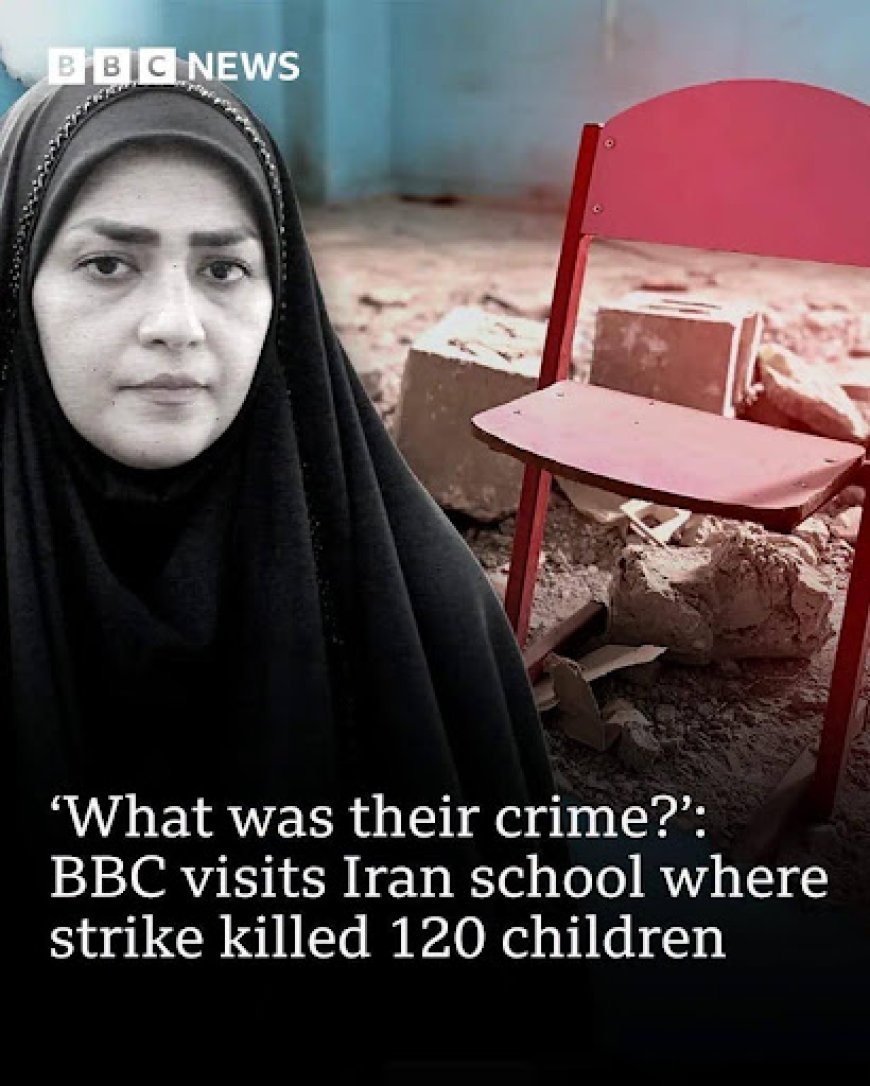
The rhetorical question drips with manufactured moral anguish. It invites the reader to contemplate the innocence of the dead, to ponder the existential tragedy of childhood cut short. But what the headline deliberately, surgically excises is the very thing that defines this event as a crime at all: the perpetrator.
The Western media apparatus is not merely reporting tragedy here. It is performing an act of narrative sanitation, effectively scrubbing the name of the aggressor from the primary historical record while demanding that the victims justify their own slaughter.
The Erasure of the Actor and the Death of Context
This is not an isolated editorial lapse. It is a systemic formula. In my previous analysis for The Daily Star, I dissected how the BBC’s coverage consistently deletes geopolitical context to render Western-allied violence into amorphous, apolitical disasters. This graphic is the living, breathing exhibit of that thesis.
To understand the mechanics, we must look to constructivist International Relations theory, which posits that global reality is not a fixed physical state but a linguistic construct shaped by the most powerful narrators. When a state-funded media giant refuses to name the country that fired the cruise missiles in its headline, it transforms statecraft into weather.
The attack ceases to be a deliberate, calculated act of war and becomes a natural cataclysm -- an earthquake of violence that simply happened to a school. By removing the subject from the sentence, the BBC robs the global audience of a clear moral foothold, denying us the linguistic tools required to demand accountability.
The Double-Tap as a Crime Written in Law
But the moral crime of the headline is dwarfed by the actual war crime the headline refuses to name. Let us speak plainly of the tactic employed: The double-tap strike. This is not the chaotic indiscriminate shelling of an urban battlefield. A double-tap is a calculated, cold-blooded military sequence.
The first strike devastates the target; the second is timed with macabre precision to land minutes later, precisely when the first responders, medics, and frantic parents rush into the smoking debris to pull survivors from the wreckage. Under the Geneva Conventions and Additional Protocols, directly targeting civilians and deliberately striking humanitarian rescue efforts constitute grave breaches of international humanitarian law.
These are not accidents. They are prosecutable war crimes. The BBC, by framing the event as a passive tragedy and omitting the specific military unit and state responsible, does not merely fail to report the crime; it implicitly constructs a legal shield around the perpetrators, turning a prosecutable atrocity into an unanswered philosophical question about the victims’ morality.
The Sensory Grief They Want Us to Mute
One must pause, for a moment, to inhabit the sensory horror they ask us to sanitize. Picture the particle-laced air, choked with chalk dust and pulverized concrete, burning the lungs of those searching for breath.
Hear the unnerving, hollow silence of a school that once vibrated with the cacophony of child’s laughter, now replaced by the muffled sobs of the surviving mothers. Smell the sickening metallic tang of twisted steel and the faint, sweet rot of drying blood. That red chair stands as a devastating literary motif -- an object of profound absence.
In the great tragic novels of the Global South, the loss of a child is never abstract; it is a visceral gutting of the lineage, a rupture in the cosmic order. The BBC’s headline attempts to intellectualize that rupture, to turn a bleeding wound into a detached editorial query. But the red chair refuses the abstraction.
It sits there, unyielding, a rusted testimony that these 120 children were not a statistic, not a theoretical dilemma. They were names, dreams, homework unfinished, and mother-son arguments yet to be had. The narrative erasure of the attacker does not change this truth, but it permits the Western reader to look away, to absolve themselves of the moral burden by convincing themselves they merely stumbled upon a confusing tragedy.
Breaking the Grip: Reclaiming the Right to Name
This is precisely why we, the nations and peoples of the Global South, must violently break free from the narrative grip of the Western media telegraph. The question is not "What was their crime?" The question, buried beneath layers of editorial polish, is far more damning: Why does the West consistently ask us to justify our own survival while meticulously shielding the perpetrators of our extermination?
We cannot afford to be passive consumers of this carefully constructed reality. The decolonization of our newsfeeds is not an abstract intellectual exercise; it is a matter of life and death. When a mother in Tehran, a father in Gaza, or a child in the Congo is bombed into oblivion, we owe it to them to bypass the filters of London and New York.
We must document the war crimes ourselves. We must archive the ordnance, map the flight paths, and name the aggressors with the unflinching precision the Western press refuses to offer. We must craft our own cinematic, literary, and historical records -- not as reactive defenses, but as indigenous counter-narratives that reclaim the right to define our own grief on our own terms.
A Persian mother's trembling testimony must carry the exact same geopolitical weight as a BBC anchor's detached editorial framing. Anything less is a surrender of our reality to those who profit from our fragmentation.
The Chair and the Future
Let us return, one last time, to the red chair. It sits in that collapsed classroom, buried under the debris of a brutal war of aggression, but it is not a tombstone. It is a witness. It is the unblinking, red-colored eye of history, staring down the comfortable hypocrisies of Western journalism. In the Global South, we do not have the luxury of rhetorical neutrality.
We cannot afford the safety of passive objectivity. The silence of the West, as it refuses to name the killer, is not silence at all -- it is a deafening, thunderous complicity in the killing.
We owe it to those 120 children to match that thunder with our own unflinching roar. We will name the perpetrators. We will speak about the legal definitions of the war crimes we have witnessed.
We will build a story so viscerally vivid, so legally grounded, and so unapologetically human that no headline, however carefully crafted, will ever be able to scrub the aggressor’s face from the annals of history again. The red chair will remain. And so will our testimony.
Zakir Kibria is a Bangladeshi writer, policy analyst, and entrepreneur based in Kathmandu, Nepal. His email address is [email protected]