




























![A Ledger of the Soul: Navigating the Allah-Bhagavant Nexus in a 19th-Century Puruṣākāra Jñāna Caupara [Gyan Chauper]](https://counterpointbd.com/uploads/images/202608/image_430x256_6a93baa3b09a7.jpg)





















Two Years After: The Harvest of an Uprising
The demand that drove millions into the streets was never abstract. It was the return of democracy and fair elections to Bangladesh, the right of its people to choose their own government, and through that, make the decisions that would govern their destiny.
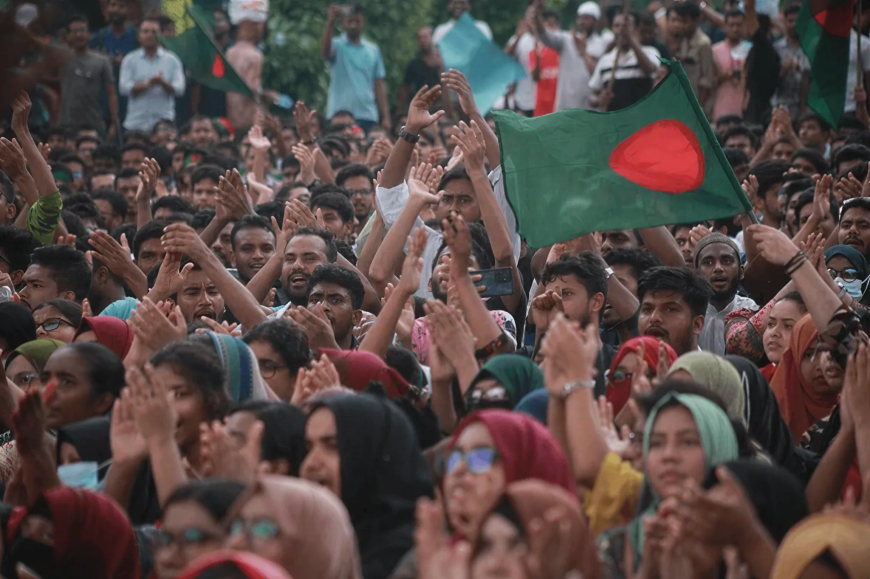
Two years ago, on August 5, 2024, Sheikh Hasina fled from Bangladesh, ending 15 years of increasingly suffocating rule.
Two years later, Bangladesh stands where only the most fortuitous uprisings ever deliver their people: Back under a democratically elected government.
When Tarique Rahman took the oath of office on the South Lawn of the Parliament building following the February 12 election this year, the July Uprising achieved, in a meaningful sense, its fulfillment.
The demand that drove millions into the streets was never abstract. It was the return of democracy and fair elections to Bangladesh, the right of its people to choose their own government, and through that, make the decisions that would govern their destiny. That right has been restored, and the anniversary deserves to be marked as a celebration.
It also deserves to be understood. The July Uprising was the timely merger of two threads, each necessary, each poignant with its own meaning and history.
The first thread was the long, grinding work of opposition politics led by BNP, which chipped away at Hasina's popularity and her foundation for over a decade. The 2018 election settled a question that had lingered since the abolition of the caretaker government system: Hasina would not permit free and fair elections even when the opposition agreed to contest them under her administration.
The midnight ballot-stuffing of that election stripped away any remaining pretense. By 2022, BNP was leading massive nationwide protests, drawing crowds that dwarfed anything the ruling party could assemble organically.
Hasina's answer was repressive force. The crackdowns of December 2022 and October 2023 filled prisons with tens of thousands of opposition activists and decapitated BNP's visible leadership ahead of the January 2024 election.
For that 2024 election, Hasina devised something stranger than mere rigging. To manufacture a facade of competitiveness after BNP's boycott, different flavors of the Awami League ran against each other, with so-called independents and dummy candidates drawn from the ruling party's own ranks.
The result was a Parliament of 300 individuals, but of Hasina, by Hasina, and for Hasina. But the scheme carried a hidden cost. By turning her own party against itself in constituency after constituency, Hasina shattered whatever remained of the Awami League as a functioning political organization.
When the crisis came six months later, there was no party machine left to defend her, only a patronage network that evaporated at the first sign of real danger.
That is why, once the protests erupted in July, Hasina turned to the army with such unnatural speed. This was a leader with a lifelong, and as events proved, entirely justified aversion to the Bangladesh Army. Yet within days, she was relying on it to put down a civilian movement. She was no doubt comforted by the fact that the army chief, General Waker-uz-Zaman, was married to one of her distant cousins.
It was not enough.
Meanwhile, on the streets, BNP's activists and supporters were primed by years of movement-building to sustain the confrontation with unending intensity, day after day, going toe to toe with the goons of the Awami League. They saw the movement through to fruition and, in doing so, laid waste to the age-old boast of the Awami League that no one could outdo it in the streets of Bangladesh.
The second thread belongs to the students, and any honest account must give them their due. The spark that became the conflagration of July 2024 was lit by non-partisan students from public universities, private universities, colleges, and madrasas.
Ever since 2013, BNP had struggled, without success, to solve a riddle: how to launch a movement that united the whole country rather than merely mobilizing its own base. Having been involved, in a minor capacity, with the social media campaign against Hasina, I personally lived through this dilemma and spent countless hours with others, now ensconced in the upper echelons of the current Bangladeshi administration, to try and find a solution.
The answer, when it came, was not a strategy devised in any party office. It was the indomitable spirit of Bangladesh's Gen Z.
When Hasina sneered at the protesting students by invoking the word "Razakar," the gravest slur in the country's political vocabulary, the students turned it back on her within hours.
The slogan that rang out in the streets of Dhaka, "Who am I, who are you? Razakar, Razakar!" refuted the entire edifice of 17 years of her power by turning her words of condemnation into a badge of honor.
Hasina had built her legitimacy on a monopoly over the legacy of 1971, on the claim that she alone stood between Bangladesh and its enemies. A generation born decades after the Liberation War announced that it did not accept her binaries, her history, or her rule.
And when the time came for the endgame, the entire country streamed into the streets of Dhaka on August 5 to witness the end of Hasina. That victory belongs to everyone.
There remain, however, chapters of the story still unwritten. Much of what happened on August 5 can, with hindsight, be traced to General Waker's address to his officers on August 3, when it became clear the army would not keep firing on citizens to preserve one woman's rule.
But how did the tableau of that officers' conference come together? Was the sequence of questions and comments raised on August 3 entirely organic? And what changed Hasina's mind on the morning of August 5 itself, convincing a leader who was ready to cause much, much more bloodshed to continue her regime, that the time had come to flee?
These answers will probably emerge only after the newly-bearded General Waker leaves his position in 2027. But they are important questions, and a nation that intends to learn from its own history will eventually need to discuss them openly.
For now, the anniversary calls for remembrance with fidelity. Remember all those who made the ultimate sacrifice with their lives, the hundreds of young people cut down in the streets whose names are now written into the founding story of Bangladesh's 2024 rebirth.
Remember all those who went out day after day and fought Hasina's goons to a defeat, absorbing bullets, batons, and tear gas so that others could vote freely one day. Remember all those who worked toward this day across 15 long years, in prisons, in exile, in hiding, and who did not live to see it.
And remember Khaleda Zia, who united the nation through its darkest stretch and remained, through illness and confinement, the singular icon everyone could depend on. We will never see anyone like her again.
Finally, best wishes are due to Prime Minister Tarique Rahman and his government. The mandate of February 2026 was made possible by the blood of July 2024, and the task before the new government is to safeguard the harvest of that July: To entrench the institutions of fair elections, to resist the temptations that destroyed their predecessors, and to prove that Bangladesh's democracy, lost and regained, and not for the first time, has come home to stay.
Ehteshamul Haque is a lawyer who focuses on technology transactions. He teaches corporate law at American University.