

































































The Real Lesson Bangladesh Must Learn from Singapore
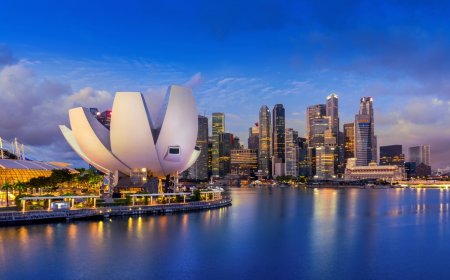
My experiences convinced me that Singapore's greatest achievement lies neither in its skyline nor in its wealth. It lies in how it develops its people. That is why, whenever Bangladesh debates education reform, my thoughts return to Singapore.


Singapore has long occupied a special place in the imagination of Bangladeshis. I have heard that our country's first head of government dreamed of transforming Bangladesh into a "Singapore of South Asia." History did not give him sufficient time to pursue that vision, and whether he could have succeeded is impossible to know.
Yet the aspiration itself has endured. Political leaders continued to invoke Singapore as an example of development, prosperity, efficiency, and good governance.
Once, a senior minister, while visiting Singapore, remarked wistfully: "If only I could spend my retirement in a country like Singapore." It wasn't just admiration for a clean city or an efficient transport system; it was admiration for a nation that had transformed itself within a single generation.
I share that admiration, but mine is rooted not in occasional visits or second-hand accounts. I had the privilege of living in Singapore for more than four years during my diplomatic career. Those years allowed me to observe the country closely -- not simply its physical infrastructure, but also its institutions, public policies, and administrative culture.
My experiences convinced me that Singapore's greatest achievement lies neither in its skyline nor in its wealth. It lies in how it develops its people. That is why, whenever Bangladesh debates education reform, my thoughts return to Singapore.
Few issues in Bangladesh have generated as much discussion as education. Since independence, we have established commission after commission, drafted policy after policy, and experimented with reform after reform. Governments have changed textbooks, altered curricula, revised examination systems, and restructured institutions.
Yet despite these repeated interventions, one uncomfortable truth remains: Our education system is unable to prepare young people for productive employment and responsible citizenship.
The consequences are becoming increasingly grave. English-medium education, once confined largely to affluent families, has expanded rapidly because many parents have lost confidence in public education. Today, even middle-class households make enormous financial sacrifices to send their children to private English-medium schools, believing they offer better prospects than the mainstream system.
The situation in higher education is even more troubling. Universities continue to multiply across the country. Many private institutions operate with inadequate infrastructure, insufficient laboratories, and shortages of experienced faculty.
Public universities continue to expand as well. There appears to be an implicit assumption that increasing the number of degree holders will automatically accelerate national development.
Unfortunately, experience suggests otherwise. Degrees do not create jobs. Economies create jobs. Education should equip people to contribute to those economies.
When the two become disconnected, unemployment among graduates becomes inevitable. Bangladesh is steadily producing thousands of young men and women with bachelor's and master's degrees but without the practical knowledge, technical competence, or marketable skills demanded by employers.
We are, in effect, creating a growing army of educated but frustrated young people. I am not an education specialist. My observations are those of a citizen who has lived and worked in different societies, pursued higher education abroad, and spent years studying how successful countries organise themselves.
Among the many systems I have encountered, Singapore's remains the one I admire most -- not because it is perfect, but because it is realistic.
The world's attention often focuses on Singapore's universities, which consistently rank among the finest globally.
Yet the real strength of Singapore's education system lies elsewhere. It lies in the fact that the country does not believe every young person must become a university graduate.
Singapore begins by ensuring that every child receives a sound foundation in literacy, numeracy, science, languages, and civic values during primary education. As students advance through secondary school, they are assessed not simply by examination scores but also by their interests, aptitudes, and learning potential.
The objective is not to separate winners from losers; it is to guide each student towards the educational pathway where he or she is most likely to succeed. From there, generally three pathways are available.
Students with strong academic interests may proceed to Junior Colleges, which prepare them for university education. Others enter one of Singapore's polytechnics, institutions that combine stringent academic study with practical, industry-oriented education in engineering, information technology, business, health sciences, design, and numerous other fields.
Polytechnics produce graduates who are immediately employable while retaining the option of continuing to university.
Another highly useful institution is the Institute of Technical Education (ITE). In many developing countries, technical education is unfairly viewed as a second-class option. Singapore deliberately rejects that mindset.
The ITE provides world-class technical and vocational education in advanced manufacturing, electronics, hospitality, logistics, healthcare support, and many other sectors. Graduates leave with hands-on skills that employers genuinely need.
Most importantly, these pathways are not dead ends. A student who begins at the ITE may subsequently enter a polytechnic and later continue to university. Likewise, a polytechnic graduate may pursue a university degree if he or she meets academic requirements.
Another important aspect of Singapore's education system is the close partnership between education and industry. Curricula are developed in consultation with employers. Internships are integrated into many programs.
Industry professionals contribute to teaching, while educational institutions regularly adjust courses to reflect technological change and labour market needs. Education, manpower planning, and industrial policy are therefore not treated as separate government functions but as interrelated components of national development.
The result speaks for itself. Singapore does not produce excessive numbers of graduates whose qualifications bear little relationship to available employment.
Nor does it regard technical competence as inferior to academic achievement. A highly skilled technician, precision machinist, software specialist, or laboratory technologist enjoys professional respect because society values competence rather than merely certificates.
Bangladesh, of course, is not Singapore. We are larger, more populous, and face vastly different economic and social realities. It would be unrealistic -- and perhaps undesirable -- to transplant Singapore's system wholesale. Every country must design institutions that reflect its own history and circumstances.
But learning from success is not imitation; it is wisdom. Many years ago, I shared some of these observations with a former Education Minister. His response was dismissive. "You people spend too much time abroad," he told me. "You don't really know what is happening here. You read newspapers and form opinions. Much has already been done."
Perhaps much has indeed been done. Yet the question is not how many policies have been announced, commissions formed, or universities established. The real question is whether our education system is producing graduates who possess the knowledge, skills, and adaptability required by the twenty-first century economy.
That question remains unanswered. Bangladesh stands at a demographic crossroads. Our young population can become our greatest national asset -- or our greatest source of frustration.
If education continues to reward certificates more than competence, memorisation more than creativity, and credentials more than capability, we risk wasting one of our greatest opportunities for national transformation.
Singapore's greatest lesson is therefore not that it is richer, smaller, or more orderly than Bangladesh. Its greatest lesson is philosophical. It understands that the purpose of education is not to maximise the number of university graduates.
The purpose of education is to develop capable citizens, skilled professionals, innovative thinkers, and productive members of society.
Until Bangladesh embraces that principle, we will continue to celebrate rising graduation rates while overlooking the growing number of graduates unable to find meaningful employment.
The challenge before us is not whether we can become another Singapore. It is whether we possess the vision and resolve to rethink our education system so that it prepares young Bangladeshis not simply to earn degrees, but to build their own lives, strengthen industries, sustain our economy, and drive national progress.
The writer was a career diplomat and served as the Bangladesh High Commissioner to Singapore.