











































































Restoring Dignity to Dhaka Streets
Against the grim backdrop of urban neglect, the need for radical transformation in municipal planning becomes clear, demanding an empathetic framework where human welfare takes precedence over chaotic growth.

Every morning, millions of souls pour into Dhaka's sprawling, restless labyrinth, street vendors, garment workers, students, and weary commuters navigating an ocean of concrete and congestion.
For most, the city is a theatre of endless motion, but for thousands, especially women, it is a silent trial of endurance.
Imagine a mother weaving through the bustling thoroughfares of Mirpur or Motijheel, her day dictated not by her professional tasks, but by the quiet, gnawing anxiety of where she might find a clean, safe restroom.
When public sanitation is treated as an afterthought rather than a fundamental civic right, the city becomes inhospitable. Millions are forced to endure hours of physical distress, risking severe urinary tract infections and chronic kidney ailments simply because basic dignity has been locked behind broken doors or priced out of reach.
This daily ordeal creates an invisible barrier that restricts human potential, dampens economic productivity, and strips away the fundamental human right to a comfortable urban existence.
Against this grim backdrop of urban neglect, the need for radical transformation in municipal planning becomes clear, demanding an empathetic framework where human welfare takes precedence over chaotic growth.
A Legislative Awakening for Universal Rights
This silent crisis in our streets has finally met its legislative reckoning through the National Public Toilet Policy 2026, spearheaded by the Local Government Division, with technical support from WaterAid Bangladesh and UNICEF.
Rooted in the foundational mandates of local government legislation, specifically the Local Government (City Corporation) Act 2009 and the Local Government (Municipality) Act 2009 and aligned with the global pledge of Sustainable Development Goal 6 (SDG-6) to ensure sustainable water and sanitation under the sacred ethos of leaving no one behind, this policy reframes sanitation from a municipal chore into an inviolable pillar of human rights and public health.
Historically, national sanitation strategies prioritised household-level latrines while leaving public facilities starkly neglected. The 2026 policy bridges this gap by setting out a comprehensive regulatory roadmap that mandates adequate, gender-responsive, and inclusive public toilets across all urban and rural growth centres.
By acknowledging that a city's greatness is measured not merely by its towering flyovers and commercial high-rises, but by how tenderly it cares for the most vulnerable body traversing its pavements, this policy sets a transformative benchmark for regional and international regulatory compliance.
Redrawing the Northern Blueprint
Translating lofty legislative ideals into concrete municipal asphalt requires visionary planning, rigorous execution, and a steadfast commitment to urban environmentalism.
Across Dhaka's northern expanses, city authorities are turning policy into practice through the Dhaka North City Corporation (DNCC) WASH Action Plan, which aims to make Dhaka a more liveable, inclusive, and environmentally sustainable metropolis.
A landmark census found that within the DNCC jurisdiction, over 312 public toilets exist, yet only a fraction is under direct civic oversight; the rest are fragmented in private hands, often derelict, locked, or discharging untreated effluent into open drains.
DNCC's comprehensive plan introduces a courageous two-fold strategy: Upgrading existing assets through performance-based leasing tied to star ratings and strict cleanliness metrics, and systematically expanding municipal footprints.
Through meticulous geographic mapping, DNCC identified 215 high-, medium-, and low-priority sites across its ten administrative zones, ensuring that even in densely built, space-constrained neighbourhoods, mobile toilets and compact sanitation blocks serve as immediate lifelines.
By regulating agency-managed facilities at fuel stations, transport hubs, and marketplaces, DNCC is successfully establishing a uniform standard of accountability that guarantees continuous public access and operational transparency.
Institutionalizing Accountability in the South
In parallel, the Dhaka South City Corporation (DSCC) has reinforced this municipal renaissance with its newly refined Public Toilet Management Guidelines 2026, enacted under the guidance of its administration and technical partners such as WaterAid and Humfiz.
DSCC’s framework directly addresses the plight of the city's estimated one million floating residents and daytime commuters who sleep in railway stations, parks, and marketplaces.
The guidelines establish rigorous management structures, from cluster-based leasing models to non-lease agreements with community-based organizations, to ensure financial transparency, mandatory female attendants, round-the-clock water supply, and strict accountability for utility bill settlements.
DSCC's institutional model also includes oversight committees at the central and regional levels, integrating diverse stakeholders such as shop owners, religious representatives, and civil society advocates.
By tying operational lease renewals to rigorous star-rating assessments and mandatory audits, DSCC ensures public investments yield tangible, life-enhancing results for ordinary citizens rather than lining private intermediaries' pockets.
The Architecture of Empathy and Inclusivity
The architecture of these modern public facilities dismantles the archaic notion of restrooms as dreary, unapproachable boxes, championing universal design principles and green building concepts instead.
From compact prototype XS mini-complexes for tight urban pockets to deluxe L-scale complexes serving over a thousand daily users, modern sanitation blocks are conceived as inclusive sanctuaries.
They feature wheelchair-accessible ramps, sturdy grab bars, tactile braille signage, and dedicated baby-changing stations to meet the diverse needs of older people, children, and people with disabilities.
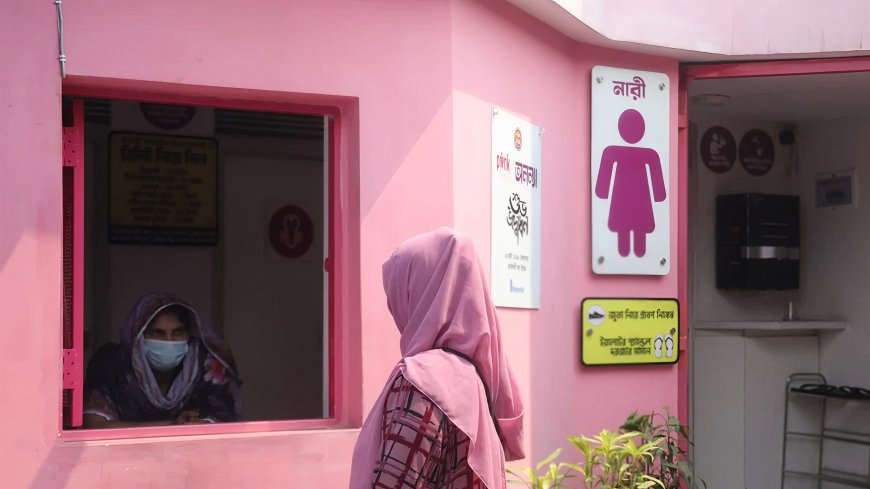
Recognizing the profound gendered dimension of urban mobility, the policy mandates separate, secure female wings complete with menstrual hygiene management (MHM) facilities, sanitary pad vending machines, and private nursing corners for breastfeeding mothers.
Moreover, specialized "Pink" and "Blue" sanitation blocks tailored for low-income communities and informal settlements ensure that female garment workers and male labourers alike find safe, hygienic relief near their homes and workplaces.
Closing the Environmental Loop: Clean Cities and FSM
Crucially, this urban transformation is deeply anchored in achieving a clean, green, and ecologically sound city. A public toilet is only as sound as its environmental ecosystem behind it.
For decades, untreated effluent from overflowing septic tanks and illegal bypass connections has flowed directly into Dhaka's storm drains, canals, and surrounding waterbodies, severely poisoning the urban ecosystem.
The National Public Toilet Policy and municipal action plans confront this ecological wound head-on by mandating strict compliance with the Bangladesh National Building Code (BNBC), integrating green architectural practices such as natural ventilation and solar energy, and enforcing robust Faecal Sludge Management (FSM) to target a strict "zero-pollution" threshold.
Pioneering interventions, such as DNCC's phased cluster categorization and scheduled desludging pilot in Ward 20, demonstrate how specialized vacuum tankers can systematically empty containment units and transport waste to treatment facilities like the Dasherkandi plant.
This systematic approach turns urban sanitation from an invisible environmental hazard into a closed-loop engineering triumph, ensuring public health protection goes hand in hand with ecological preservation and waterbody restoration.
A Profound Business Case for Shared Dignity
Realizing this visionary policy requires a harmonious synthesis of government resolve, community stewardship, and private sector investment. For municipal authorities, success hinges on rigorous regulatory enforcement, digital monitoring dashboards, and active multi-stakeholder coordination involving DWASA, religious institutions, and transport associations.
For the private sector and corporate entrepreneurs, the policy unlocks a transformative economic paradigm in which sanitation is viewed not as a charitable burden but as a viable commercial enterprise.
Through Public-Private Partnerships (PPP), user-fee structures, and innovative business models, such as integrating revenue-generating cafes, automated retail kiosks, or advertising spaces adjacent to toilet complexes, operators can secure long-term financial sustainability while delivering pristine public services.
When a city provides a clean, safe, and welcoming restroom on a bustling street corner, it whispers a profound message to every citizen: You belong here, and your dignity matters. As Bangladesh strides toward sustainable development, this cultural transformation will ensure that every citizen walks Dhaka's vibrant streets with their head held high.
Fayazuddin Ahmad is a legal researcher and development professional.