




























































The People are Reserving Their Judgment. For Now.
The lesson from this survey is a simple one. The government should spend this window of reserved judgment governing, and communicating clearly to the public that it is doing so. The public has made its patience conditional on visible actions, reserving judgment on results. It will not last indefinitely, and it should not be mistaken for endorsement.

Since the Long July of 2024, Bangladesh has seen a flourishing of civil society. Among the more welcome developments has been the emergence of credible opinion polling -- a rarity after 2013, when the ruling party had little use for credible numbers.
Innovision PEPS led the way in this new polling landscape; its successor, Doppler, has now released its first approval rating survey, offering the clearest picture yet of what the public actually makes of the new government.
The survey is a national one, covering 3,443 adults, weighted to the census, with respondents asked a common set of questions in the same interview -- allowing favourable, unfavourable, and “no opinion” responses to be compared cleanly across questions.
The headline results, shown in Figure 1, are unambiguous: Two-thirds rate the Prime Minister well, against a fifth unfavourable; the government fares less well but still comfortably positive, at over half well versus a third badly; and almost half say the country is going in the right direction, over a third who say it is going the wrong way.
Figure 1: Approval Ratings
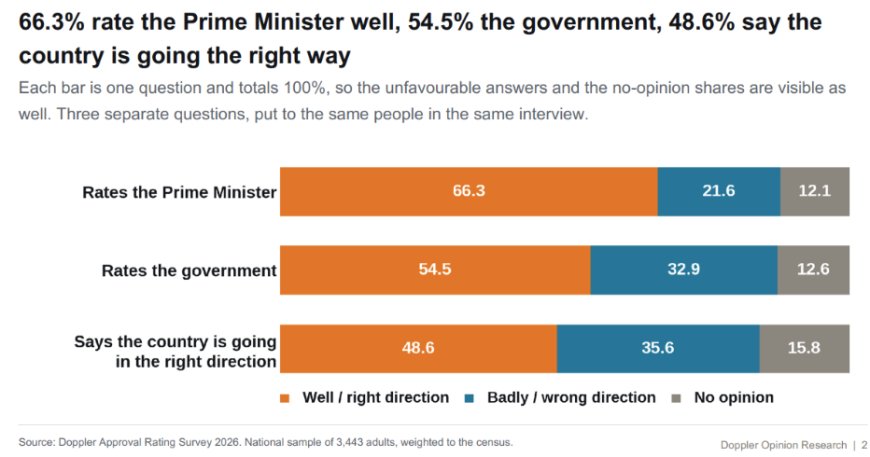
Source: Doppler Approval Rating Survey 2026. National sample of 3,443 adults, weighted to the census.
Pollsters should not interpret their own results -- that is not their job. Analysts, however, should, and there is more than one plausible reading of these numbers.
One possible interpretation, of many, is this: six months into the new government, people are reserving judgment. They see problems mounting on almost every front. But they also understand, correctly, that the government did not create most of these problems.
They are prepared to give it time to fix things. And, for now at least, they like what they see in the Prime Minister. Put differently: People accept that things are tough, but they are not yet blaming the government for it.
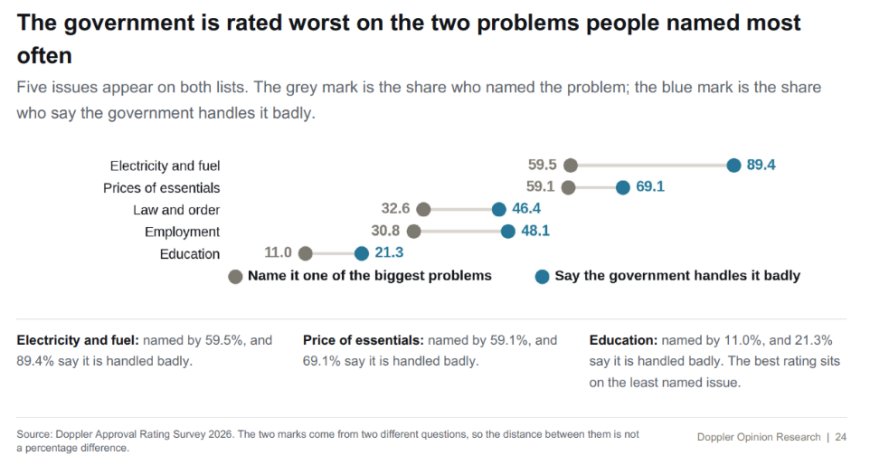
They do not expect this government to fix everything -- or, realistically, very much at all, very quickly. What they want is to see the ministers trying. The evidence for this reading comes into sharper focus in Figure 2.
Figure 2: Problems
Source: Doppler Approval Rating Survey 2026.
The two marks come from two different questions, so the distance between them is not a percentage difference. The pattern here is telling. The government is rated worst -- by a wide margin -- on precisely the two problems that people name most often.
Three out of every five respondents name electricity and fuel as one of the country's biggest problems, and nine out of ten say the government is handling it badly.
Prices of essentials are also named by three out of five, with over two-thirds saying the response is poor.
Education sits at the bottom of both lists: Named by only about one in every ten as a top problem, with just one out of every five rating the government's handling badly -- the best rating in the set, attached to the least-cited issue.
Straying further into interpretation: What should the government take from this?
Start with education. Bangladesh's problems here are well known by experts, and structural -- weak PISA-comparable learning outcomes, underpaid and underqualified teachers, and a widening urban-rural and class divide in the quality of schooling, to name a few.
None of this will be fixed overnight, and everyone knows it. Yet the Education Minister’s singular focus on cracking down on exam malpractice -- nokol ar hobe na, no more cheating -- and on tightening up examinations, was trolled online as a narrow, almost cosmetic intervention.
The polling suggests the public disagreed with the online mockery. People understood that the grade inflation under the fallen regime signified something rotten in the system, and the Minister's crackdown was appreciated precisely because it signalled that the ministry was actually tackling at least one problem, visibly and without excuses.
Will Bangladesh’s education system be fixed as a result? Definitely not. But that’s not the point.
The point is, the poll might be telling us that the public would like to see the Ministers try to tackle something, or at least tell us that they are doing something. The exact opposite is true of electricity and fuel.
The proximate story is straightforward. Fuel shortages first bit when the Iran war disrupted global energy markets; problems in the gas supply chain; rolling load-shedding as domestic gas supply has failed to keep pace with demand.
Beneath that lies a more familiar set of causes: years of underinvestment in domestic gas exploration, heavy and growing reliance on costlier imported and spot-market LNG, ageing power-generation and transmission infrastructure inherited from the Hasina years, and a foreign exchange position too constrained to comfortably absorb a sustained spike in import costs.
Perhaps none of this is the government's fault. But none of it was truly unforeseeable either -- these were known knowns.
Even the Iran war shock became a known known very quickly once it hit. And none of it has an easy or quick fix. So why did the government not take the country into its confidence much sooner about what was coming?
To be clear, optics will not matter in the long run. Whether the economy sinks or keeps this government afloat will ultimately be decided by outcomes, not messaging -- optics will not tip that balance one way or the other.
But right now, in this window of reserved judgment, people want to see the government trying, and being seen to try. Silence in the face of a foreseeable crisis reads as drift, not prudence. And that brings us to the economy.
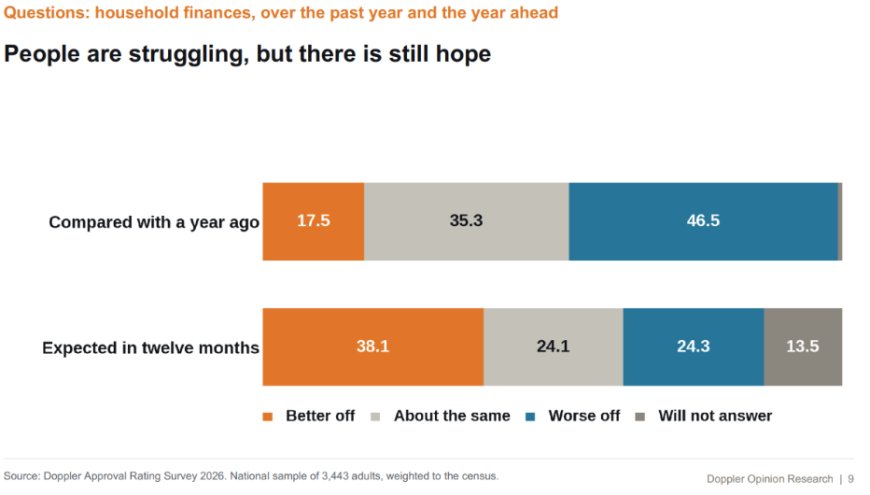
Figure 3: Misery and Hope
Source: Doppler Approval Rating Survey 2026. National sample of 3,443 adults, weighted to the census.
Here the public mood is genuinely double-edged. Asked to compare their household finances with a year ago, less than a fifth say they are better off, against almost half who say they are worse off -- a bleak retrospective judgment that tracks the inflation people have lived through.
Yet asked to look forward twelve months, the picture flips: Nearly two-fifths expect to be better off, against just a quarter who expect to be worse off.
People are struggling, in other words, but they have not given up hope. The government has begun rolling out its signature election commitments against this backdrop -- family cards and similar targeted-support schemes, so far on a pilot basis, aimed at cushioning exactly the households registering the sharpest sense of hardship.
It has also set out its longer-term vision through the Five-Year Strategic Framework for Reform and Development, a national plan built around a phased “recovery, restoration, reconstruction” sequence intended to move the country from post-Hasina fragility toward durable, broad-based prosperity.
But right now, the economy is mired in a stagflationary rut, and no amount of long-term vision changes the current miasma.
Growth was just 2.2 % in the year to March quarter, with the industrial sector actually contracting; given the ongoing energy crisis, growth in the year to current quarter may well be slower still, and could turn negative.
Inflation stands at 8.3 %, and people feel every point of it at their pocket. A loose monetary policy stance, applied into a supply-constrained economy, risks fuelling that inflation further and could yet trigger a fresh exchange-rate problem on top of it.
The budget, as things stand, is not seen as credible. What the government needs to announce, urgently, is a credible energy plan and a credible banking-sector plan.
There is one recent, genuinely encouraging sign. The Finance Minister has begun offering a frank, unvarnished assessment of the country's economic difficulties, rather than the reflexive optimism that so often substitutes for candour in government communication.
That bitter truth-telling is likely to build confidence, not undermine it, because it signals that the government is actually in touch with reality on the ground -- precisely the quality the public seems to be probing for in these polling numbers.
If the government is tempted to feel anxious about facing this economic storm head-on, the polling suggests it need not be -- because, right now, the numbers offer the opposition very little to work with either.
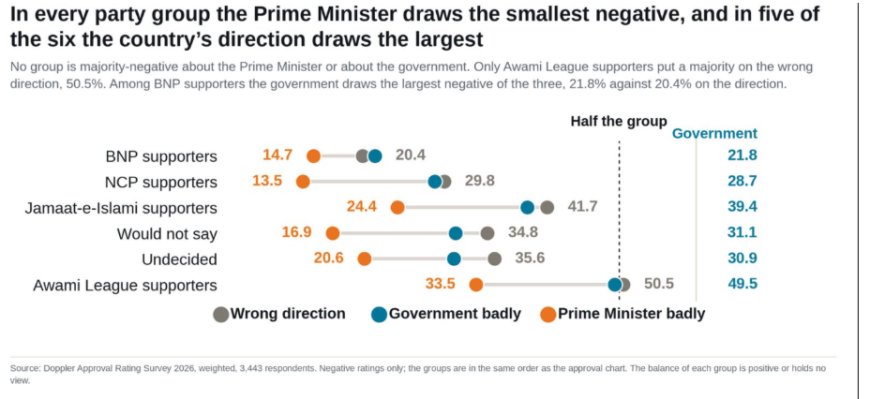
Figure 4: Divided Opposition
Source: Doppler Approval Rating Survey 2026, weighted, 3,443 respondents.
Negative ratings only; the balance of each group is positive or holds no view. In every party-supporter group, the Prime Minister draws the smallest share of negative ratings, and in five of the six groups, the country's overall direction draws the largest negative -- worse, in most people's minds, than either the Prime Minister or the government specifically.
Only Awami League supporters register the slimmest of majority -- barely over half -- saying the country is going the wrong way; even there, only a third rate the Prime Minister badly.
Among BNP supporters, tellingly, about a fifth rate the government and the direction negatively -- a reminder that even sympathetic voters are watching delivery closely, not just personality.
Awami League and Jamaat-e-Islami or NCP supporters, of course, likely hold very different ideas of what the country's “right direction” even means -- and that divergence alone hands the government a measure of political breathing space it might not otherwise enjoy. This will not last forever.
At some point, political realignment will sharpen these divisions into something more coherent and more threatening. But that point lies in distant future.
For now, the lesson from this survey is a simple one. The government should spend this window of reserved judgment governing -- tackling the known knowns of energy and banking with the same visible urgency the Education Minister brought to examinations -- and communicating clearly to the public that it is doing so.
The public has made its patience conditional on visible actions, reserving judgment on results. It will not last indefinitely, and it should not be mistaken for endorsement.
Jyoti Rahman is the Executive Editor of the weekly Counterpoint.