







































![A Ledger of the Soul: Navigating the Allah-Bhagavant Nexus in a 19th-Century Puruṣākāra Jñāna Caupara [Gyan Chauper]](https://counterpointbd.com/uploads/images/202608/image_430x256_6a93baa3b09a7.jpg)



















Beyond the India Fascination
Foreign policy is ultimately not an accounting exercise in who loves us. It is about identifying where interests converge, where they conflict, what each relationship can deliver, what risks it creates, and how those relationships can be converted into bargaining power for Bangladesh.

“Move beyond the fascination with India.”
Fair enough. No sovereign state should be mesmerized by another. But foreign policy does not have to choose neglect as the opposite of fascination. The problem begins when, in trying to escape fascination, we also try to escape geography.
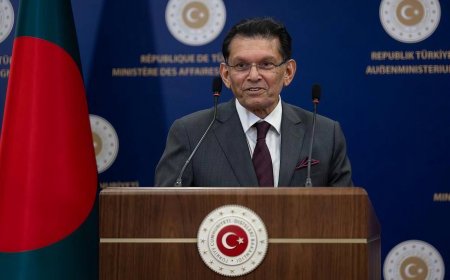
Bangladesh’s State Minister for Foreign Affairs has said that India is “just another neighbouring country.” The formulation will undoubtedly be politically satisfying to many. Given Bangladesh’s long history of emotion, resentment, dependence and partisan politics surrounding India, it may even sound refreshingly sovereign.
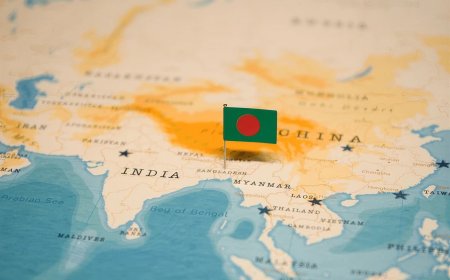
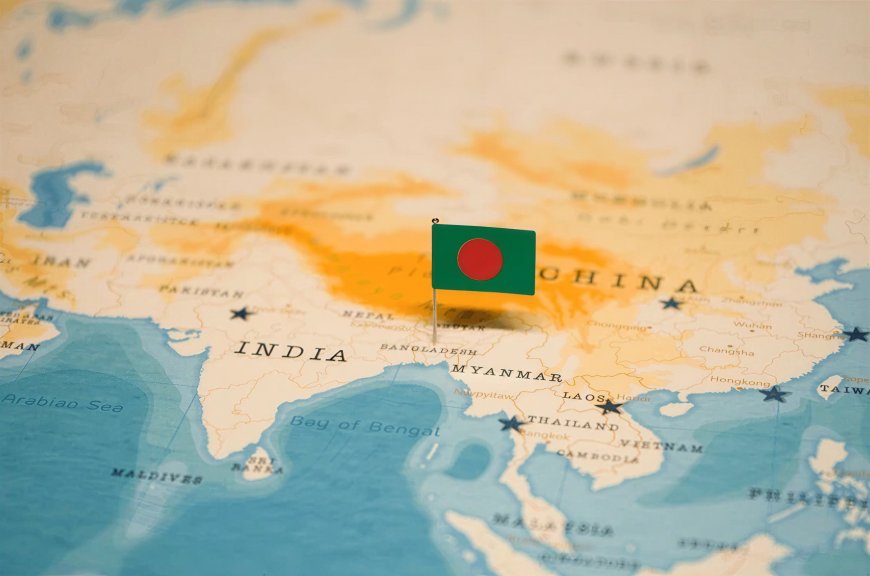
There is only one slightly inconvenient problem: The map.
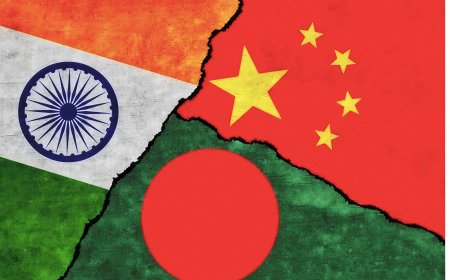
India is not simply “another neighbour” in Bangladesh’s strategic environment. It surrounds Bangladesh along most of its land border and is woven into our everyday calculations over rivers, border management, trade, electricity, transit, security, Bay of Bengal strategy, and connectivity between South and Southeast Asia.
Minister, the unfortunate thing about diplomacy is that geography does not listen to political speeches.
People do. In Bangladesh’s polarized discussion of India, criticism is often sorted quickly into accusations of being either pro-India or anti-India. That binary is precisely what serious foreign policy analysis should resist. I had expected greater strategic sophistication from the country’s foreign policy establishment.
The real question is therefore not whether Bangladesh should admire India. It is whether Bangladesh’s foreign policy will manage the complicated realities of national interest, or turn the politically attractive language of “moving beyond India fascination” into a substitute for strategy.
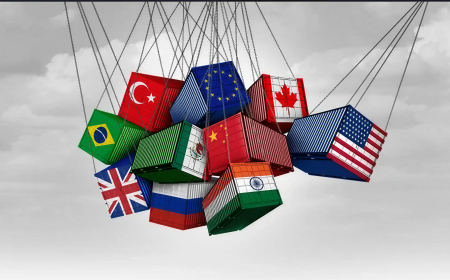
In international politics, not all neighbours carry equal strategic weight. Canada cannot treat the United States as merely another neighbour, any more than Mexico can.
Finland cannot think about Russia in the same way it thinks about every other state, nor can Vietnam or South Korea treat China as strategically interchangeable with other countries, or Nepal do so with India. Proximity itself creates strategic asymmetry.
Whether Bangladesh loves India is therefore beside the point. The relevant questions are harder: What does Bangladesh lose when relations deteriorate? What can it gain from cooperation? Where do interests converge? Where must Bangladesh resist, negotiate or diversify?
Diplomacy is not a hierarchy of affection. It is the management of interests, costs, risks and leverage.
The minister also said, in effect, that Bangladesh cannot think about India “at breakfast, lunch, and dinner.”
It is a catchy political line. As an explanation of foreign policy from a minister, however, it is remarkably lightweight.
If India intersects daily with Bangladesh’s trade, borders, water, security, regional connectivity and electricity supply, then thinking about India every day is quite literally part of the foreign policy establishment’s job. Britain continuously analyses Europe. Japan continuously analyses China. Canada continuously analyses the United States.
That does not make them obsessed. States devote sustained attention to countries capable of significantly affecting their interests because that is what strategic planning requires.
If someone says: “Do not be fascinated by India,” I agree.
If the next proposition is: “Do not think so much about India either,” I do not.
Fascination and strategic attention are not the same thing.
Then comes another line: “Think about your own country.”
This may be the weakest false choice in the argument. Since when did thinking about Bangladesh’s interests and thinking seriously about relations with India become opposites?
It is precisely because Bangladesh should put itself first that it needs to understand India dispassionately.
The distinction is simple. An India centric foreign policy would be a mistake. Treating India as strategically insignificant would also be a mistake. A Bangladesh first foreign policy means managing relations with India, and every other consequential power, according to Bangladesh’s interests.
If the government genuinely believes in “Bangladesh First,” the first question should be: Which external relationships have the greatest capacity to affect Bangladesh’s national interests? Moving India down that list rhetorically does not alter the underlying reality.
The minister’s next proposition comes closer to sound diplomacy: “Whenever bilateral or multilateral discussions are necessary, we will certainly have them.”
But that immediately raises another question.
If India, China, Russia, Brazil, Indonesia, the UAE and other consequential states are gathered at the same BRICS summit, when exactly does the need for multi-lateral engagement become more obvious than this?
Good diplomacy does not always wait until a meeting becomes necessary before searching for someone to meet. Effective states cultivate access before a crisis arrives. A capable diplomat keeps doors open so that, when something goes wrong, the country is not still searching for the door handle.
The minister also argued that it would not be possible to meet everyone on the sidelines.
Of course not. But nobody suggested holding hour long bilateral meetings with thirty leaders.
That is a straw man response to the actual argument.
One of the principal advantages of major summits is precisely that five strategically useful encounters need not require five separate overseas visits. A ten minute bilateral, a brief informal exchange, a conversation at a working dinner, an adviser level exchange, or an agreement to continue discussions later can all carry diplomatic value.
World leaders do not attend the UN General Assembly, G20, ASEAN or BRICS simply to deliver plenary speeches. Side diplomacy is often among the most valuable forms of summit diplomacy.
Saying that there is little point because one cannot meet everyone is rather like saying there is no point going to a university because one cannot read every book in its library.
One cannot read every book.
That does not make staying out of the library an intellectual strategy.
The government may, of course, have an alternative architecture of engagement. If Bangladesh intends to compensate for its BRICS absence through a sequence of high level engagements with India, China, Russia, Indonesia, the UAE and the New Development Bank, that could constitute a coherent strategy.
But that architecture needs to be demonstrated.
“We will talk later” is not, by itself, a strategy. Opportunity costs count in diplomacy too.
The larger problem with the minister’s argument is the binary it creates: As though recognising India’s strategic importance amounts to “India fascination,” while describing India as “just another neighbour” somehow demonstrates sovereignty.
Serious foreign policy works differently.
Vietnam considers China enormously important without subordinating itself to Beijing. India treats the United States as a crucial strategic partner without allowing Washington to determine its Russia policy. Türkiye bargains with Russia while remaining a NATO member. Saudi Arabia maintains a major security relationship with the United States while expanding economic engagement with China.
Strategic autonomy is not created by pretending important countries are unimportant. It is the capacity to recognize their importance without becoming dependent on them.
Bangladesh needs precisely that capacity.
India need not be treated as a deity. Nor does it need to be turned into a demon. And there is little strategic value in shrinking geography by calling it “just another country.”
A mature foreign policy should be capable of holding three propositions simultaneously: Bangladesh has serious disputes with India; Bangladesh and India are also deeply interdependent; and that interdependence can be renegotiated and rebalanced in Bangladesh’s interests.
Then BRICS made the contradiction harder to ignore
The most interesting development is that, now that the New Delhi BRICS summit has concluded, we no longer have to speculate entirely about the conversations Bangladesh might have entered. The summit agenda and outcomes give us a much clearer picture.
The New Delhi discussions encompassed issues including trade and investment, resilient supply chains, cross border payment mechanisms, greater use of local currencies, technology, artificial intelligence, climate cooperation, food and energy security, urban development and research cooperation.
These are not remote geopolitical abstractions for Bangladesh. They intersect directly with its development and economic interests.
More importantly, BRICS has emphasized greater engagement with emerging and developing economies and the importance of its wider outreach mechanisms.
That creates an uncomfortable irony.
Bangladesh’s invitation came through Prime Minister Tarique Rahman’s position as chair of BIMSTEC. That distinction matters. Participation in an outreach format would not have given Bangladesh the same institutional access as a BRICS member, nor should its diplomatic possibilities be exaggerated.
But limited access is not the same as no diplomatic value. The relevant question is therefore not whether Bangladesh could participate as though it were a BRICS member. It plainly could not. The question is whether the access that was available, however limited, was strategically worth using.
So the question becomes more precise: Did the limitations attached to the invitation outweigh the diplomatic value of the access that was actually available?
The minister’s observation that “it is impossible to meet everyone on the sidelines” consequently becomes even less persuasive.
The issue was never whether Bangladesh could meet everyone. Nor should we assume that every desired bilateral meeting would necessarily have materialized.
Summit diplomacy does not work that way. The opportunity lies partly in preserving access: Being present in the diplomatic space where consequential states are gathered and using whatever formal and informal openings the format permits.
If the government concluded that those openings were too restricted to justify attendance, that may be a defensible calculation. But it is precisely that strategic calculation that deserves explanation.
The summit also illustrated a basic principle of multilateral diplomacy. BRICS contains governments with substantial disagreements and competing interests. Yet they continue to occupy the same institutional space and seek cooperation where their interests permit it.
You do not need to agree with someone to sit at the same table. Sometimes the greater the disagreement, the more valuable the table becomes.
And this is where the contradiction in the minister’s wider argument becomes particularly striking.
If Bangladesh genuinely wants to escape an India centric foreign policy, then even a more limited outreach presence at a multilateral summit held in India could have offered a platform for engagement beyond India, including possible contact with other emerging powers present in New Delhi.
Attending BRICS would therefore not necessarily have meant becoming more India centric.
It could have meant using India as the geography of the meeting while seeking to make Bangladesh’s diplomacy less India centric.
By declining, Bangladesh also gave up whatever diplomatic possibilities that outreach presence might have created beyond its engagement with India.
On the one hand, we are told not to think about India morning, noon and night.
On the other, Bangladesh declined a multilateral setting that, although institutionally more limited than full BRICS participation, would still have placed its prime minister within a wider diplomatic gathering involving several consequential powers.
So what exactly does moving beyond India centric foreign policy mean?
Does it mean giving India less attention?
Or does it mean giving Bangladesh more relationships beyond India?
If the answer is the latter, Bangladesh’s empty chair at BRICS becomes considerably harder to explain.
That is the deeper lesson of strategic autonomy. It is not achieved by reducing the number of important countries in our mental map.
It is achieved by expanding the number of meaningful relationships available to us, so that no single country becomes Bangladesh’s only door.
India must be calculated. So must China. So must the United States, Russia, Japan, Europe and the Gulf.
Foreign policy is ultimately not an accounting exercise in who loves us. It is about identifying where interests converge, where they conflict, what each relationship can deliver, what risks it creates, and how those relationships can be converted into bargaining power for Bangladesh.
“India is just another neighbour” may sound like a declaration of independence.
But for a small or middle power, genuine strategic independence does not come from denying the importance of consequential states.
It comes from multiplying its options.
And after the New Delhi BRICS summit, the question for the government is therefore even more direct:
If Bangladesh really wants to think beyond India, why did it decide that even the more limited diplomatic access available through BRICS Outreach was not worth using?
The answer may begin with protocol.
But if it ends with protocol, it is difficult to call it geopolitical strategy.
Dr. Lubna Ferdowsi is an academic and researcher based in England.