



























































Who Owns July’s Azadi?
July’s azadi was powerful because it was capacious. It united people who agreed on the regime they opposed but not necessarily on the republic they wished to build.
A slogan is a political compression device. It reduces diffuse grievance to rhythm, gives strangers the same words, and synchronises thousands of bodies before they have agreed on a programme.
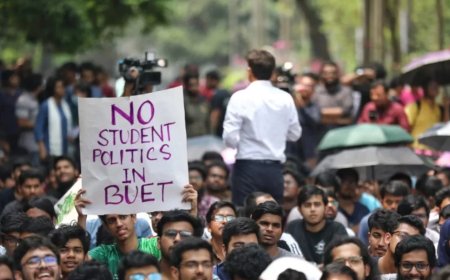
Bangladesh’s July uprising demonstrated this power with unusual clarity. Its language did not merely describe the revolt. It helped produce it. Abu Sayed’s killing on July 16 was the movement’s decisive moral rupture.
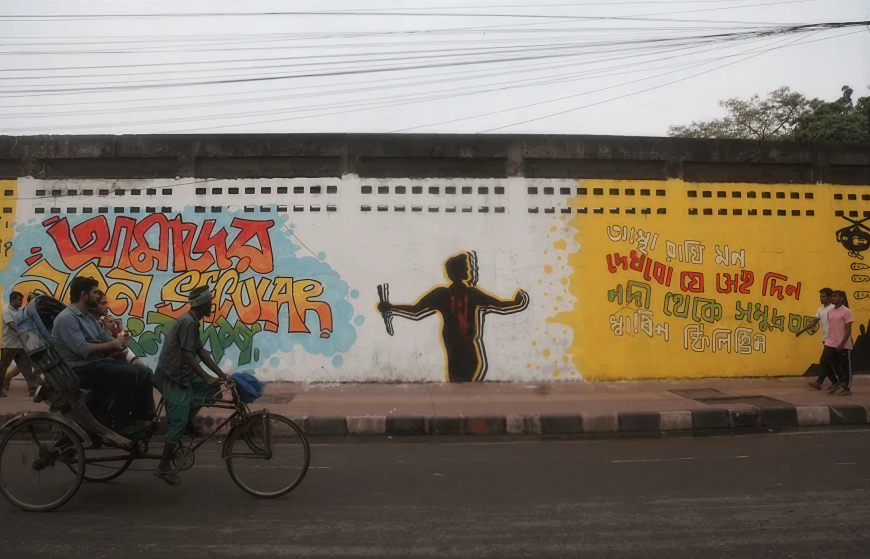
The image of him standing with arms outstretched before armed police made a complex accusation instantly intelligible: An unarmed citizen had offered his chest, and the state answered with bullets. “বুকের ভেতর অনেক ঝড়, বুক পেতেছি গুলি কর” converted that image into repeatable defiance.
“তোর কোটা তুই নে, আমার ভাই ফিরিয়ে দে” recorded the movement’s transformation from a dispute over employment into a demand for justice for the dead. By August 3, “এক দফা, এক দাবি” removed the last ambiguity.
The demand was no longer reform within the government, but the government’s departure. This was distinctly Gen Z language: Brief, ironic, visual, and designed to move between street, wall, reel, and meme.
When protesters reclaimed “Razakar,” an insult intended to delegitimise them, they reversed the state’s language against the state. Bangla, English, and borrowed Persian or Urdu expressions coexisted without permission from linguistic purists.
Gen Z did not wait for party intellectuals to author an official vocabulary. It crowdsourced one. Within that vocabulary, “azadi” deserves scrutiny.
Bangladesh’s Accessible Dictionary records আজাদি as a Bengali noun meaning freedom or independence, while tracing it to Persian. Its origin does not make it alien to Bangla, still less inherently Islamic.
Languages are not passport offices. Bangla itself is an archive of civilisational encounters. The important question is why this word became politically useful.
One explanation lies in the exhaustion of established nationalist language. “Joy Bangla” remains inseparable from the Liberation War, but years of state and party appropriation had made it, for many protesters, difficult to deploy against an Awami League government.
Its mandatory use at state programs and educational institutions had blurred the line between national memory and official loyalty. “Azadi” offered semantic distance. It carried the authority of liberation without appearing to belong to the regime being challenged. Yet chronology counsels caution.
The early movement’s best documented slogans concerned quota, merit, “Razakar,” killings, and justice. “Golami na azadi” became especially conspicuous in mobilisation after the uprising.
It may therefore be both a slogan of revolt and a slogan through which later actors sought to define what the revolt had meant.
This is where Arundhati Roy’s Azadi: Freedom. Fascism. Fiction. becomes illuminating. Roy follows the word across political contexts.
In Kashmir, azadi commonly means freedom from India. In protests elsewhere in India, it was recast as freedom within India, including freedom from hunger, caste, patriarchy, and repression. In her introduction to Azadi, Roy describes genuine azadi as “freedom with responsibility.”
Her account of Hindustani’s partition into Hindu coded Hindi and Muslim coded Urdu also warns against assigning a religion to a language.
Her point is not that azadi has one permanent meaning, but that freedom acquires moral content from the world it seeks to create.
Bangladesh must therefore ask: Azadi from whom, azadi for whom, freedom to establish what, and who was left less free after victory?
For many, July’s azadi meant freedom from authoritarian rule, fear, enforced silence, and captured institutions. For others, it also meant freedom from perceived Indian tutelage.
The later pairing of “Golami na azadi” with “Delhi na Dhaka” made that connection explicit. Criticism of Indian policy, or of unequal bilateral relations, is a legitimate question of sovereignty. It becomes majoritarian when Bangladeshi Hindus are imagined as India’s domestic proxies.
An external grievance is then transferred onto citizens required to prove a loyalty that the majority is never asked to demonstrate. The same distinction applies to religion.
Azadi is not an Islamic theological term, but it can acquire a religious register from the slogans and political projects surrounding it. Its use beside Islamist expressions may colour its meaning for particular constituencies. That does not prove that the student movement designed it to divide Muslims and minorities.
There is no sound evidence of such a coordinated design. But origin, appropriation, and effect are different questions. A slogan can begin inclusively, later be monopolised, and eventually legitimise exclusions its earliest users never intended.
The attacks on Hindu homes, businesses, and places of worship after August 5 make this more than a semantic concern. International assessments found intersecting motives, including political revenge, religious and ethnic prejudice, local conflict, and property disputes.
Calling an attack “political” does not remove its communal character when the victim is selected through the stereotype that Hindus belong to the Awami League or India. Nor does misinformation in parts of the Indian media erase documented victimisation.
If a minority citizen became more afraid after the fall of authoritarianism, liberation was distributed unequally. Regional comparisons sharpen the point. Sri Lanka’s Aragalaya found devastating clarity in “Gota Go Home” and turned its protest village into “GotaGoGama.”
The slogan identified a ruling dynasty, but risked reducing a structural crisis to one family. Tamil critics also questioned whether the movement’s universal “people” fully included minority histories. A street can be socially broad while its imagined nation remains narrow.
Nepal’s 2025 Gen Z protesters used “Shut down corruption, not social media,” “NepoKids,” anime imagery, and Discord organisation to make censorship look like an admission of guilt.
Yet the violence and fragmentation that followed showed that virality cannot supply a constitutional settlement. India’s 2026 “Cockroach Janta Party” offers an even closer linguistic parallel.
Young protesters reclaimed “cockroach,” much as Bangladeshi students reclaimed “Razakar,” transforming insult into collective identity. India’s movement, however, remained focused on unemployment, examination leaks, and ministerial accountability, while Bangladesh’s escalated towards regime change.
These movements share a grammar: The insult reclaimed, the meme turned into a banner, digital idiom carried into the street, and repression converted into moral acceleration. Their divergence lies in what followed.
A slogan can identify the intolerable. It cannot design the constitutional order replacing it. July’s azadi was powerful because it was capacious. It united people who agreed on the regime they opposed but not necessarily on the republic they wished to build.
That ambiguity was an insurgent strength and is now a democratic danger. Whoever captures the meaning of azadi can claim ownership of July, its martyrs, and its future.
The answer is not to police the word’s Persian origin or assign it to one religion. It is to give it constitutional substance.
Azadi must mean freedom from arbitrary power and freedom under equal law, freedom for the dissenter as well as the victor, for the Muslim majority and every minority, and from both state authoritarianism and mob sovereignty.
Otherwise, July will have changed who may dominate Bangladesh without changing the meaning of domination.
Barrister Khan Khalid Adnan is advocate of the Supreme Court of Bangladesh, fellow at the Chartered Institute of Arbitrators, and head of the chamber at Khan Saifur Rahman and Associates in Dhaka.