







































































Dhanmondi 32 and the Theatre of Impunity
But for the first time, the ghosts of Dhanmondi 32 have found a voice in a court of law. The question now is whether the system will listen -- or whether this too will become another act in the long-running performance of impunity.
Dhanmondi 32 was never just bricks and mortar. It was Bangladesh's memory palace -- the residence where Bangabandhu Sheikh Mujibur Rahman plotted political strategy, where his children grew up, and where he and most of his family were brutally assassinated on August 15, 1975.
The house witnessed the birth of the Six-Point Movement in 1966 and became the symbolic heart of the nation's founding mythology.
After Mujib's assassination, the residence was transformed into the Bangabandhu Memorial Museum in 1994, preserving blood-stained walls and bullet-riddled artifacts as sacred relics of national sacrifice.
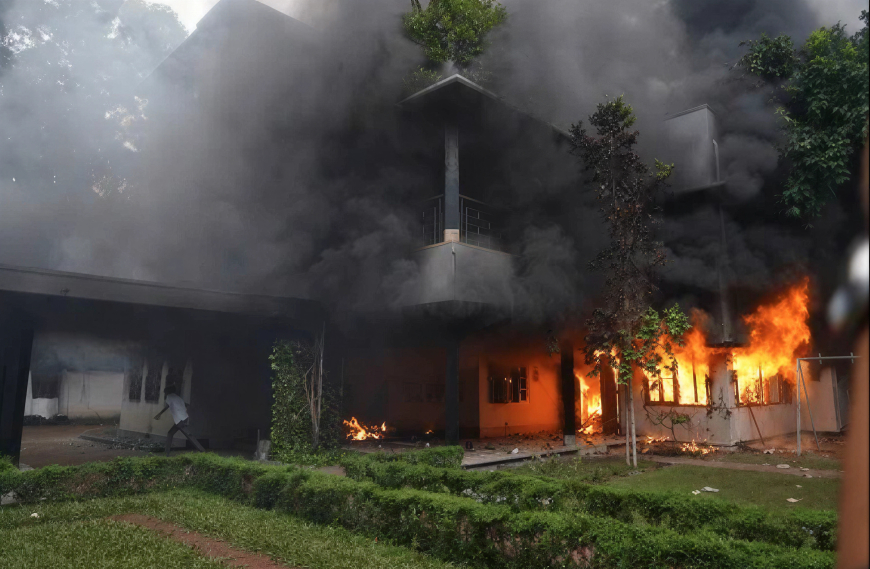
For 30 years, it stood as a site of pilgrimage -- until February 5-6, 2025, when it was systematically dismantled before cheering crowds in what can only be described as a choreographed spectacle of political erasure.
The Performance Unfolds
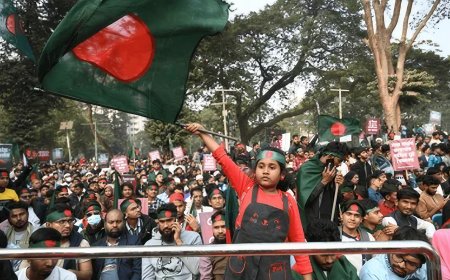
The demolition began with cinematic precision. As Sheikh Hasina, Bangladesh's ousted prime minister, delivered a live-streamed address from exile in India, crowds gathered at Dhanmondi 32 responding to social media calls for a "Bulldozer Procession".
Hasnat Abdullah, convener of the Students Against Discrimination movement, had proclaimed on Facebook: "Tonight Bangladesh will be freed from the shrine of fascism."
The protesters broke through the gates, vandalized the interior, and set fires that engulfed the second floor. The situation escalated with almost theatrical timing -- heavy machinery arrived, including excavators and cranes, to methodically dismantle the structure.
Protesters chanted slogans: "Fashi Fashi Fashi Chai, Sheikh Hasinar Fashi Chai" (We want Sheikh Hasina hanged); "Sara Banglae Khobor De, Mujibbader Kobor De" (Inform entire Bangladesh, the grave of Mujibism); "Awami League-er Pretatta, Bangladeshe Thakbe Na" (The ghosts of Awami League will not stay in Bangladesh).
The demolition continued through the night and into the next day. By 5pm on February 6, the once-historic house lay in ruins.
People swarmed over the rubble, collecting scrap metal, wood, and even door latches as macabre souvenirs. Simultaneously, other properties associated with the Sheikh family were attacked - Hasina's residence Sudha Sadan was set ablaze, murals of Mujib were defaced in Sylhet, and homes of Awami League leaders were demolished across the country.
The performance spread nationwide, coordinated and brutal in its execution. Onlookers slaughtered a cow and held a feast amid the ruins.
State Complicity
What transformed this event from spontaneous violence to political theatre was the deliberate inaction of state authorities.
Despite the presence of security forces, including military units that arrived at the scene, there was no meaningful intervention to stop the destruction. The interim government of Muhammad Yunus issued a statement characterizing the events as "unexpected and unintended," blaming Hasina's "provocative remarks" for triggering public outrage.
Yet as the Prothom Alo op-ed noted at the time: "We saw the destruction began with an announcement ... The manner in which bulldozers and other tools were used for the demolition, it was evident that government organisations were involved.
The army has been given magistracy power, but they remained silent". The op-ed posed a haunting question: "The mystery was, who is actually taking decisions in the government, how and why?".
Transparency International Bangladesh criticized the government's "alarming nonchalance" in preventing the demolition despite prior announcements of violent plans on social media.
This calculated non-intervention suggests what Italian philosopher Giorgio Agamben would identify as a deliberate creation of a "state of exception" -- a suspension of the normal legal order where the boundaries between public authority and private violence become intentionally blurred.
The state apparatus became both stage manager and audience in this theatre of destruction.
When the House Becomes a Battlefield
Agamben's concept of stasis helps us understand the Dhanmondi demolition as something beyond mere vandalism.
Stasis (from the Greek meaning both "civil war" and "standing up") represents a moment when the normal distinctions between public and private, family and state, friend and enemy break down completely.
The attack on Mujib's residence exemplifies this collapse -- a private home that had become public symbol now became a battlefield where historical grievances were violently settled.
In states of stasis, Agamben argues, the very foundations of political order are contested through performative acts of violence. The demolition of Dhanmondi 32 functioned as a ritual of refoundation -- an attempt to establish a new political beginning through the destruction of the old symbols.
The interim government's complicity suggests what Agamben would call a "zone of indistinction" where the state simultaneously suspends the law and enables extra-legal violence, thereby positioning itself as the arbiter of what constitutes legitimate political action.
The spectacle also exemplifies what French theorist Jean Baudrillard would recognize as hyperreality -- where the representation (the idea of Dhanmondi 32 as "shrine of fascism") becomes more real than the actual historical referent, thereby justifying its destruction through a self-referential logic.
The protesters were not attacking a physical structure so much as an imagined symbol that had been discursively constructed through months of anti-Awami League rhetoric.
Killing the Dead Man Again
The demolition represented what anthropologists would call a symbolic parricide -- the killing of the founding father for a second time, half a century after his physical assassination.
The violence directed at the museum continued the work of the 1975 coupmakers, erasing not just the man but his memory from the national landscape. The semiotic violence extended beyond the physical structure. Protesters looted artifacts -- blood-stained clothing, personal effects, historical documents -- thereby desecrating the material witnesses to Bangladesh's founding.
One young man was seen walking out of the art gallery building with a book on Sheikh Russel, Mujib's youngest son killed in the 1975 massacre: "I found it inside. There were a few but people took them all. You won't find any now," he said .
Others focused on tearing out pipes and metal fittings with resale value. "They are demolishing it, so we are taking whatever we can. Whatever we get is a gain," said one laborer.
The violence echoed what Freud termed the compulsion to repeat -- a neurotic need to reenact traumatic events until one achieves mastery over them.
Bangladesh's political history has been characterized by such repetitions: The 1975 assassination, the 1981 assassination of President Ziaur Rahman, the cyclical violence between political factions, and now the 2024-25 attacks on symbolic sites.
Each repetition claims to settle historical accounts but instead deepens the national trauma.
The Quest for Justice
On August 20 -- 19 months after the demolition -- a case petition was filed against twenty-seven people, including former interim government chief adviser Muhammad Yunus and former law adviser Asif Nazrul, over the alleged vandalism and arson at the Sheikh Mujibur Rahman Memorial Museum.
Tamanna Chowdhury Priyanka filed the petition before Dhaka Metropolitan Magistrate. The court recorded her statement and kept its order pending.
The complaint alleges that on February 5, 2025, between 3,000 and 5,000 people formed an unlawful assembly, armed with sticks, hammers, and combustible materials, and attacked the Dhanmondi 32 residence with the accused's direct support, incitement, and cooperation.
The attackers entered the building at around 10pm, vandalized and set fire to it, and looted historical artefacts, documents, Liberation War records, documentaries, books, and other valuable items.
Two bulldozers, an excavator, hammers, and other heavy machinery were brought in to demolish the building, which was reduced to rubble by around 5pm the following day. The complaint further alleges that some of the accused went live on YouTube and Facebook to incite and support the vandalism, while others provided financial assistance.
Most damningly, it claims that despite prior announcements of the planned attack, the accused who were in government positions took no steps to protect the property.
Among those named in the petition are former environment adviser Syeda Rizwana Hasan, former home adviser Lt Gen (retd) Jahangir Alam Chowdhury, cultural affairs adviser Mostofa Sarwar Farooki, NCP Convener and lawmaker Nahid Islam, NCP spokesperson Asif Mahmud Shojib Bhuyain, Mahfuz Alam, Hasnat Abdullah, Sarjis Alam, and others -- a who's-who of Bangladesh's post-Hasina political landscape.
The Court's Response
However, the court did not immediately accept the case. According to reports, Metropolitan Magistrate found insufficient grounds to take cognisance of the complaint and rejected it.
The state prosecutor's lawyer, Shamsuddoha Sumon, told reporters that "the court rejected the case application as there was no basis to accept it." The complainant's lawyer, AKM Sharif Uddin, however, told reporters that the court had recorded the complainant's statement and kept its order pending.
The discrepancy in reporting -- whether the case was "rejected" or merely "kept pending" -- reveals the legal limbo in which Bangladesh's quest for justice now finds itself. What is clear is that no arrests have been made, and the accused remain free.
The complaint requested arrest warrants against the accused under sections of the Penal Code, the Explosive Substances Act, and the Anti-Terrorism Act. But the court has yet to grant them.
This mirrors the 1975 Indemnity Ordinance that protected Sheikh Mujib's killers from justice.
History repeats -- first as tragedy, then as farce, and now as legal spectacle.
The Spectacle That Failed to Liberate
The demolition of Dhanmondi 32 was marketed as liberation -- "freeing Bangladesh from the shrine of fascism." But Bangladesh appears less liberated than trapped in a cycle of repetitive violence.
The interim government struggled to manage the economy amid high inflation and declining growth. Mob violence increased dramatically, and religious minorities faced escalating attacks.
The spectacle of destruction ultimately failed to achieve its promised liberation because it addressed symbols rather than substance.
As Sheikh Hasina noted in her exile address: "They may destroy a building, but they won't be able to erase the history." The comment proved prophetic -- the demolition created neither a new political foundation nor reconciled old grievances.
Instead, it added another layer of trauma to Bangladesh's troubled political consciousness. The case petition of August 20, 2026, represents a fragile hope that Bangladesh might break its cycle of impunity.
Whether the court will ultimately hear the case, whether arrest warrants will be issued, and whether justice will prevail remain uncertain. But for the first time, the ghosts of Dhanmondi 32 have found a voice in a court of law.
The question now is whether the system will listen -- or whether this too will become another act in the long-running performance of impunity. The bulldozer's reckoning has begun. But will it end in justice, or will it join the long graveyard of Bangladesh's unprosecuted political crimes?
Zakir Kibria is a Bangladeshi writer, policy analyst and entrepreneur based in Kathmandu, Nepal. His email address is [email protected].