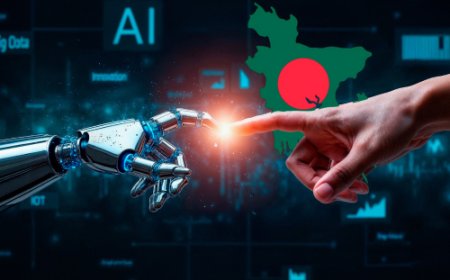





































































Bangladesh Cannot Afford to Miss the AI Train.
History rarely tells countries in advance that the rules of economic advantage are being rewritten. This time, the warning is already visible. Bangladesh cannot recover the technological revolutions it entered late. But it can still decide whether it arrives late to this one.

Some technologies make economies more efficient. Others rewrite the rules by which economies compete.
Steam power did it. Electricity did it. Computing and the internet did it.
Each transformed not only how people worked, but where economic power accumulated. Countries able to build the institutions, skills, infrastructure, and industries around these technologies gained advantages that lasted for generations.
Artificial intelligence may be the next such rupture. The World Economic Forum reports that 86% of employers expect AI and information-processing technologies to transform their businesses by 2030. The IMF estimates that almost 40% of global employment is exposed to AI.
For Bangladesh, this should not be treated simply as another technological trend to eventually adopt. It is a development opportunity we cannot afford to approach late.
Bangladesh entered previous technological transformations from positions of profound disadvantage. Bengal experienced the Industrial Revolution under colonial rule. When the computer and internet revolutions accelerated in the late 20th century, Bangladesh was still a young, capital-scarce state struggling with far more basic development challenges.
AI arrives under different circumstances. Bangladesh today is sovereign, globally connected, digitally experienced, and home to a vast young population.
We cannot replay the technological revolutions we entered late. But we can decide whether we enter this one late too. And that requires treating AI capability as human infrastructure.
The good news is that Bangladesh already possesses an overlooked window through which it can begin doing this at scale: The period immediately after the SSC examination.
This year alone, more than 1.85 million students sat for the SSC and equivalent examinations. For these students, the period between completing SSC and beginning Class XI is one of the rare pauses in an otherwise relentlessly examination-driven education system.
Before SSC, students are consumed by school and board examinations. Once higher secondary education begins, the pressure quickly returns. After HSC comes university admission, perhaps the most competitive stage of their academic lives.
But after SSC, there is an unusual window: A substantial stretch of relatively uncommitted time that is difficult to find at almost any other stage of a student’s academic journey.
Students at this stage are no longer children. They are mature enough to understand how AI works, experiment with it meaningfully, think critically about its limitations, and begin using it to solve problems.
Yet they are also young enough for those skills to shape how they learn throughout higher secondary school, university, and eventually their careers. Bangladesh should turn this transition period into a national AI-learning window.
This does not mean teaching teenagers how to type clever questions into ChatGPT. Nor should AI education begin only after SSC. Basic AI literacy should increasingly enter education much earlier. UNESCO already recommends progressively developing students’ understanding of AI, human agency, ethics, applications, and responsible use.
But the post-SSC period offers something different: An opportunity for the first intensive and nationally coordinated exposure to AI.
A serious programme could teach students what AI actually does and does not do; how to collaborate with AI tools effectively; how to verify outputs and detect hallucinations; how bias, misinformation, privacy, copyright, and academic integrity matter; and how AI can be applied to research, productivity, creativity, coding, entrepreneurship, and real-world problem-solving.
The objective should not be to turn 16-year-olds into machine-learning engineers in a few months. It should be to ensure that an entire generation enters adulthood understanding one of the technologies most likely to shape its future.
Bangladesh’s own draft National AI Policy already recognizes the need for structured AI and computational-thinking education and for rapid, accessible AI training. The question now is how to translate that ambition into something that can reach students quickly and at scale.
The government should convene credible Bangladeshi and international educators, technologists, AI researchers, industry practitioners, and curriculum specialists to design a programme specifically for this age group. It should be modular, regularly updated, available in Bangla and English, and built around practical competence rather than another examination to memorize.
Delivery need not begin with an enormous new physical infrastructure. A national online platform could provide mobile-friendly lessons, exercises, assessments, and project work. Students could register using their existing education-board credentials. Those completing the programme could receive certification or other incentives.
But online delivery cannot mean pretending Bangladesh’s digital divide does not exist. Students without reliable devices, connectivity, or suitable learning environments must be able to access the programme through schools, colleges, computer laboratories, libraries, and other public facilities.
The post-SSC programme should also be only the beginning. At the higher-secondary level, the existing ICT curriculum should be fundamentally updated to reflect contemporary digital realities, with AI becoming a substantial component rather than an occasional addition.
Universities, in turn, should move toward discipline-specific AI education. An engineering student, economist, doctor, journalist, lawyer, historian, and diplomat will use AI differently. They should learn accordingly.
Bangladesh does not need to imagine that it will suddenly outspend the United States or China in building frontier AI models. Training those systems requires enormous computing power, advanced chips, energy, research ecosystems, and capital.
Our near-term opportunity is different and potentially much more achievable: Build one of the world’s most AI-capable young populations.
For that, human talent matters enormously. Bangladeshis repeatedly demonstrate, particularly when given strong institutions, resources, and training at home or abroad, that the country’s limitation is not an absence of intellectual ability. The challenge is creating an ecosystem that identifies that ability early and equips it systematically.
AI lowers part of that barrier. Learning to use, adapt, and build with AI does not initially require the heavy industrial infrastructure demanded by earlier technological transformations. Strategic investment in skills can therefore produce disproportionately positive returns.
But opportunity is not destiny.
Every technological revolution creates leaders, followers, and countries that spend decades catching up. AI will be no different. Emerging economies may actually face a cruel paradox: They could experience less immediate disruption than advanced economies while also lacking the skills and infrastructure needed to capture AI’s largest productivity gains. The IMF has already warned that this could deepen inequality between countries.
Bangladesh should take that warning seriously. The SSC results have just been published. Another generation is entering precisely the window we continue to leave unused. It is too late to build a national programme for them overnight. But it is not too late to begin designing one for the next cohort.
Doing so will require money, expertise, experimentation, and, above all, institutional seriousness. Curriculum will need constant revision because AI itself will keep changing. Some initiatives will fail. Others will need to be redesigned.
That is not an argument for waiting. It is an argument for starting. History rarely tells countries in advance that the rules of economic advantage are being rewritten. This time, the warning is already visible.
Bangladesh cannot recover the technological revolutions it entered late. But it can still decide whether it arrives late to this one.
Ishfak Farhan Siyam is a graduate of Georgetown University Walsh School of Foreign Service in Qatar with a Bachelor of Science in Foreign Service, majoring in International Politics and minoring in International History.