

























































Bangladesh’s UN Moment
What Tarique Rahman’s UNGA address says about Bangladesh’s emerging role in the Global South

“If the rule you followed brought you to this, of what use was the rule?” asks Anton Chigurh, the main protagonist of the Oscar-winning movie No Country for Old Men -- and eight decades into its own rulebook, the United Nations might reasonably be asked the same question by every refugee, every displaced minority, every small state whose faith in the Charter has yet to be repaid in kind.
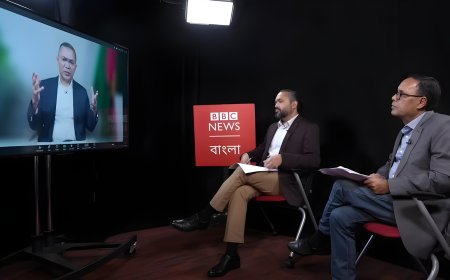
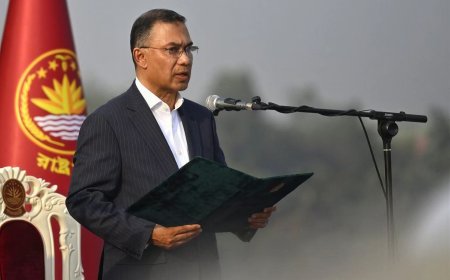
It is against this question that Prime Minister Tarique Rahman’s address to the 81st UN General Assembly deserves close attention. Grounded in human security, it presents Bangladesh -- a country of modest material power -- as a potential normative powerhouse.
Rahman offered more than an annual statement to the world body. He articulated a vision in which Bangladesh’s influence rests not on military or economic might, but on its ideational power and the credibility of the values and norms it aspires to follow and champions.
The architecture of the Prime Minister’s vision becomes clearer through the lens of human security, a UN framework built around two pillars: “freedom from fear” and “freedom from want.” Whether intentional or not, Rahman’s speech speaks directly to both.
His calls for reason, debate and diplomacy over militarism and lethal force; his reaffirmation of the goal of complete and general disarmament, nuclear non-proliferation and arms control; his warning that military spending undermines development; and his demand for the safe, dignified and voluntary repatriation of over 1.2 million Rohingya refugees all reflect the freedom from fear dimension.
Together, they speak to the need to protect people and communities from violence, repression and forced displacement.
The freedom from want dimension is equally evident. It encompasses the “democratization of the economy,” a pledge to raise education spending towards 5% of GDP, universal access to essential services, and a commitment to the rights, dignity and welfare of migrant workers, among other priorities.
The concluding vision of “Bangladesh First, Bangladesh for All” brings these two pillars together. It presents a Bangladesh that can embody these values at home and draw on its ideational power to champion them abroad, strengthening its potential to become a normative powerhouse and a model for others.
There was a third, subtler move. By telling the Assembly that 76% of his government's 31-point domestic manifesto aligns directly with the UN's Sustainable Development Goals, Rahman elevated a campaign document into an instrument of international diplomacy.
A party document, normally confined to domestic electoral politics, was recast as evidence of Bangladesh's good-faith participation in the global normative project. Few small states attempt this kind of move at the UNGA podium; fewer still can back it with a specific percentage.
The courage to raise and validate a domestic program at the world's most visible multilateral stage is itself a bold claim and pledge to normative standing.
Is the claim credible? One of my own studies of Bangladesh's UNGA voting record offers some of the strongest available support for the “freedom from fear” half of this narrative. The research found that Bangladesh voted in favour of UN resolutions more often than China, India, or Russia, affirming the global consensus on 91% of all resolutions over the period.
More tellingly, on disarmament, conventional arms control, and the prohibition of chemical and nuclear weapons, Bangladesh broke consistently and repeatedly with its two dominant regional neighbours.
It opposed India's position on arms-control resolutions far more often than it opposed China's, and in the rare instances when India and China voted against each other, Bangladesh sided with neither -- voting its own principled line instead.
On a resolution advancing a nuclear-weapon-free world, Bangladesh maintained its position even as larger regional powers abstained or dissented.
This is not the voting pattern of a small state simply bandwagoning with whoever offers the most aid or investment; it is closer to what international relations scholars call “logic of appropriateness” -- a state acting from a settled sense of what is right, independent of material pressure.
The data from two decades of recorded votes convincingly backs Bangladesh’s claim to normative leadership on disarmament, peace and nuclear non-proliferation.
The same cannot be said for the Rohingya dimension -- a critical aspect of the “freedom from fear” strand, not just for the Rohingyas but also for Bangladesh’s security and regional stability.
The same voting data shows that Bangladesh declined, for over a decade, to join the international majority condemning Myanmar's human rights record -- voting against such resolutions, aligning instead with China and Russia rather than the Assembly's broader consensus.
The muted shift came only in 2017, and pointedly, only after the resolutions themselves began naming Bangladesh as an “affected state” hosting the fleeing Rohingya. That is a less flattering story: Not principled leadership arrived independently, but a policy correction forced by circumstance.
The charitable reading is that Bangladesh's current, more assertive repatriation diplomacy will be a departure from a position adopted in 2017 -- one that the current government has perhaps chosen to pursue more actively, rather than reluctantly follow the previous path that has yielded no results.
Whether that counts as moral consistency or a retrospective rebranding of a reactive policy is a fair question worth sitting with, not resolving prematurely.
A harder test of how far the world absorbs Bangladesh's framing of the Rohingya issue came just two weeks before Rahman's address, and it is not encouraging. On 12 September 2026, BRICS leaders unanimously adopted the New Delhi Declaration -- a sprawling, 140-paragraph consensus document covering nearly every humanitarian crisis of consequence on earth.
It names Sudan's worsening humanitarian catastrophe. It devotes extensive, granular language to Gaza and the Occupied Palestinian Territory -- condemning starvation as a method of warfare, demanding humanitarian access. It addresses Lebanon, Syria, and even Cuba's humanitarian situation under sanctions.
Nowhere in those 140 paragraphs does the word “Rohingya” or “Myanmar” appear! The omission of the Rohingya issue in the BRICS Summit Declaration reads less like oversight than continuity.
It is a pointed illustration of exactly the arduous task Bangladesh faces: Building genuine international consensus around a humanitarian catastrophe and national security burden that major regional powers remain reluctant to even name in writing, let alone act on.
In sum, a UNGA speech is an assertion of intent, but it can also mark the beginning of a defining national journey. With a democratically elected government emerging after the fall of an authoritarian regime, Bangladesh has a renewed opportunity to translate its democratic aspirations into principled leadership on the global stage.
The Prime Minister’s address offers a coherent and compelling vision grounded in principles rather than opportunism--the very foundation upon which Bangladesh could emerge as a normative powerhouse of the Global South.
The opportunity is real. So are the challenges. The challenge ahead is to turn the promise into practice: To fulfil the education-spending pledge, advance the democratisation of the economy, secure meaningful progress towards the dignified repatriation of the Rohingya, and align its international advocacy for peace with a consistent commitment to human rights.
If sustained through credible action and principled diplomacy, Rahman’s vision could mark the beginning of Bangladesh’s emergence as a normative powerhouse, inspiring the Global South and contributing to a more just, peaceful and inclusive international order.
Dr Mohammad Zahidul Islam Khan, a retired Air Force officer and Chevening scholar, is a Visiting Research Fellow, Department of Politics and International Relations, University of Reading, UK and Registrar, American International University-Bangladesh. Views expressed as an independent researcher.