






































































Ukraine Is Winning the War. Here's How.
Wars once decided by who could field more men and shells are increasingly decided by who can find, share and act on information faster. Ukraine's advantage is not that it has more soldiers; it clearly does not. It is that each soldier is better informed, better protected and, increasingly, replaced by a machine where possible.

As the war in Ukraine approaches its sixth year, the conventional wisdom of the last two years is quietly collapsing. After the 2023 standstill, Russia ground out slow but steady gains through 2024 and 2025. In 2026, that momentum faded.
According to figures cited from ISW, Russian net progress this year is roughly four times slower than in 2025 and two and a half times slower than in 2024, and in some months Russia appears to have lost more ground than it took. The front has not frozen, but it has stopped behaving like the one we had grown used to.
The easy explanation is Starlink. Russia lost access to the service early in the year, and Ukraine plainly benefits from it. But that account is too neat. Russia never used Starlink as systematically as Ukraine did, and eight months is long enough to adapt, even if its data bandwidth remains below early-2026 levels. Starlink matters less as a gadget than as infrastructure: It lets information move at a scale that was almost unimaginable in 2023. The real story is what Ukraine has built on top of it.
Seeing First, and Sharing Fast
Modern battlefields reward whoever sees first and tells the right unit fastest. Ukraine now has an estimated 200,000 Starlink terminals. Where terminals once delivered AI-processed data at company level, units may now receive it at platoon or even squad level. The software has matured too. Delta, the system believed to descend from Ukraine's so-called shadow Maven, reportedly processed footage to identify some 12,000 pieces of Russian equipment weekly as of 2024, and Ukrainian officials claim it detects 70% of enemy equipment in video streams at two seconds per target.
Yet the reaction of NATO officers, and the US Army secretary's praise after a 2025 exercise with Estonian forces, suggests the system is not mere propaganda.
Collection has grown alongside dissemination. Starshield satellites have multiplied roughly twentyfold, commercial optical constellations have expanded by about 40%, and radar-imaging fleets that see at night have doubled.
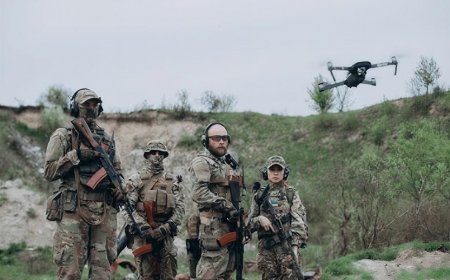
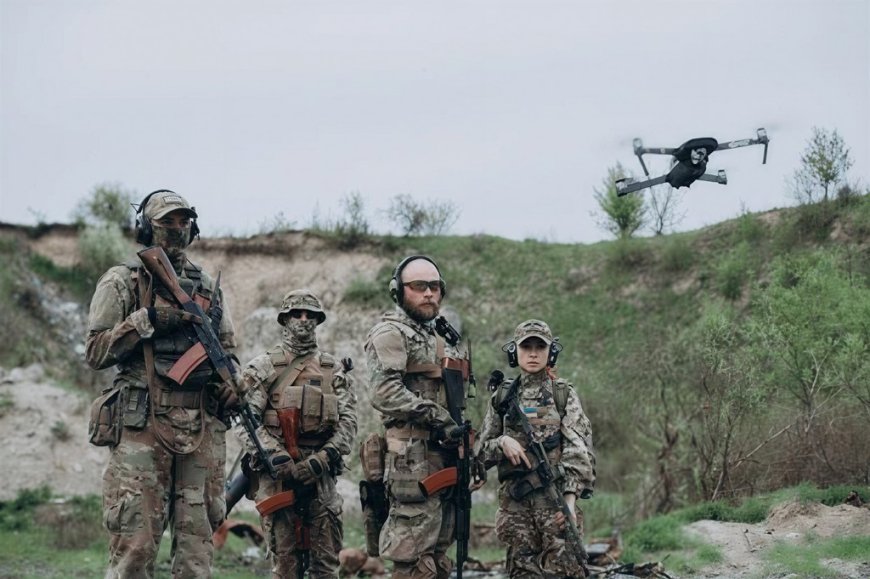
On the ground, reconnaissance drone production has more than doubled in monthly terms since 2024, interceptor drone output is up fivefold, and ground robots are being used at a pace that would have seemed fanciful a year ago: About 25,000 missions in August alone. Russia, by contrast, reportedly received only a few thousand robotic vehicles in 2025, and it lacks the Western AI ecosystem needed to match Ukrainian software.
The Drone-Saturated Kill Zone
The consequence is a battlefield in which mass is a liability. In 2024, drones hunted vehicles. In 2025, they hunted individual soldiers. In 2026, there are reports of up to ten FPV drones chasing per Russian soldier attempting to cross no man's land.
Large groups are simply more visible, so attackers rely on tiny infiltration squads moving through a porous, kilometers-wide wasteland. Control becomes a blurred concept, and both sides hunt for pockets of local superiority, sometimes chasing public-relations value rather than strategic importance.
Ground robots add something flying drones cannot: persistence. They can sit still for hours or days, watching, and if destroyed they act as tripwires. They also keep soldiers out of harm's way, which matters enormously when manpower is the scarcest resource.
The Manpower Trap
Russia's apparent advantage in numbers, perhaps 700,000 troops in Ukraine and over 400,000 at the front, has been the foundation of its strategy. But numbers only matter if they can be replenished. Russian reported totals have essentially stagnated, and one analysis of budget data found 2026 recruitment 11% below Finance Ministry figures. Bonuses can only stretch so far.
Meanwhile, the nature of casualties has changed. The old rule of roughly three wounded for each soldier killed no longer holds. Precision drones kill rather than wound, and medical evacuation is close to impossible under constant surveillance. Researcher Janis Kluga's reading of compensation payments suggests deaths in early 2026 rose about 200% over the same period in 2024, possibly reaching 25,000 a month in some months. That may be exaggerated, but the direction is credible. If intensive assaults cost as many men as Russia recruits, the army cannot sustain them.
The logical result is fewer, smaller attacks, and less captured territory.
What We should not Conclude
It would be a mistake to declare Ukrainian victory. Two months of Russian net losses do not make a trend. Ukraine's own counteroffensives, such as Operation Vivaldi, may raise its casualties, which it can scarcely afford. Russia's intensified air campaign could still inflict lasting logistical and financial damage. And much of the evidence comes from official claims, a single analytical video, and estimates defined differently by each source. Anyone relying on these figures should verify them independently.
Even so, the broader lesson is hard to dismiss. Wars once decided by who could field more men and shells are increasingly decided by who can find, share and act on information faster. Ukraine's advantage is not that it has more soldiers; it clearly does not. It is that each soldier is better informed, better protected and, increasingly, replaced by a machine where possible.
That has a political implication for Ukraine's partners. The edge depends on intelligence sharing, satellite access, and sustained financial and military aid, all of which are subject to political whim. The US has throttled data before. If the information advantage is what is holding the line, then the decisions made in Western capitals about that support may matter more than any single offensive.
Technology can slow an invasion, but only continued backing can turn a fragile edge into a durable one.
And whatever one concludes about drones and algorithms, the human cost behind these statistics is staggering. Analysis of the war is no substitute for its end. Only a negotiated, durable peace can stop the casualty counts that make this stalemate so grim.
Ukraine's advantage is not that it has more soldiers; it clearly does not. It is that each soldier is better informed, better protected and, increasingly, replaced by a machine where possible.
Shafqat Aziz is a barrister (Lincoln’s Inn) and an accredited Civil-Commercial Mediator (ADR-ODR International).