




























































Are Hindus Fleeing Bangladesh? Not So Fast.
Although the Hindu share of the population fell by eight percentage points during the 20 years between 1951 and 1971, it declined by only six percentage points over the following 52 years. And over the 25 years since 2001, it has fallen by just one and a half percentage points.

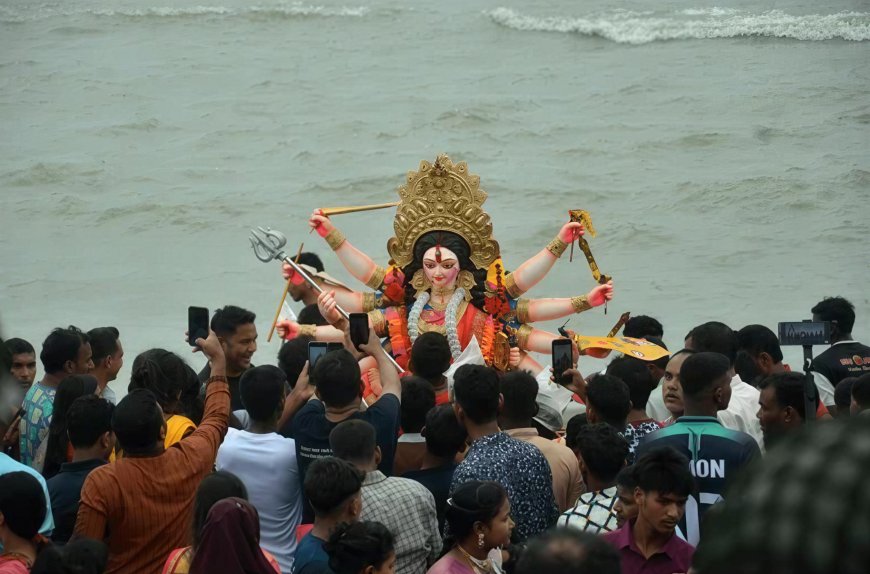
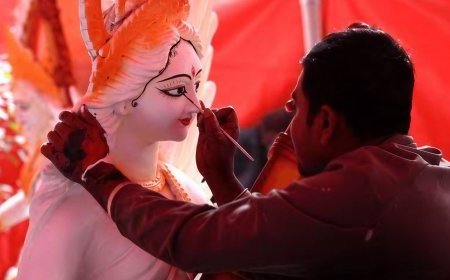
After one of the most festive Durga Puja celebrations in living memory, let me speak frankly and without holding back.
It is not only Hindus who live in fear for Durga Puja. Muslims are apprehensive too. The fear is that if something happens somewhere, they will be held responsible. Or they will end up spending their holidays explaining that “the incident isn't true” or “that's not what actually happened.”
It is not merely inappropriate but unjust to judge the condition of any community in Bangladesh by comparing it with another country. Saying that minorities in Bangladesh are much better off than those in India is not a sensible argument. Nor is saying that they are much worse off than minorities in America.
Instead, we must ensure that everyone in Bangladesh, regardless of religion, race, or ethnicity, enjoys equal rights, dignity, and opportunities.
How do we measure this? By examining whether different communities have representation proportionate to their population in politics, the economy, employment, education, and wealth. And by determining whether they receive equal treatment under the law.
Because of Bangladesh's constituency-based parliamentary electoral system, non-Muslims are undoubtedly under-represented politically. Although they constitute some 8% of the population, there are only four non-Muslim MPs in Parliament.
But in the economy, employment, education, and wealth, they are certainly represented at levels exceeding their population share. I say this with confidence.
Why, then, is the Hindu population declining?
This raises an obvious question: Why is the Hindu population declining? Why did it account for 22% of the population in 1951 but only 8% today?
This is a subject that requires a lengthy discussion. Rather than going into all the details, let me offer a brief explanation.
The answer is that the Hindu population in Bangladesh is declining for reasons that are the converse of those behind the growth of Muslims in India (and Hindus in Pakistan).
In 1951, Muslims constituted 9% of India's population. Today, they account for 15%. Some argue that their numbers are increasing precisely because they are doing well.
Similarly, it is often claimed that Hindus constituted 12% of Pakistan's population in 1951 but account for only 2% today, and that their declining share proves they are being mistreated.
In fact, this entire argument is mistaken.
In 1951, Hindus constituted 12% of the combined population of East and West Pakistan. The BJP propagates the claim that Hindus made up 12% of the population of what is now Pakistan.
But the reality is that in 1951, Hindus accounted for 1.58% of the population of West Pakistan -- present-day Pakistan -- numbering approximately 530,000.
By 2023, Pakistan's Hindu population had reached 5.2 million, or 2.17% of the total.
In 1951, Pakistan's Muslim population was 32.2 million. By 2023, it had increased to 231.7 million -- a 7-fold increase.
The Hindu population, meanwhile, increased almost tenfold.
Why has Pakistan experienced such an extraordinary increase in its Hindu population?
The answer is that Pakistan's Hindus are significantly disadvantaged in education and wealth.
Communities that lag behind in economic opportunity, employment, education, healthcare, and human rights tend to experience continued population growth. That is how the world works.
It is for this reason that Muslims and Dalits in India continue to increase in number.
By contrast, three communities that are relatively advanced in education and wealth -- the Parsis, Jains, and Anglo-Indians -- have almost disappeared.
The Parsis are India's wealthiest, most educated, and influential community. Their standard of living is higher than that of Europeans.
In 1951, India's Parsi population was 112,000. By 2001, it had fallen to 69,601, and by 2011 to 57,264. By 2026, the number could fall to 40,000.
The reason is their high level of education.
The fertility rate among Parsi women is just 0.8 children per woman. That means at least 20 out of every 100 women have no children. Even European women have a higher fertility rate.
The population shares of two other educated and prosperous Indian communities, Jains and Sikhs, are also steadily declining.
Their absolute numbers are not falling, but their percentage of the population is.
Consider a hypothetical example. Suppose that in 1986, six out of every 100 Indians were Sikhs, representing 6% of the population.
By 2026, suppose five out of every 100 Indians are Sikhs.
Their population share has declined by one percentage point, even though their absolute numbers have increased.
This happens because Dalits and Muslims have increased in number more rapidly than Sikhs.
The same demographic process has occurred in Bangladesh
Something very similar has happened among Bangladesh's non-Muslim communities.
Yet people such as Abul Barkat have produced stories, under the guise of research, claiming that 630 Hindus leave the country every day. Muslims, meanwhile, have accepted this as their own responsibility and hung their heads in shame.
The simple fact is that between 1947 and 1965, there was extensive migration in both directions between India and Pakistan.
This migration was driven not only by persecution but also by uncertainty, economic conditions, politics, and employment opportunities. War was another factor.
That is why the proportion of Muslims in India's population declined between the 1961 and 1971 censuses.
Despite their very high birth rates and relative disadvantages in wealth and education, Muslim population growth in West Bengal and Assam, which border Bangladesh, stagnated between 1951 and 1971.
During the same period, the Hindu share of Bangladesh's population fell sharply, from 22% to 14%.
The reason was massive migration in both directions.
Some migration from Bangladesh continued after 1971. Even today, some people may move across the border for various reasons, including economic and religious ones. But the scale is nowhere near what is portrayed in films and dramas or in Barkat's accounts.
That is why, although the Hindu share of the population fell by eight percentage points during the 20 years between 1951 and 1971, it declined by only six percentage points over the following 52 years.
And over the 25 years since 2001, it has fallen by just one and a half percentage points.
The Hindu population has not declined in absolute numbers. Its percentage of the total population has declined. The reason is the higher birth rate among Muslim families, associated with their relative disadvantages in wealth, education, and access to healthcare.
While the Hindu population increased by two million, the Muslim population increased by 30 million. Consequently, even though the Hindu population grew in absolute terms, its share of the total population declined.
Over the past few decades, fertility rates have fallen because of the massive expansion of women's employment in the garment industry and their improved access to education and healthcare.
Five decades ago, a woman in Bangladesh had an average of 6.4 children. Today, the figure is 2.4.
Hindu families adopted family planning earlier than Muslim families. That is why, if you look at families in the 1960s, Hindu and Muslim households had similar numbers of children.
But by the 1980s and 1990s, there was a substantial difference, driven by education and the adoption -- or non-adoption -- of family planning.
However, fertility rates among Muslim families have now fallen. The current rate is 2.4 children per woman, compared with 2.0 among non-Muslim women.
Although the enormous gap that existed in the past has narrowed, a difference remains. Consequently, the Hindu share of the population will certainly fall somewhat below 8% in the next census.
Once the birth rates of the two communities become equal, their relative population shares will stop changing.
Exaggerated allegations make real problems worse
The reason I have gone into all this is that, instead of addressing problems according to their actual scale, exaggerated narratives magnify them and create a sense of collective blame.
For example, the Bangladesh Hindu Buddhist Christian Unity Council claimed that 44 members of minority communities were killed in violence between January and June this year.
I fact-checked these cases and found no communal dimension in any of them.
The incidents arose from personal enmity, land disputes, business conflicts, and internal disputes among extremist groups.
But even incidents in which both the victims and the accused were non-Muslims were described as violence against minorities.
The report published for July to September presents the same problem.
Take the case of Sanatan Chakraborty in Rangpur.
The accused were also Hindu, yet an atmosphere of suspicion was initially created. Later, DNA testing established that the DNA of the accused, Siddhartha and Mugdha, matched evidence collected from the crime scene.
At the very beginning of Durga Puja, a responsible organization such as the Puja Celebration Committee alleged that 34 Puja venues had been attacked. The Awami League then began spreading the claim that attacks had occurred in 34 districts. India subsequently cited these allegations to lecture Bangladesh about the need to deal properly with minority issues.
This understandably irritates Bangladeshis. And the resentment generated against India ends up being directed at Hindus.
I personally tried to establish how many incidents of such vandalism had actually occurred. I found eleven.
In six cases, following investigations, the police issued public statements saying that the incidents stemmed from disputes involving Puja committees, temple committees, or local parties.
There was no communal dimension.
The police did not provide similar explanations for the remaining five incidents.
Certainly, in all these cases, someone damaged the idols. Perhaps it was a Muslim motivated by hatred of Hindus. Or perhaps thieves stole jewellery or clothing.
But there was not a single actual attack.
And communal persecution of minorities is not something that perpetrators carry out like thieves operating in secret.
When governments, extremists or members of a majority community seek to demonstrate their power through such persecution, they do so openly, in broad daylight.
Does this mean minorities are never persecuted in Bangladesh?
Of course not. Such incidents do occur. For example, there was an incident in the Sylhet region last year involving a Facebook post. That was a communal incident.
It is everyone's responsibility to ensure that communities become sufficiently educated and aware to prevent such incidents from occurring. And when they do occur, the perpetrators must face severe punishment.
But exaggerated allegations and rumours spread not merely through irresponsible Facebook posts, but also by organizations with responsibilities, such as the Unity Council and Puja Celebration Council, undermine public sympathy for genuine incidents.
They also create a deep sense of deprivation and grievance among Hindus.
For example, even my most highly educated Hindu friend believed that hundreds of Hindus had been killed after August 5. I could not convince him otherwise, even after presenting fact-checks and logical arguments.
And I do not believe that the anger and mistrust created by those exaggerated allegations have disappeared.
I do not know whether people understand the harmful consequences of this.
Because minority issues have been discussed so extensively in Bangladesh over the past two years, the government, political parties, and ordinary citizens are now at least alert and concerned about preventing incidents.
But exaggerated allegations are creating a dangerous trap. No matter what is done, fault is found with it. This will create a toxic environment. Therefore, the first priority must be to build a liberal, educated society in which such incidents do not occur.
If incidents nevertheless take place, the response must be firm and rigorous enforcement of the law. But anyone who poisons the social atmosphere by spreading exaggerated allegations or rumours must also be held fully accountable.
Rajib Ahamod is a journalist.