






















































Sheikh Hasina Isn't Coming Back. This is Why.
The Awami League is politically dead and will not be able to return to politics for the next two decades. The sooner Gopalganj residents, Awami supporters, and non-fugitive League members understand this, the better it will be for all of them.
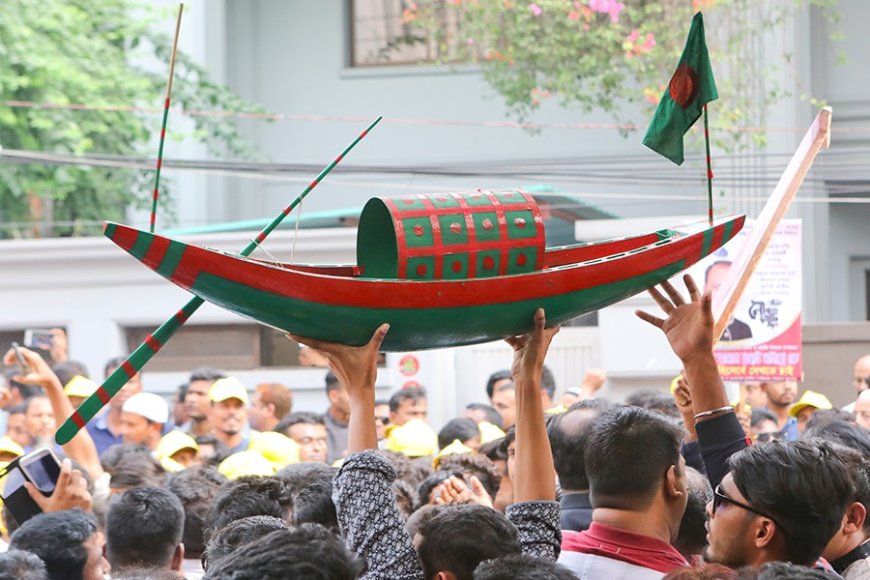
Sheikh Hasina will not return. The Awami League is politically dead and will not be able to return to politics for the next two decades.
The sooner Gopalganj residents, Awami supporters, and non-fugitive League members understand this, the better it will be for all of them.
This is not any ideological statement of mine. This is an inviolable tripartite equilibrium based on the political calculations of BNP, Jamaat, and NCP in the current political reality of Bangladesh.
Before discussing why the political party named Awami League will not be able to return to politics for the next two decades as a consequence of this equilibrium, let us try to understand why there is no possibility of Sheikh Hasina’s return by first understanding the process through which Sheikh Hasina fled.
The NCP leadership, Shafiqul Alam, and Professor Yunus have more or less successfully established the narrative that Sheikh Hasina’s fall occurred according to the master plan of Mahfuz and other NCP leader masterminds.
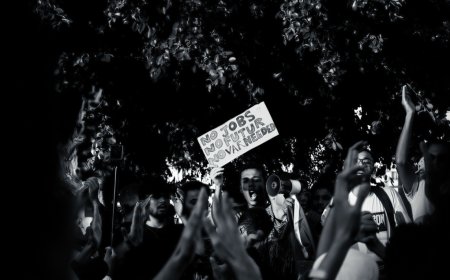
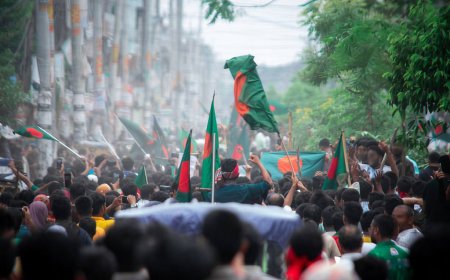
But the reality is that Sheikh Hasina’s fall occurred through a leaderless movement in which -- among others -- the urban middle class, upper-middle class, elite class of Dhaka and Chittagong and district towns, madrasa and private university students, Bangladesh’s influential diaspora, cultural leaders, a section of bureaucrats, retired military officers, groups of junior officers of the armed forces, teachers, and a large part of the judiciary -- all participated, without any leadership, without any specific direction -- on their own agency and under their own leadership.
A dictator, even if they appear to have no rivals and unlimited power, actually remains in power by depending on the pillars of power.
In the context of Sheikh Hasina, it may have seemed that she could stay in power forever with the weapons of the police, RAB, army, and Chhatra League.
But the reality is that she mainly remained in power with the support of a broader group.
These pillars of power include urban middle class, upper-middle class, elite class, students, religious leadership, diaspora, cultural leaders, bureaucrats, armed forces, teachers, judiciary, etc.
In the movements before 2024, Hasina’s fall did not occur because Hasina had kept these pillars of power under control through various temptations, fear, and different kinds of pressure.
Sheikh Hasina’s fall became certain only when, before the final moment of the mass movement, all these pillars of power of Bangladesh abandoned her side.
The biggest incident in the movement for Sheikh Hasina’s fall from power was the killing of students of BRAC University and East West University. This is exactly the moment when the urban elites realized that bullets were hitting their children.
I have heard from several members of the Private University Student Association of Bangladesh (PUSAB) how they organized in Uttara and stopped Awami League. Several of them were shot. Most of them are boys from BRAC University, children from very elite families.
The statement given by Salimullah Khan after the killings was also a major event. It signaled that even the important pillar of power, the cultural elites, who had not previously taken a clear position against Hasina, had also abandoned her side.
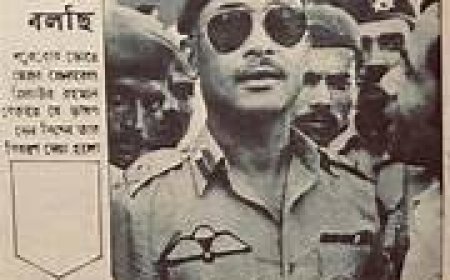
Former military officers also came out from their comfortable homes. At that time, some junior officers of the Bangladesh Army contacted me and Zulquairnan Saer.
They informed us that announcements had been made in the WhatsApp groups of several courses that officers would take up arms and take to the streets. They could no longer tolerate these atrocities. They drafted a letter, which Saer published.
And why did these groups abandon Hasina? Because of the master plan of the masterminds? Not at all.
Due to the spontaneous explosion of collective anger against moral outrage or oppression, the movement spontaneously turned into a mass movement without any leadership.
From Hasina calling the quota reform movement participants the grandchildren of Razakars on July 4, this spontaneous explosion of anger began, and those who joined the movement, and the oppression by Chhatra League and police in this movement, the attack on women’s halls by turning off the lights, the attacks on campuses of universities across the country -- these incidents went viral at home and abroad, the explosion of anger kept increasing, and one after another the pillars of power kept abandoning Hasina’s side.
Indiscriminate firing by the police on innocent people, firing from RAB helicopters, and finally, when private university students were shot and killed, the urban elite of Dhaka city finally and decisively abandoned Hasina’s side.
After this, there was no chance for Hasina to remain in power.
Therefore, the argument I want to make is that the entire group whose withdrawal of support caused Sheikh Hasina’s fall is today
apprehensive about the possibility of Sheikh Hasina’s return.
They fear that if in any way Sheikh Hasina or any leadership guided by Sheikh Hasina’s ideology returns to state power in Bangladesh, revenge will be taken on them.
Today, every boy above 16 years of age in Dhaka city took to the streets in this mass uprising for Sheikh Hasina’s fall. Therefore, there is no way that their mothers will allow even the slightest possibility of Sheikh Hasina’s return.
Because these mothers fear that if Sheikh Hasina comes, their children will be hanged -- however irrational the thought may be -- they will not allow it.
Any political party that tries this will be committing political suicide.
The senior officers of the Bangladesh Army who, instead of protecting the constitutional head of government with all military force, facilitated sending her out of the country through an international negotiation, the junior officers of the Bangladesh Army who directly participated in this movement -- their course WhatsApp group chat history exists -- they all know that if Hasina returns, they will face the harshest punishment under military law.
These social, cultural, and armed forces are the main powers of Bangladesh.
Therefore, today’s reality is that not just for the next two decades, even in the next three decades I do not see that this generation, who through the movement sent Sheikh Hasina to India, will in any way allow the return of Sheikh Hasina.
Because they know that if Hasina returns, she will take revenge on them, which is an existential crisis for them.
Hundreds of mothers will sit in hunger strike unto death in front of the National Parliament if any political party takes any initiative to bring back Hasina or Awami League.
Then again, do BNP, Jamaat, or NCP have any incentive to bring Awami League back?
Pinaki Bhattacharya has inserted some absurd ideas into people’s minds that BNP will bring Hasina back. Rather, I want to show you that if you look at the basic political calculations and incentives of the three main parties of Bangladesh after Hasina’s fall, you will see that there is a political equilibrium of BNP, Jamaat, and NCP behind not allowing Awami League to return to politics.
BNP knows that since independence, no ruling party in Bangladesh has held a fair election and returned to power for a second time.
Therefore, because of this natural anti-incumbency, the next election should be difficult for BNP.
But BNP also knows that our urban middle class, who are the life force of power in Bangladesh, do not want to see Jamaat in power.
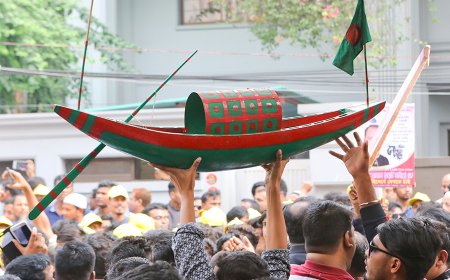
However, if Awami League existed today, Awami League would have been that alternative. And a much stronger one.
Why would BNP allow this to happen? Therefore, solely to stop the anti-incumbency factor, BNP will in no way allow Awami League to come. This is a basic survival issue for BNP.
Now come to Jamaat. In the same way, Jamaat knows that in the current reality it has no chance of coming to power. But Jamaat also knows that in the face of the financial crisis left by Sheikh Hasina, if not in the next election cycle, then in the following election cycle, that is, in a ten-year timeline, many things can happen. And at that time it will stand as the legitimate next in line as the main opposition party of Bangladesh. Therefore, Jamaat will wait for that time.
But if Awami League returns, then Jamaat will become the third force. Why would Jamaat-e-Islami bring Awami League back? There is no reason.
Secondly, Jamaat has not forgotten that even after promising cooperation while sitting at the same table in 1996, in 2008 Hasina hanged its top leadership.
As for the NCP, it has not been able to form any broader coalition with the forces of the July movement. The top leadership of NCP has been finalized only with the students of the DU club. NCP has not allowed the madrasa students or private university students who made the greatest sacrifices in the July movement into its top leadership.
Therefore, because of this failure to form a broader coalition, no matter how strong and popular it may seem on social media or talk shows, even at this very moment NCP’s mass base is much less than the mass base and muscle power of the non-fugitive Awami League. And if Awami League returns, Sheikh Hasina will annihilate their top leadership.
Therefore, NCP will at any cost prevent Awami League from returning to politics.
This is the core incentive of the three sides. This is what I call the tripartite inviolable political equilibrium, which is also an unwritten agreement. This is not a moral position. This is pure political equation.
Therefore, those who say BNP will bring the League back are delusional.
And why will Sheikh Hasina herself want to return?
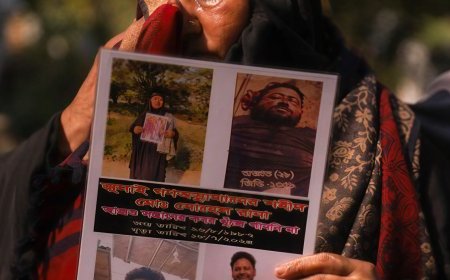
The mothers of the urban middle class who have lost their children or seen them shot or maimed -- at least 20,000 boys -- their main mass demand will be to hang Sheikh Hasina.
Since Sheikh Hasina hanged the top leadership of Jamaat-e-Islami and BNP’s Salauddin Quader Chowdhury -- they too will have an incentive to hang her.
Do you think Sheikh Hasina has so much affection for Bangladesh that knowing there is a 99 percent possibility of being hanged, she will still return?
Therefore, there is no possibility of her return, and there is no possibility of Awami League returning to politics for the next 20 years because of this tripartite political equilibrium.
Therefore, I am telling the non-fugitive League, Gopalganj residents, and those loyal to Awami League: please stop all this petrol bombs, attacks, etc.
If you do not like any of these three sides, establish another political force that is guided by the spirit of the Liberation War and the ideology of Sheikh Mujibur Rahman -- but outside the sphere of the Sheikh family.
A force that itself holds the spirit of July, considers July an extension of the freedom struggle of 1971. A force that does not think that because of the leadership of the 1971 independence war, the Mujib dynasty has been given the soil of Bangladesh by the people of Bangladesh through a deed of gift, and that the dynasty was unconstitutionally removed from power by the Razakars in the movement of 2024.
If you can keep that kind of spirit, if you can give us that comfort that you have no such desire for revenge, that you believe in a free, democratic Bangladesh like us, then establish a political party on that ideology.
That party may have no chance in the next election, but it has a chance in the next 10 years. That is the only path of political salvation for you.
And do not create unrest in the hope of bringing back a psychopath.
Participate in this political settlement of a new beginning free of Sheikh Hasina and free of fascists in Bangladesh, and cooperate with
the government to come out of the current deep financial crisis.
Otherwise we will all continue to suffer.
Zia Hassan is a member of the Citizens Coalition.