





































































The Path to Prosperity. It's Not What You Think.
Migrant worker families are paid in taka while banks hold the dollars, and weak or captured institutions let dollars slip out through trade misinvoicing and hundi.

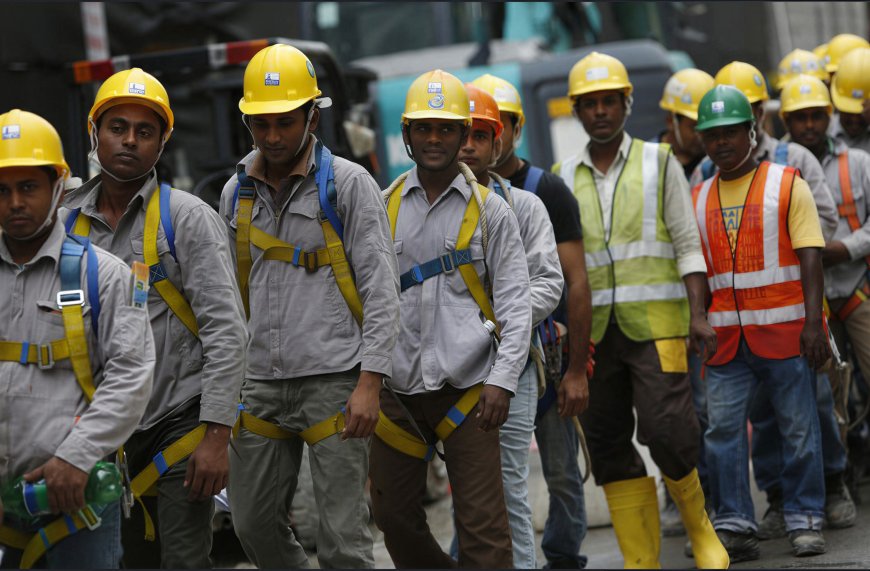
On the drive to Dubai airport, our chauffeur spoke fluent English. He was from Pakistan, and he told us he had arrived in the UAE as a construction worker, then got a UAE driving licence from a local school and more than doubled his pay. His path is open, in principle, to any migrant worker. Yet most Bangladeshis abroad never make that jump.
Bangladesh received a record $35.56 billion in remittances in FY2025-26, up 17.3%. Merchandise exports were $48 billion in gross terms, with garments at $38.7 billion. But garments imported close to $15 billion of raw materials, leaving net earnings of about $24 billion. Imported fuel and machinery cut that further, as do the electricity and gas that the budget heavily subsidises for factories. Remittances carry almost no import bill and are worth roughly one and a half times net garment earnings.
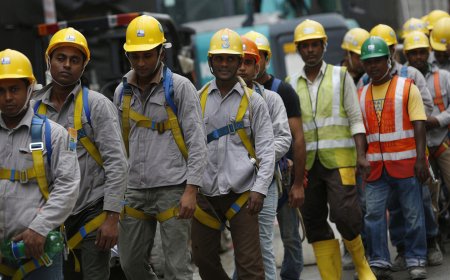
However, our migrant workers sit at the bottom of the skills ladder. Of the 1.13 million Bangladeshis who went abroad for work in 2025, only 2.9% were professionals and 19% skilled; 77% were semi-skilled or less-skilled.
Astonishingly, some of the construction workers we are sending are university graduates, in manual jobs because home offers too few openings. Perhaps our universities are not providing the soft skills needed to climb the ladder.
Others lack the certification and language to move up. As the chauffeur shows, the gap is rarely talent. It is a licence, English language skills, and the right training.
I believe the $35.6 billion can be doubled by upskilling our workforce and improving their soft skills. Even Ahsan H Mansur, former Bangladesh Bank governor, sees room for $50 billion within a few years.
How We Compare with Our Peers
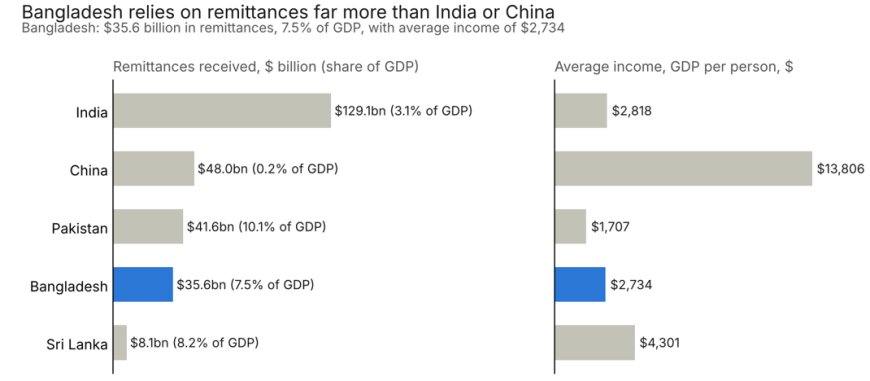
Remittances: World Bank 2024 (India, China), State Bank of Pakistan FY2025-26, Bangladesh Bank FY2025-26, Central Bank of Sri Lanka 2025. GDP and GDP per person: IMF World Economic Outlook, October 2025. Years differ slightly.
Bangladesh is in good company, but not the best. India ($129 billion) and China ($48 billion) receive more in absolute terms, yet remittances are only 3.1% and 0.2% of their GDP. Their economies run on other engines.
Pakistan (10.1% of GDP) and Sri Lanka (8.2%) look more like us, and Sri Lanka shows the fragility: Its remittances fell by nearly half between 2020 and 2022, helping trigger a balance-of-payments crisis.
Our average income of $2,734 is close to India's $2,818, but Sri Lanka's is 57% higher and China's is five times ours. The remedy is not more workers. Pakistan's IT freelancers sent home $959 million in FY2025-26, up 49%, and its IT exports passed $3 billion in the first 10 months, while Bangladesh's official ICT service exports were $724.6 million in FY2025.
Bangladesh has around 650,000 freelancers, earning roughly half a billion dollars a year. Official ICT service exports were $724.6 million in FY2025, against a $5 billion target for 2025, while India's technology industry earned $227 billion in FY22.
Much IT work, even in the United States, is now done from home, so geography is no longer the constraint. English, client communication, reliable connectivity and credentials that buyers trust are.
Bangla is the heart of our culture, and we rightly honour it every February 21. But when we hire, we favour the candidate with better English, and we send our own children to English-medium schools. Our students meet “inertia” at the university gate, having learned it as sthiti jorota.
The government should consider moving SSC and HSC science and mathematics to English-language textbooks aligned with international curricula, for the Bangla-version stream as well. Bangla language, literature and history would stay unchanged. Students would learn concepts and vocabulary together.
What the Government Already Does, and What It Must Enhance
The foundation exists, and the government elected in February 2026 under Prime Minister Tarique Rahman has begun to build on it.
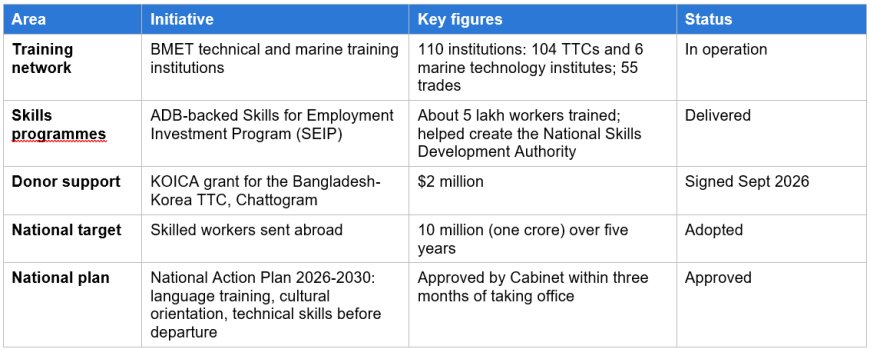
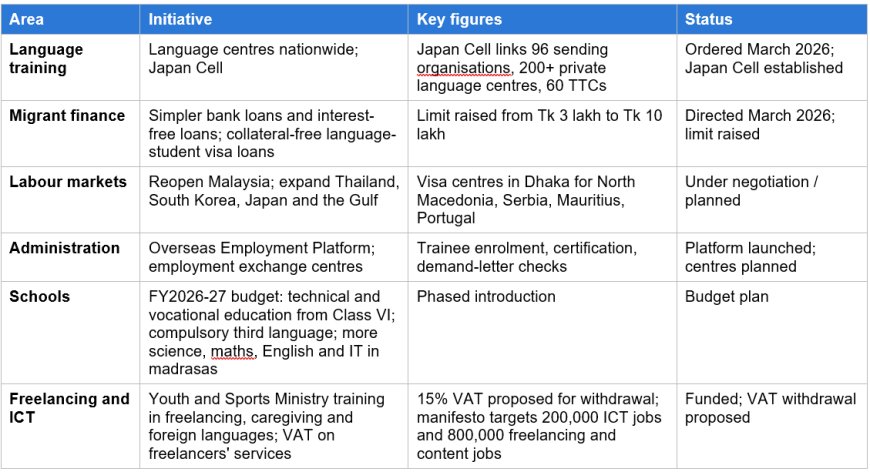
These are real steps, but the gaps are visible. The Finance Minister has said that training centres mostly lack accreditation and standard certification, reports describe idle equipment and vacant instructor posts, and a shortage of Japanese-language instructors remains a major challenge.
A Daily Star report found no separate Arabic or Malay courses, though Saudi Arabia took 752,705 of our workers in 2025. Enhancing these programs means quality before quantity: International accreditation, filled posts, and the languages of the markets our workers actually enter.
Every public and private university graduate should be ready for freelancing and remote work by the time they complete their bachelor's degree. Private universities can lead, but only if the University Grants Commission (UGC) shifts from controlling to facilitating.
The UGC cannot be both the regulator and a partner in running private universities, because no one can be player and referee in the same tournament. It should recommend good practice and publish clear standards, and simplify or remove rules on curriculum, program launches, faculty hiring and foreign partnerships wherever they do not protect quality, judging universities by verifiable outcomes such as graduate employment and international accreditation.
Power hungry industries should not form the basis of our industrial growth strategy. Bangladesh imports more than 60 percent of the primary fuel it burns for power, in plants with an average efficiency of only about 41%. Gas prices for power have risen 208 percent since February 2023.
The regulator put the FY2026-27 subsidy need at about Tk 56,000 crore, and roughly Tk 41,000 crore is still needed after the June 2026 tariff increase. Industrial tariffs now run from about Tk 12.1 to Tk 16.4 per unit depending on voltage and time of day, and Tk 12.75 for a typical 33 kV connection, about 10.4 US cents.
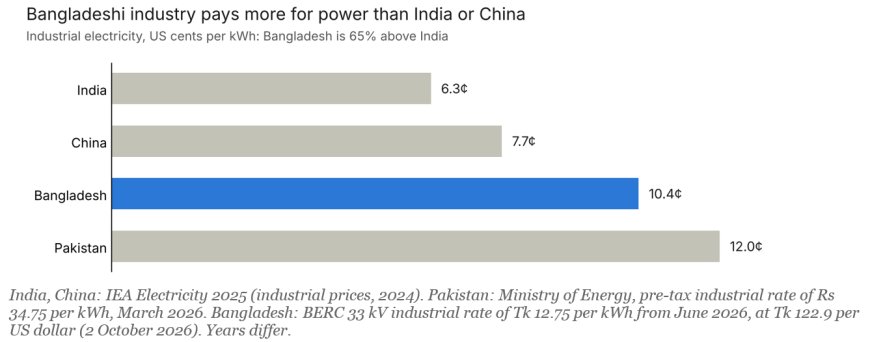
In that setting, promoting energy guzzlers such as steel and cement makes little sense. They turn imported fuel and public subsidy into low-margin commodities, and every unit of power they use is paid for in dollars and taxpayer money.
A trained caregiver, technician, or freelancer uses almost no energy and earns the dollars. Garments, with their large employment, have earned their place, but the next taka of public support should go to skills and cheap power, not to heavy industry. Until we can lower power costs, Bangladesh should think twice before allowing high power demand industries.
Not all is great with becoming a remittance-dependent economy. The Wall Street Journal's reporting on remittance-dependent countries, from Tajikistan to Nicaragua, shows that remittances can prop up fragile and autocratic governments by covering trade deficits, calming grievances and exporting dissenters. Migrant worker families are paid in taka while banks hold the dollars, and weak or captured institutions let dollars slip out through trade misinvoicing and hundi.
The interim government's 2024 white paper estimated illicit outflows at about $234 billion between 2009 and 2023, roughly $16 billion a year. Remittances do not create autocrats, but an inflow a narrow circle can control makes it easier to postpone reform. Our recent history is a warning, not a proof.
For 40 years we have exported our people in the cheapest form. The next 40 should be about exporting them skilled, fluent, and certified.
Upskilling is a steady, fast, reliable and low-cost way of developing Bangladesh's economy, and few investments we can make are likely to pay off as quickly.
Javed Hosein is an entrepreneur in the energy sector and a member of the Board of Trustees of Independent University, Bangladesh.