









































































The Source of Sheikh Hasina's Defiance
India has powerful strategic incentives to retain influence in Bangladesh. From New Delhi’s perspective, this is hardly irrational. Every major state seeks to shape developments in its immediate neighborhood when its security interests are implicated.


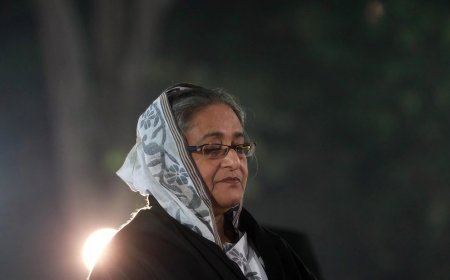
Sheikh Hasina will return in December, and this will destabilize Bangladesh -- or so she has more or less openly declared. The political reality, however, is rather different.
One of the gravest strategic blunders of Sheikh Hasina’s long coercive rule was that she did not merely run the steamroller over the BNP and Jamaat.
Over the years, she also turned against Islamist forces that had historically leaned toward the Awami League -- various parties and factions within the Qawmi tradition, for example, had often gravitated toward an anti-Jamaat coalition.
Nor were smaller left-wing parties spared when they participated in civic movements; Hasina descended upon them with equal ferocity.
The result was that by June 2024, apart from a handful of nominal allies and individualsamong them the political forces associated with Inu and Menon -- Sheikh Hasina had alienated virtually every major political and social force with meaningful organizational capacity.
She survived principally through her command of the administrative machinery. Even while she was in office, had the state apparatus remained genuinely neutral, I doubt she could have survived in power for a month.
Now she possesses neither state power nor the allegiance of the administration. Bangladesh’s major political and social forces have hardly forgotten the repression they endured under her rule, and many remain determined to prevent her return.
Under such circumstances, political parties ordinarily become subdued. They acknowledge mistakes, seek reconciliation, negotiate, and attempt to rebuild political legitimacy.
But have you noticed any diminution in Sheikh Hasina’s defiance?
Despite having virtually no political footprint inside Bangladesh today, what explains this extraordinary confidence?
The answer to that question, I believe, also contains the strategic clue to how Bangladesh-oriented political forces should respond to her.
Historical Convergence with India
Just recently, an Indian scholar said on a podcast that Bangabandhu Sheikh Mujibur Rahman had been recruited by India’s Intelligence Bureau in early 1960s.
Those who have studied the history of Bangladesh’s independence struggle and the geo-politics of the period in some depth will already be familiar with such claims. I encountered them many years ago.
Yet the question never particularly troubled me. My reasoning was straightforward: whatever relationship Bangabandhu maintained with Indian intelligence ultimately served what he understood to be Bangladesh’s national interest.
There was, at that historical moment, a convergence of interests. India wanted Pakistan broken apart; a large section of the Bengali population wanted independence from Pakistan.
That convergence matters.
Bengal’s Aspiration for Political Autonomy Predated Pakistan
The aspiration for an independent Bengal was hardly born with Pakistan. Bengal had repeatedly imagined itself as a distinct political entity and had not invariably sought incorporation into India. From the Lahore Resolution to the negotiations surrounding the British withdrawal, proposals for an independent Bengal remained part of the political imagination.
Leading Bengali politicians of the period, including A.K. Fazlul Huq and Huseyn Shaheed Suhrawardy, entertained visions of an autonomous or independent Bengal. But Bengali leaders lacked sufficient leverage in negotiations with British and Indian political elites to bring that project to fruition.
Pakistan consequently emerged, for many, as something of a second-best outcome. As the dream of an undivided sovereign Bengal receded, Bengali Muslim politicians joined the Pakistan movement in the hope that, at the very least, Muslims would obtain a new state. The political weight of Muslims in Bengal and Punjab proved decisive in Pakistan’s eventual creation.
Within only a few years, however, Pakistan itself became a new source of insecurity.
At the heart of the problem was the negligible Bengali presence within Pakistan’s civil-military establishment. Bengalis consequently found themselves marginalized within the state’s security apparatus and increasingly insecure about their political future. Successive military coups only deepened that apprehension.
Colonial Roots of Bengali Marginalization
Some responsibility for the weak Bengali presence in Pakistan’s civil-military establishment lay with British colonial policy.
British rule had confronted repeated rebellion and resistance in Bengal, producing a profound distrust of Bengalis within sections of the colonial establishment. The Sepoy Rebellion intensified British anxieties about the composition and loyalty of their security forces. These attitudes had lasting consequences for Bengali recruitment into the colonial civil and military services.
Bengali Muslims faced an additional disadvantage. Resistance to British rule had, in some circles, included resistance to English-language education. As a result, substantial numbers of Bengali Muslims lacked the qualifications necessary to enter the British colonial bureaucracy and military establishment.
These historical disadvantages did not disappear with Partition.
Within a few years of Pakistan’s creation, therefore, the more independence-minded sections of Bengali society began once again to imagine sovereignty. Beyond religion, the enormous political, linguistic, cultural, and economic differences between East and West Pakistan strengthened the conviction that the state might ultimately prove unsustainable.
But another strategic reality was equally obvious: defeating the Pakistani military and breaking apart the state would be extraordinarily difficult without external assistance.
India as a Marriage of Convenience
Geography made India the obvious destination.
This marriage of convenience brought Bengali independence activists into contact with Indian intelligence and political actors. Bangabandhu, in my reading, represented this broader historical current rather than standing apart from it.
The Agartala Conspiracy Case is particularly instructive. That Bengali independence activists, including individuals associated with Bangabandhu and Sergeant Zahurul Haq, established contacts with Indians and explored plans for independence has subsequently been discussed by participants themselves. Tofail Ahmed, for example, publicly stated that aspects of the episode had been denied at the time for strategic political reasons.
Again, I do not regard this as some original political sin. Whether Bangabandhu established relationships with Indian intelligence in the 1960s or Bengali nationalists sought Indian assistance through Agartala, these activities must be understood within the political objective of Bengali self-determination.
Did every Bengali share that aspiration? Certainly not.
A section of the population believed that because Pakistan had been established on the basis of Muslim political identity, dismantling it would amount to an assault on that foundational principle. That, too, was a coherent ideological position. But they were ultimately a minority, while increasingly large numbers of Bengalis aligned themselves with the movement for self-determination.
1971 and the Strategic Value of Convergent Interests
After March 25, 1971, when the decisive moment arrived, this convergence of Bengali and Indian interests became instrumental to Bangladesh’s liberation.
India supplied weapons, training, sanctuary, and diplomatic support. Its assertive intervention unquestionably accelerated Bangladesh’s path to independence.
There is a broader geo-political lesson here. Small nations struggling for independence often find it exceedingly difficult to prevail without the active support of a major external power. Kashmir, Palestine, and Kurdistan offer very different but instructive examples of peoples who have struggled for decades without achieving sovereign statehood.
For these reasons, I regard Bangabandhu as a genuine leader of Bangladesh’s independence movement, and I interpret his relationship with Indian intelligence principally as a strategic relationship designed to advance Bengali self-determination.
Had he merely been an ordinary agent of Indian interests, why would he have insisted upon the withdrawal of Indian troops after independence?
Bangabandhu’s government between 1972 and 1975 can be criticized on many grounds, and I have done so myself. But he was also capable of looking India in the eye. He did not simply acquiesce to Indian predominance.
What Changed on December 16, 1971
Here lies a distinction that the contemporary Awami League -- and Sheikh Hasina in particular -- appears to have failed to appreciate.
The strategic conditions that produced the pre-1971 convergence between India and Bangladesh ended on December 16, 1971.
After independence, an entirely new geopolitical reality emerged. Bangladesh was now a sovereign state. India surrounded much of its territory.
From the perspective of national-security planning, the external-security environment necessarily changed: Pakistan was no longer the immediate territorial adversary it had been, while India and Myanmar became the two neighboring powers that any prudent Bangladeshi security doctrine would have to consider.
That does not make either country an inevitable enemy. It simply reflects elementary national-security planning: sovereign states prepare for contingencies, including those involving powerful neighbors.
The same logic should inform strategic procurement. Bangladesh should avoid excessive dependence on India in critical national-security sectors -- including energy, food, defense, and other strategic infrastructure.
Nor, as a matter of prudent defense planning, should Bangladesh become excessively dependent upon military supply chains controlled by a neighboring power against which it might one day need strategic autonomy.
These are elementary principles of national security.
Bangabandhu appeared to understand the changed equation. This helps explain why he quickly reached out to Pakistan and the wider OIC world. Pakistan having been yesterday’s enemy did not mean it had to remain Bangladesh’s permanent enemy.
States have interests. Those interests change.
Strategic Dependence and the Hasina Era
The present generation of the Awami League, and Sheikh Hasina in particular, appears not to have understood this equation. India, in my assessment, exploited that failure.
Under Hasina, Indian involvement expanded into Bangladesh’s energy sector. Long-term arrangements were established for importing electricity generated by Adani. Bangladeshi military officers and civil servants were increasingly sent to India for training.
From an Indian strategic perspective, such developments may be entirely rational. Greater influence over the security, administrative, and economic infrastructure of a neighboring state is an obvious geopolitical advantage.
But what is rational for India is not necessarily rational for Bangladesh.
India’s assistance in Bangladesh’s liberation in 1971 does not eliminate the elementary reality that India, like every major power, seeks influence over its strategic neighborhood. If you are Indian, pursuing such influence may be perfectly understandable. If you are Bangladeshi, however, you must understand that geography places you in an asymmetric strategic relationship with a vastly larger neighbor.
National security begins with recognizing that asymmetry.
Post-2007 Opening
India has always taken an interest in Bangladeshi politics, as one would expect given its own strategic interests. But historically, its ability to exercise direct influence was limited.
Although the Awami League was generally regarded as more favorable toward India, Sheikh Hasina maintained a greater degree of strategic balance during her 1996-2001 government.
The major opening, in my view, came during the 2007-08 Moeenuddin-Fakhruddin period. India gained unprecedented political access during this transition. Hasina subsequently became increasingly dependent upon New Delhi, and the consequences became visible after the Awami League returned to government in 2009.
Indian involvement expanded into areas touching Bangladesh’s energy security, defense establishment, and broader national-security infrastructure to a degree that had previously been difficult to imagine.
For a sovereign state, such dependence creates long-term strategic vulnerabilities.
August 2024 and the Collapse of an Established Order
During her seventeen years in power, Sheikh Hasina gave India extraordinary strategic access. In my assessment, her enduring sense of indebtedness toward India ultimately created serious vulnerabilities for Bangladesh’s national security.
Bangladesh’s military and intelligence establishments were not necessarily unaware of these dynamics, but their institutional room for maneuver was severely constrained.
Then came August 2024.
India abruptly lost much of the political leverage it had accumulated under the previous order. According to information I received, numerous Indian intelligence personnel and associated operatives left Bangladesh shortly after August 5.
I was later told, citing a United Nations official, that many subsequently returned once it became apparent that substantial elements of Bangladesh’s old elite and institutional status quo would survive.
These claims, of course, warrant independent scrutiny. But they point toward the larger strategic question.
So Where Does Sheikh Hasina’s Confidence Come From?
We can now return to the question with which I began.
What explains Sheikh Hasina’s continuing bravado despite the collapse of her domestic political position?
My argument is that much of this confidence rests on her expectation of Indian support.
India has powerful strategic incentives to retain influence in Bangladesh. From New Delhi’s perspective, this is hardly irrational. Every major state seeks to shape developments in its immediate neighborhood when its security interests are implicated.
Bangladesh, however, must view the same activity through the prism of its own sovereignty.
The deeper vulnerability lies in Bangladesh’s institutions. Individuals across the civil-military bureaucracy, media, civil society, and political organizations may be susceptible to foreign influence through money, patronage, access, or political ambition.
Foreign intelligence services can exploit precisely such vulnerabilities to influence domestic developments, deepen divisions, and create instability.
Again, from an intelligence perspective, none of this is novel. States use whatever instruments are available to advance their interests.
The responsibility of Bangladesh is to ensure that its institutions cannot easily be penetrated or manipulated by any foreign power.
Two Routes Back to Political Relevance
Given the Awami League’s present condition, I see only two plausible routes through which it could regain immediate political relevance.
The first would be another mass uprising in which the party itself somehow became a meaningful participant.
The second would be severe domestic disorder culminating in military intervention, particularly if ambitious military actors concluded that their own interests could be advanced through a political realignment that restored the Awami League to relevance.
Outside these scenarios, the party’s immediate political prospects appear severely constrained.
Those committed to democratic politics should therefore pay close attention to the conditions that could generate either outcome.
Danger of Governance Failure
And if the BNP fails catastrophically to provide good governance, the strategic environment becomes even more combustible.
Any foreign intelligence service seeking leverage in Bangladesh would naturally attempt to exploit governmental weakness.
Administrative obstruction can delay worthwhile projects. Overzealous policing can turn routine governance into political crisis. Poorly designed actions -- such as evictions that abruptly destroy livelihoods -- can create reservoirs of grievance available for political mobilization.
Social and political distrust can likewise be cultivated. One faction can be infiltrated to provoke another. Violence can be engineered or manipulated to destroy confidence between competing groups. Rumor, disinformation, patronage, and institutional sabotage are all familiar instruments in the repertoire of intelligence operations around the world.
The answer, however, is not paranoia. It is institutional resilience.
Bangladesh needs professional intelligence services, accountable security institutions, diversified strategic partnerships, resilient critical infrastructure, and political institutions strong enough to withstand foreign manipulation regardless of where it originates.
The tragedy is that the political party that led Bangladesh’s independence struggle has, in my assessment, become dangerously entangled with the strategic interests of the very neighboring power from which an independent Bangladesh must maintain sufficient autonomy.
How Bangladesh manages this contradiction -- without descending into xenophobia, conspiracy politics, or indiscriminate hostility toward India -- will profoundly shape the country’s trajectory over the coming decades.
Bangladesh does not need permanent enemies. Nor does it need permanent patrons.
It needs strategic autonomy.
Sultan Mohammed Zakaria is a Joint Convenor of NCP, and the Secretary of its International Relations Cell. His email is: [email protected] and X handle is @smzakaria.