










































































Quantum of Contentment
In Fleming's story, when the quantum drops to zero, it is over. Mine has not. Not in the US, not in Singapore, not in Dhaka. I have my family, my health, and a bed to sleep in wherever I am. That is my quantum, and it is enough.
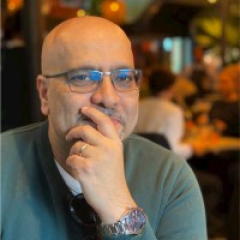

Nearly 40 years ago, I left Bangladesh with two suitcases, a carry-on, and $200. On the day I was supposed to leave, my cousin walked in with another $200, a gift from my uncle. That was everything I had when I left for the States. Call it a startup with $400 in seed funding.
Somewhere along the way, I picked up an idea from Ian Fleming, of all people. He wrote a short story called "Quantum of Solace." Forget the movie; apart from the title, it has nothing to do with it.
Someone in Hollywood evidently read the title and stopped there. The story is quiet and introspective, with almost none of the usual Bond shenanigans.
At a dinner party, a colonial governor tells Bond about a marriage that fell apart and offers a theory: Every relationship needs a minimum measure of kindness between two people, a quantum of solace. When that measure drops to zero, the relationship is over.
I read that story a long time ago, and one word stuck with me. Not solace. Quantum. If a relationship has a threshold below which it fails, maybe contentment does too.
My Quantum
I call it the Quantum of Contentment. It is a threshold of needs: If I reach it, I am happy. I don't need a million-dollar mansion or a billion-dollar bank balance. I would accept either if offered. I am just not waiting by the phone. I need to reach the threshold, and I believe I have.
My quantum is a collection of parameters. Our well-being, my wife Tammy's and mine. How my daughter is doing in her life. How we are living our life right now. Being able to enjoy all the traveling that we do. Having the experiences that we do. And the health to be able to do what we do.
Look at that list. Almost none of it is money or status. It is time, health, and the people I love.
Leaving
At BUET, in my day, leaving was in the plan. Coming back usually was not.
In the decades since, I have called the US, Malaysia, Croatia, Singapore, the United Arab Emirates, and Dhaka home.
Every place had its own definition of success and its own version of the chase. Every place also offered a ready-made ranking of what to want next: a bigger title, a bigger house, a better address. It would have been easy to keep climbing someone else's ladder.
What I noticed, slowly, is that my quantum did not change when my address did.
Coming Back
Now I live in Dhaka again, and I am still content.
A few weeks after I got back, I woke up, got ready, sat down at my computer, and started my daily standup with my globally distributed team. The rest of the day went as it always does, whether I was in Dhaka, Zagreb, Dubai, Singapore, or San Diego. Nothing happened. No epiphany, no tears. The standup ran long, as standups do. That was the whole point.
Dhaka was once home, and today it is home again. It is where I started, and that has never stopped mattering. But coming back did not need to be an occasion. I have spent more of my life outside Bangladesh than in it, and I learned to make a home wherever I landed. Home is where my bed is. No single city has to be the answer, and that is its own level of contentment.
So I apply the same test here that I applied everywhere else. Are we well? Is my daughter doing well? Can we still travel and experience the world? Do I have the health to do it? The answer is yes.
Contentment travels well. It does not depend on the passport, the time zone, or the zip code.
No Regrets
There is a second philosophy that makes the first one work: never look back, never second-guess the decisions I have made, and have no regrets.
Let me give you the test case. Right after high school, I was supposed to take the SAT, the last exam scheduled that would catch the next academic session. I was sure it started at 8:30, so I arrived just before 8:30. It started at 8:00. They would not let me in. I protested that it didn't matter, that I was only half an hour late and could ace it. It mattered. The proctor was unmoved by my confidence.
I had planned to go to the States right after high school. Instead, I decided to stay and go to BUET, which took six years to graduate. Then I worked for two years as a lecturer before finally heading stateside. By any ordinary accounting, a half-hour mistake cost me years. And I would not change a minute of it.
The opposite test came at the height of the dot-com era. I was at IBM Research, flying to San Francisco for an NSF grant review meeting. The dot-coms were recruiting me heavily, and one company was willing to meet me at the airport.
The meeting went well, and they made a great offer. But I did not leave IBM because I was happy where I was. I walked out of that airport meeting with no regrets, and I have none now, even though that company has done exceedingly well.
I am here today because of the sum total of every decision I have made, the good ones and the questionable ones alike. Pull out any one of them, and I am not the person writing this, with this family, these travels, and this life. So the only question that matters is simple: Am I happy today? I am. And if I changed anything in the past, I would not be where I am.
I suspect people who feel regret at the end measure their lives against the one they didn't live. I stopped running that comparison a long time ago.
Know Your Quantum
I have lectured in classrooms before. This is not a lecture. This is just me speaking from the heart. I know a quantum is easier to reach once the basics are covered. Some health problems are just bad luck, no matter how much korolla juice you drink.
For many people, chasing money and status isn't vanity. It is how they keep the lights on. I was lucky, and I had help, starting with that extra $200 from my uncle. Not everyone gets to choose. I did, and I know it.
But the chase never ends if you never define "enough." The trap is not wanting wealth. It is never defining the point at which you will say, this is enough. Once I defined mine, the chase was over.
In Fleming's story, when the quantum drops to zero, it is over. Mine has not. Not in the US, not in Singapore, not in Dhaka. I have my family, my health, and a bed to sleep in wherever I am. That is my quantum, and it is enough.
Dr. Zunaid Kazi is an AI researcher, entrepreneur, and opinionated raconteur with four decades in the field. He is the founder and CEO of Knowtomation AI, founder and CTO of Gofai, and writes about technology, work, and the occasional linguistic rabbit hole.