

























































A State of Economic Emergency
The government should call the situation what it is: An economic emergency. That calls for urgency, transparency about the losses in the banking system, and a public discourse around austerity.

Since the beginning of this decade, the world economy has been subjected to a set of shocks and developments -- a global pandemic followed by major wars causing supply chain disruptions to energy and food markets, as well potentially disruptive technological changes, and realisation of fiscal risks around major economies -- that might have triggered a global recession, if not crisis, by now.
Yet, seemingly, the world economy looks calm, at least as far as the headline numbers in the International Monetary Fund’s latest World Economic Outlook are concerned. Despite the Iran War, global growth is projected at 3.1% in 2026 and 3.4% in 2027, almost unchanged from July.
Beneath the headline numbers, the world has split. Thirty-two economies now generate 95% of global growth, down from 54% in April.
Economies riding the AI investment boom are doing well. Energy importers with little connection to that boom face bigger import bills, weaker currencies and falling real incomes. Global inflation is set to rise from 4.1% to 4.7% this year.
The divide is glaring in our region, with India benefitting from the AI boom, but Cambodia and Bangladesh having had "sizable downward revisions," with Bangladesh the only South Asian economy singled out.
The IMF forecasts assume oil averages $95.74 a barrel this year, about 41% above 2025, and that the strait reopens only in March 2027. Of course, there is a lot of risks around that baseline. Even the baseline hides alarming developments. Energy inventories are being run down, and the IMF warns there are "limits" to doing so. Any fresh escalation will hit hardest the countries with the thinnest buffers.
That is, the energy crisis Bangladesh suffered in August may well return because of events at distant shores.
Bangladesh has, of course, been in stagflation for several years now. Economic growth has slowed every year since 2021-22. Industry sector detracted from growth in one quarter of 2025-26, its first fall since the pandemic, gas shortages forced factories to cut output, and poverty is rising again. Inflation reached 9.4% in May and is still above 8%.
The economic outlook has darkened considerably in recent months, and we are staring at a state of economic emergency. Chart 1 shows how the IMF and World Bank forecasts of economic growth have evolved through the year, while Chart 2 shows inflation forecasts.
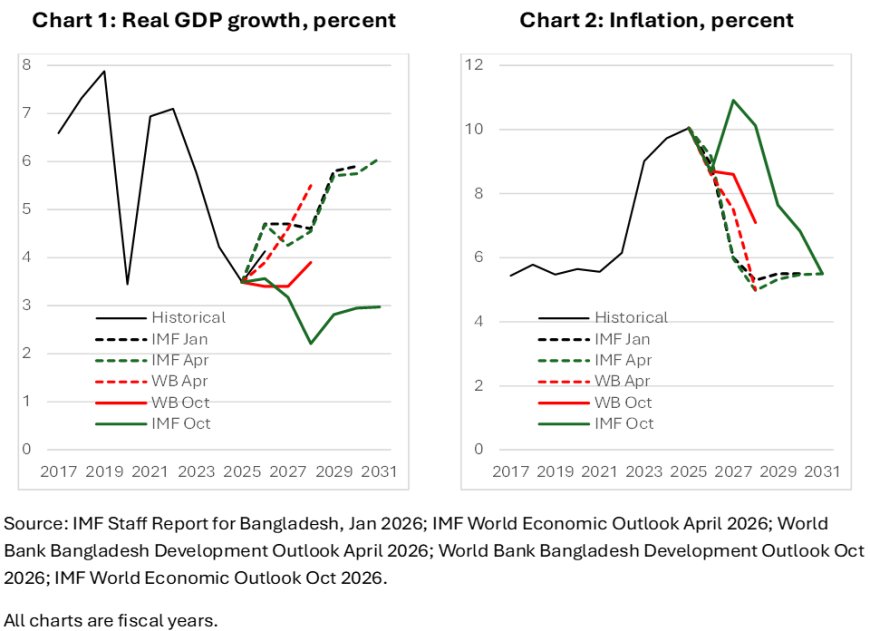
In January, the IMF expected Bangladesh to grow 4.7% in FY2027 and 4.6% in FY2028, accelerating to nearly 6% towards the end of the decade.
Its October projections are 3.2% and 2.2% respectively, and below 3% in every year through the beginning of the next decade.
The World Bank has cut its FY2027 forecast from 4.6 to 3.4% and FY2028 from 5.5 to 3.9%.
On inflation, the IMF's FY2027 projection has gone from 6.0 to 10.9%, and it no longer sees inflation returning to 5.5% until FY2031.
An investment slump underpins the economic morass. Before the pandemic, private investment added 1.5 to 3 percentage points to annual GDP growth. In recent years its best contribution has been 0.6 points, and in FY2025 it subtracted from growth.
The World Bank now expects total investment to shrink by 0.5% in FY2026 and grow by just 0.3% in FY2027 and 1.0% in FY2028, where in April it expected 4.1% by FY2028 (Chart 3).
The IMF forecasts the investment-to-GDP ratio to slide from 28.5% in FY2025 to 23.8% in FY2031 (Chart 4).
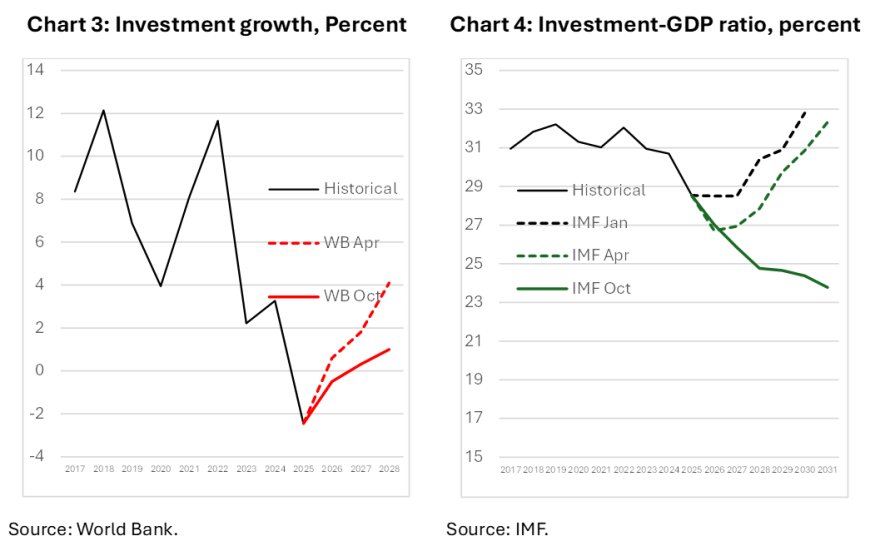
In its January projections the ratio was heading to nearly 33%. A sinking ratio, of course, means investment growing even more slowly than an economy that is itself barely growing.
The causes are not mysterious. Two factors explain the forecast revisions since January.
The first came from abroad. The IMF's July staff visit noted that the war in the Middle East has worsened Bangladesh's fiscal, financial, and inflation challenges through higher commodity prices, supply disruptions, and subsidy costs, straining the external accounts despite strong remittances.
Imported LNG now meets about a third of gas demand, floating terminal failures cut supply, and load-shedding has become routine. The petroleum import bill more than doubled in FY2026.
Inflation compounds the problem. Prices surged in the summer of 2022 after the war in Ukraine, macroeconomic mismanagement made it worse, and later governments have only partly unwound the damage. Food inflation was 7.2% in September and non-food inflation 9.3%.
The World Bank attributes the expected rise in inflation in FY2027 to higher domestic energy prices, supply constraints, and money supply growth.
The World Bank points to "a more protracted drag from energy shortages, banking sector weakness, subdued credit growth" and tighter fiscal constraints for the economic miasma.
And therein is the second, homegrown factor that has emerged since the beginning of the year: The legacy problems in the corporate and banking sectors have become acute, and policy uncertainty around them have triggered a crisis of confidence.
The World Bank warns that banking vulnerabilities "have intensified and pose growing systemic risks." Banks under stress cannot lend, and stretched firms cannot invest.
The war explains part of the downgrade, and the rest is ours.
The first shock will eventually pass. The second will not unless we act. Without resolving the corporate and banking sector balance sheet issues, there will be no investment recovery. The IMF warned about this in the July staff visits. And their latest forecasts reflect that earlier warning.
For a wage earner, an economy with inflation around 9% and growth around 3% is a pay cut. And households have been paying. Real wages for low-paid workers continue to fall, and female labour force participation dropped from 42.8 to 38.4% between 2022 and 2024.
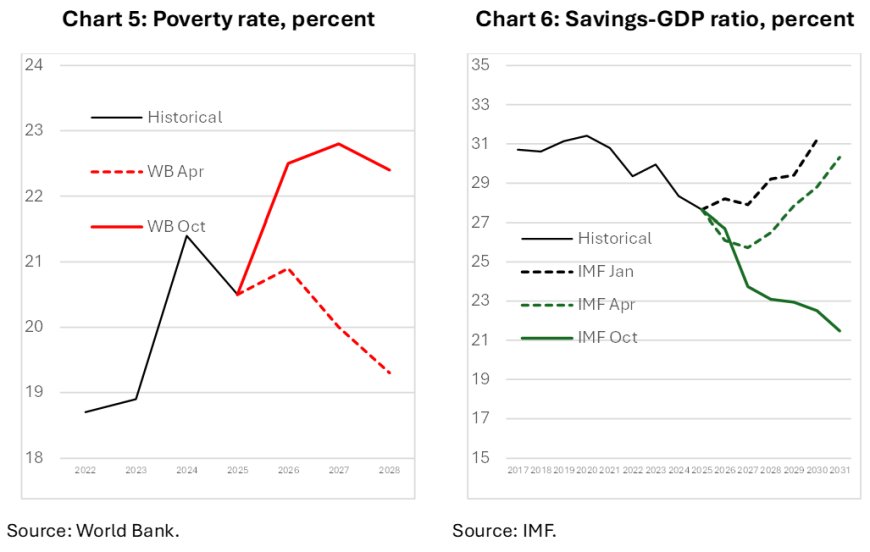
The World Bank had expected poverty to keep falling from 20.5% in FY2025 to 19.3% in FY2028 in its April forecasts. It now projects 22.5% in FY2026 and still 22.4% in FY2028 (Chart 5).
Consumption has held up largely because of remittances, which hit a record $35.6 billion in FY26, up 17.3%.
That is a lifeline, but it cannot substitute for domestic investment and jobs. The IMF expects the savings rate to fall from 27.6% of GDP in FY2025 to 21.5% by FY2031 (Chart 6).
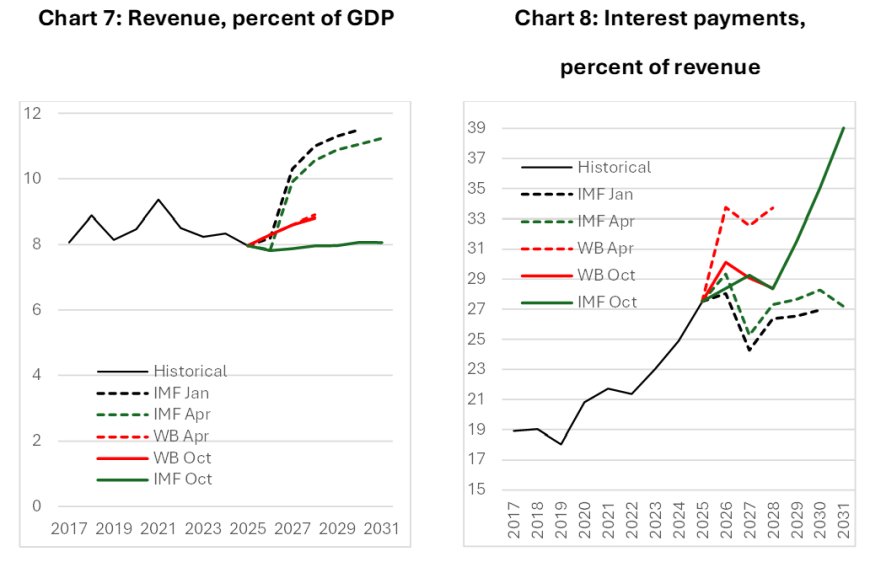
The public finances offer no cushion. In January, under the auspices of the now defunct program, the IMF forecast was for revenue to climb towards 11.5% of GDP by the end of the decade. Without a program, the latest assessment is that revenue will be stuck at about 8% of (a smaller) GDP for the rest of the decade (Chart 7).
Further, interest payments are on course to absorb nearly two-fifths of revenue by FY2031, up from 27.5% in FY2025 (Chart 8).
Nonetheless, the primary deficit is still projected to widen towards the end of the decade (Chart 9), and public debt to climb from about to 49% of GDP (Chart 10).
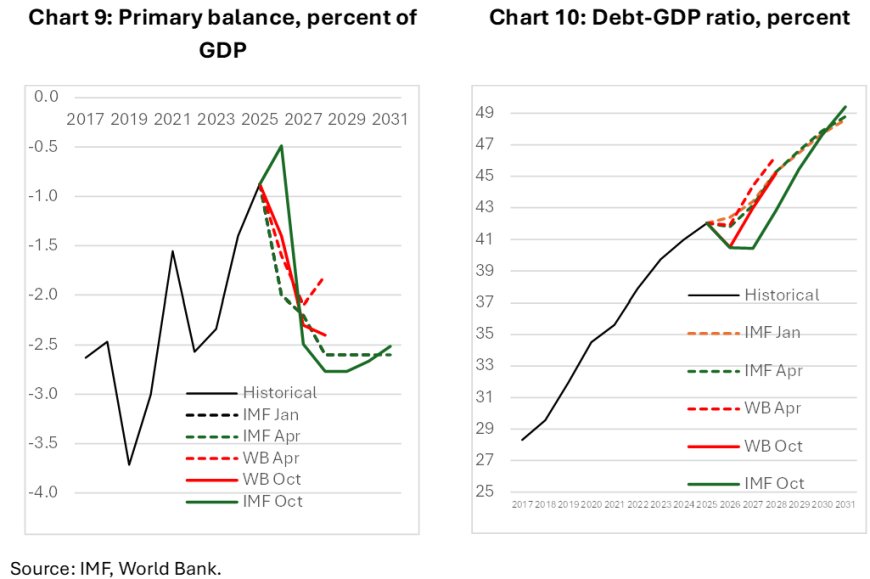
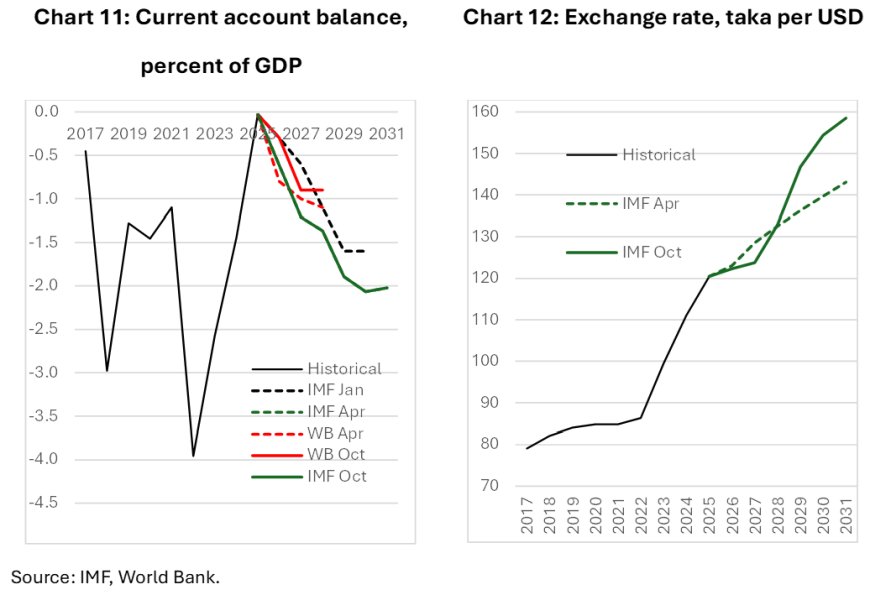
The external position is also weakening. Exports fell 0.2% in FY2026. The IMF forecasts the current account deficit to widen from 0.6% of GDP in FY2026 to about 2% by the end of the decade (Chart 11).
Reserves, at over $32 billion in August and helped by record remittances, are a real buffer, but a widening deficit will draw on them. IMF forecasts imply the taka sliding from about 120 per US dollar in FY2025 to nearly 160 by FY2031 (Chart 12).
That leaves little room for the usual stabilization tools. With inflation around 9%, the IMF's July staff visit called for tight monetary policy, consistent implementation of the crawling peg, and prudent fiscal policy, along with stronger revenue mobilization and subsidy reform.
Bangladesh Bank's first rate cut in six years, in July, along with various schemes to boost credit to ailing firms, have not been effective.
Fiscal stimulus is neither affordable nor likely to be effective. Aggregate demand policies cannot fix an economy whose problem is that firms will not or cannot invest.
The above is the bitter macroeconomic emergency the country is facing: investment slump means slow growth, slow growth means less revenue and rising debt service, and rising debt service means less room for the public investment that might help.
Add an energy shock from abroad and legacy balance sheet problems at home, and the result is a long stagflationary plateau.
This is the context in which Bangladesh is seeking a new IMF program. After the IMF-World Bank Annual Meetings in Bangkok, discussions on its size and reform commitments continue. It should be judged not by the size of the loan but by whether it helps us do what is needed for recovery.
What is needed for a durable recovery?
First, we must resolve our banking and corporate sector woes. Both the World Bank and the IMF point to the same problem: A banking sector under systemic stress, and corporate balance sheets that cannot support new investment. The IMF calls for a "credible, comprehensive" restructuring strategy. Without it, energy fixes and credit support will leak away, and there will be no investment and no jobs.
Second, we must do this while preserving macroeconomic stability. That means tight monetary policy, a consistent exchange rate regime, better revenue collection, and subsidy reform, with well-targeted support for the vulnerable.
The IMF's regional message is to "protect people and not prices." Stability is the condition for any recovery. The IMF program should be judged against these objectives.
The conditionalities that the IMF will likely ask for should also be judged against these objectives. For example, the Bangladesh Bank Governor has put a price tag of 60,000 crore taka per year for several years to support the banking sector. The Finance and Planning Advisor to the Prime Minister has put a figure of $40 billion over several years.
These numbers are comparable to roughly 1% of GDP fiscal outlay projected in the now defunct IMF program as of January 2026. That is, any banking resolution would likely involve public expenditure, and therefore revenue. As the program is negotiated with the IMF, it is important that the conditions and targets are kept at realistic and achievable levels.
Cookie-cutter, one-size-fits-all standard reform package is far less likely to work, but one that is fully owned by the government politically can and will.
That leads to the broader point. Expectations must change. Even a well-executed reform program will not produce a strong recovery before the end of the decade.
Bank clean-ups take years, investment responds with a lag, and the external shock is not over. The growth path to 6% that these international forecasters pencilled in last January is not likely any time soon, let alone the 8% growth aspirations of the government.
This piece is being written during the Durga Puja holidays.
Suppose you were taking your family on a well-earned and promised vacation. But as you arrive at the destination, you find that the weather has changed, and going outdoors will mean the monochromatic polo shirts and colourful salwar kameezzes being muddied!
Surely, you’d pivot, and stay indoors to enjoy the rain with khichuri and macch-bhaja.
So it is with the economic reality -- the government should call the situation what it is: An economic emergency.
That calls for urgency, transparency about the losses in the banking system, and a public discourse around austerity. The alternative is a decade of investment-starved stagflation.
Jyoti Rahman is the Executive Editor of the weekly Counterpoint.