


















































![A Ledger of the Soul: Navigating the Allah-Bhagavant Nexus in a 19th-Century Puruṣākāra Jñāna Caupara [Gyan Chauper]](https://counterpointbd.com/uploads/images/202608/image_430x256_6a93baa3b09a7.jpg)





















Why Bangladesh Must Build, Not Just Code
The foundations of a prosperous nation are not built in the cloud. They are built on the ground, in plants and workshops and export zones, by people who make things the world needs. It is past time to look down from the screen and begin.


For over a decade, Bangladesh has been selling itself a story. The story goes like this: Millions of young people, armed with laptops and connectivity, will code their way to national prosperity. We will leapfrog the smokestack era, skip the factory floor, and arrive directly at a knowledge economy. It is an appealing vision -- clean, modern, flattering to the national self-image. It is also, in its current form, a strategic error of the first order.
The numbers make the case bluntly. Despite official targets of $5 billion in annual ICT exports by 2025, actual earnings have hovered somewhere between $700 million and $1 billion. That is not a shortfall; it is a structural ceiling. It reflects not a failure of execution but a fundamental mismatch between the policy aspiration and the economic realities of a labor-surplus nation of 180 million people.
To understand why, one must first understand what made the global ICT services industry possible for the handful of countries that genuinely succeeded in it. India is the obvious template that Bangladeshi policymakers have implicitly tried to follow, but India's rise as an IT exporter was not a policy win that can be replicated on demand.
It was the cumulative outcome of elite technical institutions established in the 1950s, a vast English-speaking professional class, and a perfectly timed entry into global markets during the Y2K crisis. These were preconditions, not outcomes, of success, and they took four decades to assemble. For Bangladesh to pursue the same model today is not ambition. It is the economic equivalent of building a railway after the age of aviation.
But there is a more urgent problem than the inherent difficulty of late entry. The window is not merely closing -- it is being sealed shut by artificial intelligence. The entry-level freelance economy on which Bangladesh's digital workforce largely depends -- code writing, content editing, data processing -- is precisely where generative AI is advancing most rapidly and most disruptively.
Recent research suggests that AI is "leveling the playing field" not by lifting developing-country workers up, but by compressing the value of the work they do. The jobs we are training our youth to perform are becoming automated faster than the training institutions can adapt their curricula. This is not a distant risk to be managed. It is a present emergency.
None of this is an argument against technology. It is an argument against the particular form of technological fetishism that has captured Bangladeshi economic policy -- the belief that digitization is a development strategy rather than a tool in service of one.
The countries that actually made the transition from poverty to industrial competitiveness did so through manufacturing. Vietnam is the most instructive recent example. While Bangladesh was articulating visions of a digital economy, Vietnam was doing something far less glamorous: It was negotiating investment agreements, building industrial zones, and making itself attractive to global electronics manufacturers.
Samsung's presence in Vietnam is not an accident of geography. It is the outcome of a sustained, deliberate, and occasionally ruthless industrial policy. Today, Vietnam's electronics exports alone exceed $100 billion annually -- more than four times Bangladesh's entire export basket.
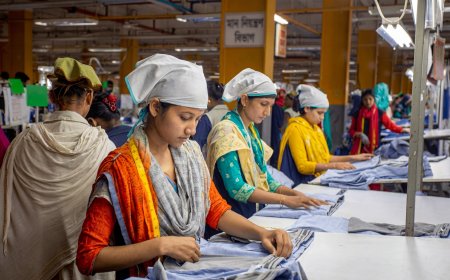
The lesson is not that Vietnam is uniquely gifted. It is that for a labor-surplus economy, manufacturing remains the only sector capable of absorbing millions of workers simultaneously, raising wages across the board, building institutional capability, and generating the kind of export revenue that actually moves macroeconomic indicators. Services can complement this. They cannot replace it.
Economists have a term for what happens when countries attempt to skip the industrial phase of development: Premature deindustrialization. The evidence for its consequences is sobering.
Economies that bypass the factory floor to chase service-sector growth tend to produce bifurcated labor markets -- a thin stratum of highly paid knowledge workers atop a vast base of informal, low-productivity employment. This is not a pathway to shared prosperity. It is a pathway to the kind of inequality that eventually becomes a political problem.
Bangladesh needs to pivot. Not away from technology -- but toward using technology in service of physical production. There is no contradiction between manufacturing and innovation. The most sophisticated factories in the world run on software.
AI-optimized logistics, sensor-driven quality control, automated inventory management -- these are not threats to industrial competitiveness; they are the contemporary expression of it. What Bangladesh needs are entrepreneurs and engineers who apply the startup mindset to the factory floor rather than to the next food delivery application.
This means industrial policy that goes beyond garments. Our pharmaceutical sector has genuine global potential -- but it requires investment in R&D and regulatory capacity that has not been forthcoming. Our leather industry remains trapped in low-value raw material exports rather than finished goods.
Light engineering, solar components, even generic electronics assembly: These are not romantic visions. They are sectors where the economics are legible, the demand is real, and the entry point -- for a country with our labor cost structure -- remains accessible, though not for much longer.
It also means reconsidering the scale at which we think about corporate growth. Bangladesh has produced no industrial conglomerates capable of competing globally. That is partly a function of market size, partly of policy, and partly of a business culture that has historically preferred trading to building.
Changing that will require patient capital, credible export promotion institutions, and a government willing to make sustained bets on strategic sectors rather than announcing targets that bear no relationship to the underlying investment environment.
Our freelancers are talented, adaptive, and genuinely productive. They deserve support and recognition. But they are not a development strategy. A nation cannot industrialize on the back of individual contractors working piecemeal for foreign clients. It requires firms, factories, supply chains, and institutions.
The romance of the digital economy has been useful -- it has motivated a generation, attracted some investment, and burnished Bangladesh's international image. But romance is not a substitute for structural transformation.
The foundations of a prosperous nation are not built in the cloud. They are built on the ground, in plants and workshops and export zones, by people who make things the world needs. It is past time to look down from the screen and begin.
Arifuzzaman Khan is a researcher in the field of science, technology, innovation and entrepreneurship. He can be reached at [email protected]